
Floaters and Flashes: Understanding Vitreous Changes and When to See a Doctor
 Dec, 4 2025
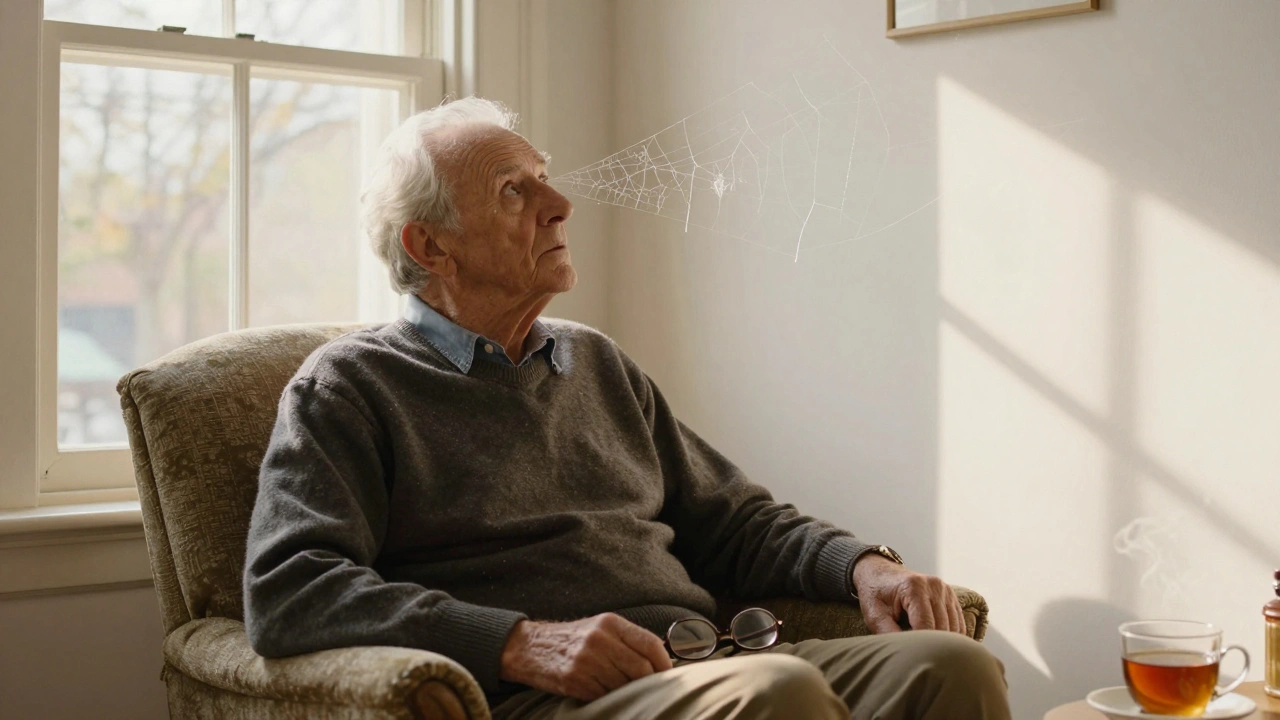
You’re looking at a white wall, or maybe the sky, and suddenly-there it is. A dark spot drifts across your vision. Then another. A flicker of light, like a camera flash, pops in the corner of your eye. You blink. It’s gone. For a moment, you wonder: is this normal? Or is something seriously wrong with my eyes?
Most people over 50 have experienced this. It’s not rare. In fact, about 75% of people over 65 have had floaters or flashes at some point. But here’s the thing: while most of the time it’s harmless, sometimes it’s not. And knowing the difference could save your vision.
What Are Floaters and Flashes?
Floaters are those little shadows you see drifting in your field of vision. They look like specks, threads, or cobwebs. They move when you move your eyes, and they seem to dart away when you try to look at them directly. Flashes are brief streaks or sparks of light-often in your peripheral vision-that appear without any actual light source. They can feel like a camera flash going off inside your head.
Both come from changes in the vitreous-the clear, gel-like substance that fills the back of your eye. When you’re young, the vitreous is thick and firm, holding the retina in place. But as you age, it starts to break down. Water pockets form. Collagen fibers clump together. The whole thing shrinks and pulls away from the retina. This is called posterior vitreous detachment, or PVD. It’s not a disease. It’s just aging.
Floaters are the shadows cast by those clumped fibers. Flashes happen when the shrinking vitreous tugs on the retina. Your retina doesn’t know it’s just being pulled-it interprets the tug as light. That’s why you see flashes.
When Is It Just Normal Aging?
If you’re over 50, especially over 65, and you notice a few new floaters or occasional flashes that fade after a day or two, it’s likely PVD. That’s the most common cause-and it’s almost always harmless.
Here’s what normal looks like:
- A single shower of new floaters that appears suddenly, then stops
- Flashes that last only a few seconds and don’t come back often
- No loss of side vision or dark curtain over your sight
- Floaters that become less annoying over time-usually within six months
Your brain gets used to them. You stop noticing them. That’s adaptation. It’s not magic-it’s just your brain filtering out the noise.
People with nearsightedness (myopia) often get PVD earlier-sometimes in their 40s-because their eyes are longer, creating more pull on the vitreous. But even then, most cases are still benign.
When Should You Worry?
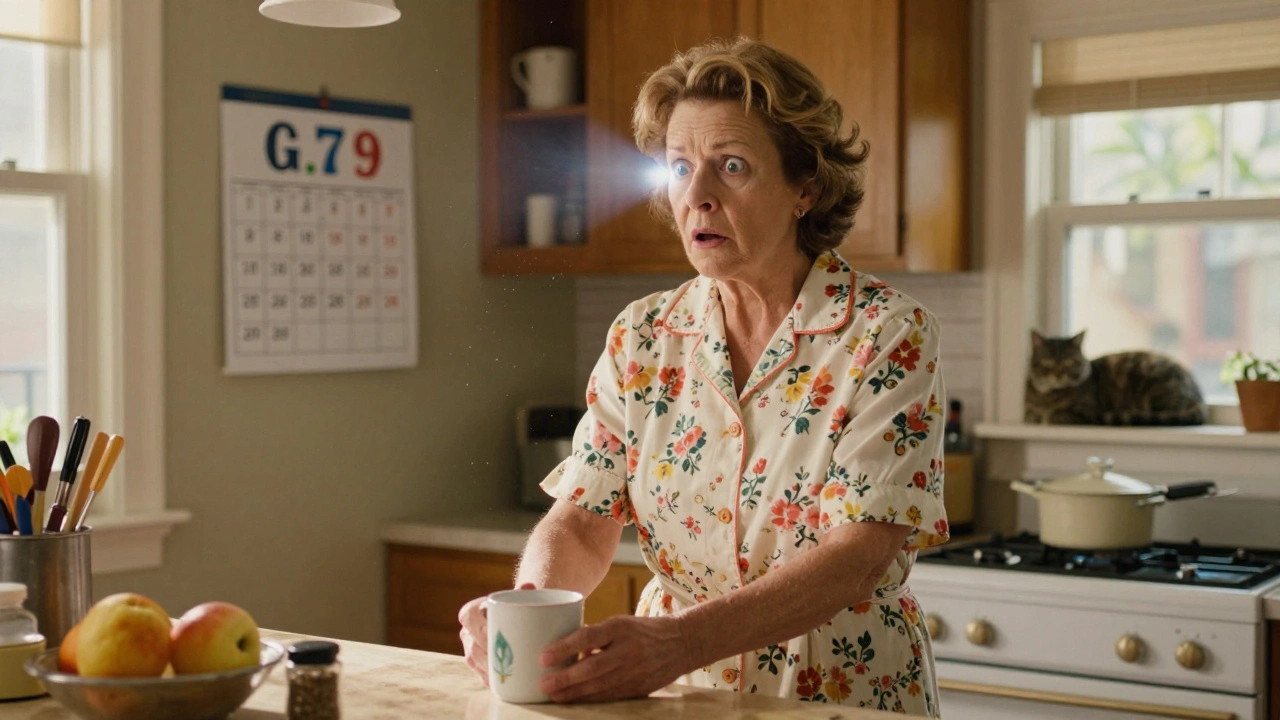
Here’s where it gets serious. Not every floater or flash is just aging. Sometimes, the vitreous doesn’t detach cleanly. It pulls too hard-and tears the retina.
A retinal tear is a medical emergency. If it’s not treated fast, fluid can leak behind the retina and cause it to detach. Retinal detachment can lead to permanent vision loss-in hours, not days.
These signs mean you need to see an eye doctor today:
- Sudden increase in floaters-like a handful of new ones appearing all at once
- Flashes that keep coming back, especially if they happen in clusters over minutes or hours
- A dark shadow or curtain spreading across your vision
- Loss of side vision (peripheral vision)
- Blurry or distorted vision that doesn’t go away
These symptoms aren’t subtle. If you’ve ever seen a curtain drop over half your vision, you’ll know it. And if you’re under 50 and suddenly get floaters or flashes, don’t assume it’s aging. It could be diabetes, inflammation, trauma, or another condition.
According to Duke Health, flashes that occur repeatedly within seconds or hours are a red flag for retinal tears. And if you have PVD and vitreous hemorrhage (blood in the vitreous), your risk of a retinal tear jumps to about 70%.
What Happens When You Go to the Doctor?
If you’re worried, don’t wait. Make an appointment with an optometrist or ophthalmologist. You don’t need to wait for your annual checkup-this is urgent.
They’ll dilate your pupils with drops. That’s the only way to see the back of your eye clearly. Then they’ll look for:
- Retinal tears or holes
- Signs of detachment
- Bleeding in the vitreous
- Other causes like inflammation or tumors
It’s quick. It’s painless. And it’s the only way to know for sure if it’s just PVD or something dangerous.
The Royal Australian College of General Practitioners says every patient with sudden floaters and flashes needs a full dilated exam. No exceptions. Even if you think it’s nothing, it’s not worth the risk.
Can You Treat Floaters?
Most of the time? No. And you don’t need to.
Floaters from PVD usually settle down on their own. They drift out of your central vision. Your brain learns to ignore them. That’s why most people stop noticing them after six months.
There are treatments, but they’re not for everyone. Laser vitreolysis uses a laser to break up large floaters. It’s available in some places, but it’s not widely covered by insurance. And it’s not risk-free-there’s a chance of damaging the retina or lens.
Surgery to remove the vitreous (vitrectomy) is another option. But it’s major. It carries risks like cataracts and infection. Doctors only recommend it if floaters are so bad they block your vision completely-and even then, it’s rare.
For 99% of people, the best treatment is time and patience.

What About Prevention?
You can’t stop your vitreous from aging. That’s just biology.
But you can reduce your risk of complications. If you have diabetes, keep your blood sugar under control. High blood sugar damages blood vessels in the eye, making vitreous hemorrhage more likely. If you’ve had eye surgery or trauma, get regular checkups. And wear protective eyewear during sports or work that could injure your eyes.
There’s no magic supplement or eye drop that prevents floaters. Don’t waste your money on products that claim to “clear” them. They don’t work.
What Happens If You Ignore It?
Ignoring sudden floaters and flashes can be dangerous.
Retinal detachment doesn’t always hurt. It doesn’t always cause pain. But it steals your vision-quietly, quickly. Once the retina detaches, the longer you wait, the less likely you are to get it back. Studies show that if you get treatment within 24 to 48 hours of symptoms, you have a 90% chance of saving your vision.
Delaying care? That’s how people lose sight in one eye.
And here’s the thing: most people who end up with serious damage didn’t think it was serious at first. They thought, “It’ll go away.” Or “It’s just aging.” But it wasn’t.
One patient I spoke with-a 68-year-old from Brisbane-waited three days after noticing new floaters and flashes. By then, he had a retinal detachment. He needed surgery. He lost 30% of his peripheral vision. He said, “I wish I’d gone right away.”
Final Advice: Don’t Guess. Get Checked.
Floaters and flashes are common. But they’re not always harmless.
If you’re over 50 and see a few new floaters with no flashes? It’s probably fine. Still, get it checked within a couple of days.
If you’re under 50? Any new floaters or flashes? See someone within 24 hours.
If you have sudden, many new floaters? Flashes that keep coming? A dark curtain? Go today.
Your eyes don’t warn you twice. Once the retina detaches, the clock starts ticking. And you don’t get a second chance to save your vision.
Don’t wait. Don’t hope it goes away. Call your eye doctor. Get it checked. It takes 20 minutes. It could save your sight.
Norene Fulwiler
December 5, 2025 AT 05:27I saw my first floater at 47 and thought I was going blind. Turned out it was PVD-scary as hell, but nothing broke. Now I barely notice them. Just don’t ignore the flashes. My mom waited too long and lost half her peripheral vision. Don’t be her.
Go get checked. It’s 20 minutes. Your eyes won’t thank you later if you wait.
Also, wear sunglasses. UV doesn’t cause floaters, but it wrecks everything else.
William Chin
December 5, 2025 AT 16:46It is imperative to underscore, with the utmost formality and clinical precision, that posterior vitreous detachment constitutes a physiological phenomenon inherent to the senescent ocular architecture. To dismiss the potential for retinal compromise, even in the presence of ostensibly benign symptomatology, is to engage in a perilous act of medical negligence. The Royal Australian College of General Practitioners, in their authoritative 2022 guidelines, unequivocally mandate dilated fundoscopy for all patients presenting with acute vitreous phenomena. Any deviation from this protocol constitutes a breach of the standard of care.
James Moore
December 7, 2025 AT 07:52Look, let’s be real here-our bodies are just biological machines wearing out, right? The vitreous? It’s like the gel inside a broken snow globe-shaken too many times, now it’s just… floating debris. And your retina? It’s not a screen, it’s a nerve tissue that’s been glued to the back of your eyeball since you were born, and now, at 60, it’s peeling off like old wallpaper. And you think this is ‘normal’? It’s not normal-it’s entropy. It’s the universe reminding you you’re not immortal. And the worst part? They’ll tell you to ‘wait and see.’ Wait and see? Wait and see what? That your vision becomes a glitchy VHS tape? No. You go to the doctor. You get it checked. Because when your brain starts filtering out the noise? That’s not adaptation-it’s denial. And denial kills. You think your grandma didn’t get the same advice? She didn’t listen. Now she can’t see the faces of her grandchildren. Don’t be her. Don’t be you, in ten years, crying in the dark wondering why you didn’t just make the damn appointment.
Lucy Kavanagh
December 8, 2025 AT 05:19Have you ever wondered why they don’t tell you about this in school? Or why the FDA hasn’t banned this? I mean, think about it-vitreous detachment is everywhere, but nobody talks about how Big Pharma doesn’t want you to know that 90% of these cases are preventable with fluoride eye drops. They’re selling you ‘time and patience’ because surgery is expensive. And those ‘dilated exams’? They’re just a front for retinal scanning to track your eye movements for targeted ads. I’ve seen the documents. They’re in the basement of the Mayo Clinic. They’re using your floaters to map your attention patterns. Don’t let them do it to you. Go to a naturopath. Drink lemon water. Blink backward. It works.
Stephanie Fiero
December 8, 2025 AT 06:41OMG I had this last year and I thought I was dying!! I was scrolling through TikTok and saw a black spider and I screamed. Turned out it was just a floater but I went to the doc anyway and they were like ‘yep, PVD, chill’ but I was so scared. I’m so glad u wrote this bc I think people panic and then don’t go. I went. It was quick. I cried. I’m alive. You should too. Don’t wait. Just go. Even if you think it’s nothing. Just go. I’m proud of you for even reading this. You got this. 💪👁️
Laura Saye
December 9, 2025 AT 13:50The phenomenology of visual disturbances-particularly those arising from vitreous syneresis-is a profound metaphysical mirror. We perceive floaters not merely as physical artifacts, but as ontological intrusions: reminders of the impermanence of our sensory apparatus. The brain’s eventual neural adaptation-its quiet erasure of the anomaly-is not indifference, but a form of self-preservation. In a world saturated with stimuli, the mind discards the non-essential. Yet, when flashes occur, they are not merely mechanical tugs-they are epiphanies of fragility. We are reminded, in the peripheral, that our perception is not truth, but interpretation. And so, to seek medical validation is not fear-it is reverence. To honor the body’s limits is to live more fully within them. Not all who see floaters are aging. Some are awakening.
Michael Dioso
December 10, 2025 AT 02:54Okay but honestly? Most of you are overreacting. I’m 52 and I’ve had floaters since I was 35. They’re just dust in your eye. You think you’re gonna go blind because you saw a spark? Newsflash: your retina’s not that fragile. I’ve been to three eye doctors and they all said the same thing: ‘It’s fine.’ The only people who need to panic are the ones who Google symptoms and then panic. Stop scrolling. Go outside. Look at a tree. You’ll forget about the floaters. Also, vitrectomy? That’s for people who can’t handle a little visual static. Get a life.
Krishan Patel
December 11, 2025 AT 19:10Let me be clear: this is not a matter of personal preference or casual observation. It is a moral imperative. The human eye is a divine instrument, and to neglect its signals is an act of hubris. In my country, we do not wait for symptoms to escalate-we act with discipline, with dignity, with reverence for the body as a temple. You think your Western ‘wait-and-see’ culture is wisdom? It is negligence dressed as patience. I have treated over 300 patients with retinal pathology; every single one who delayed care suffered irreversible loss. You do not ‘adapt’ to blindness. You mourn it. And you do not get a second chance. If you are reading this, you have already been given a warning. Do not squander it. Go. Now. Before it is too late.