
Generic Manufacturer Profitability: Business Models and Sustainability
 Dec, 27 2025
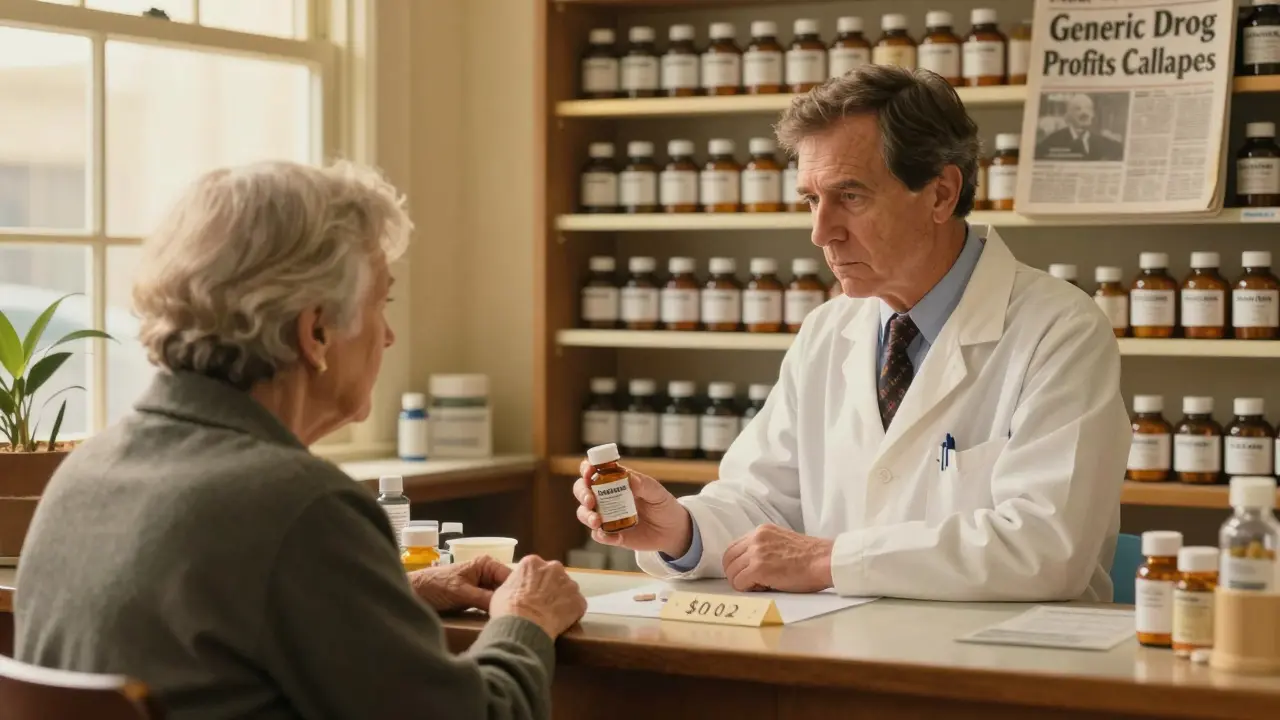
Generic drugs make up 90% of all prescriptions filled in the U.S., but they only cost 10% of what brand-name drugs do. That sounds like a win for patients - and it is. But behind that number is a broken system where the companies making these life-saving medicines are barely scraping by. In 2025, Teva lost $174 million. Mylan, now part of Viatris, barely broke even with a 4.3% profit margin. Meanwhile, the price of a simple generic pill like metformin dropped so low that some manufacturers stopped making it entirely. This isn’t a glitch. It’s the business model.
The Commodity Trap
Most generic manufacturers still play the same game they did 20 years ago: produce a cheap version of an old drug, file an ANDA with the FDA, and hope to win a bid from a pharmacy benefit manager (PBM). The problem? There are now over 16,000 generic drugs on the market. When 10 companies make the exact same 500mg metformin tablet, the only thing that matters is who can produce it for 3 cents cheaper. Gross margins have collapsed from 50-60% in the early 2000s to under 30% today. Some products are sold at a loss just to keep the factory running.This isn’t just about greed or greediness. It’s about supply chains. Raw materials like active pharmaceutical ingredients (APIs) are often sourced from India or China, where prices swing wildly based on political instability, environmental regulations, or even weather. A single batch of API can cost 40% more one quarter than the last. Factories need $100 million+ to meet FDA’s cGMP standards. And each new drug application costs $2.6 million just to file. For a small company, that’s a gamble most can’t afford - especially when the payoff might be a 2% market share on a $0.02-per-pill product.
Complex Generics: The Only Way Out
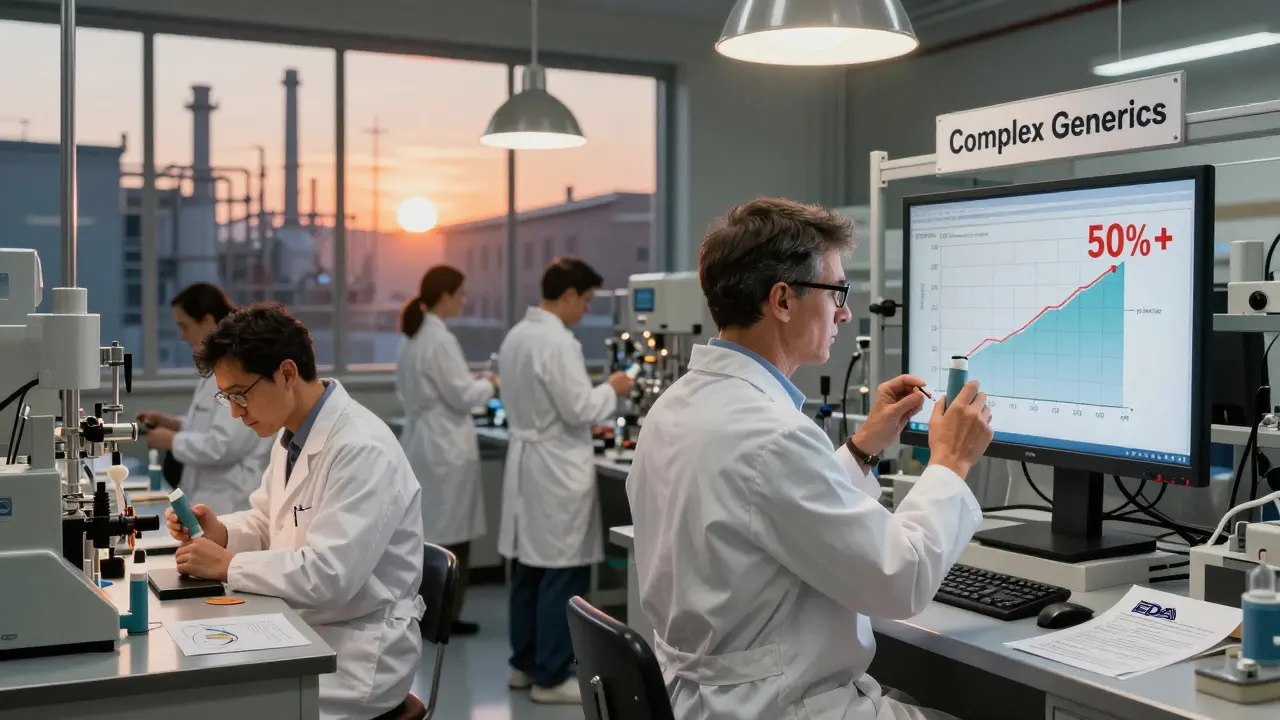
The companies surviving - and even growing - aren’t making aspirin or lisinopril. They’re making complex generics: inhalers with precise dosing, injectable suspensions that won’t clump, patches that release medication over days, or combination drugs that blend two active ingredients into one tablet. These aren’t easy to copy. They require deep formulation science, specialized equipment, and years of testing. The FDA approval process for these is longer, more expensive, and far less crowded.Take lenalidomide, a cancer drug originally sold by Celgene. After its patent expired, only a handful of manufacturers could replicate its complex oral formulation. Teva entered the market and now sells it as a specialty generic. It’s not a $0.05 pill. It’s a $150 pill - and they’re making margins above 50%. Same with Austedo XR, a slow-release treatment for movement disorders. These aren’t commodity products. They’re engineered solutions. And that’s where the money is now.
Contract Manufacturing: Selling Capacity, Not Pills
Another path out of the commodity trap? Stop trying to sell drugs altogether. Start selling your factory.Contract manufacturing organizations (CMOs) are booming. The global market for generic drug contract manufacturing is projected to hit $91 billion by 2030. Companies like Egis Pharmaceuticals and Patheon are no longer competing to sell their own branded generics. Instead, they’re renting out their clean rooms, filling lines, and quality control labs to other companies - including big pharma brands that want to outsource production to cut costs.
This model works because it turns fixed costs into variable revenue. A CMO doesn’t need to worry about formulary battles or PBM rebates. They just need to deliver batches on time, with zero defects. And with global demand rising - especially in Europe and Asia - there’s no shortage of clients. Even smaller manufacturers are pivoting. Instead of launching 20 low-margin generics, they focus on one or two high-quality contract services. It’s less glamorous. But it’s profitable.
Consolidation Is Survival
The industry has been consolidating for over a decade. In 2014, mergers in the generic space totaled $1.86 billion. By 2016, that number jumped to $44 billion. Why? Because scale is the only defense against price collapse. Viatris, formed from the merger of Mylan and Upjohn, now operates across 160 countries. They can spread R&D costs, share supply chains, and negotiate better raw material deals. Teva, despite its losses, is still the world’s largest generic manufacturer - and it’s betting everything on complexity and specialization.Smaller players? Most are gone. A 2024 McKinsey analysis found that 65% of new entrants focused only on commodity generics fail within two years. The learning curve is too steep. The capital too high. The competition too fierce. The only companies still entering the market are those with deep pockets, regulatory expertise, or a niche in complex delivery systems.

The Bigger Picture: Who Pays the Price?
The real tragedy isn’t that manufacturers are struggling. It’s that patients are paying for it in other ways. When a company can’t profitably make a generic drug, it stops producing it. And when that happens, shortages follow. In 2023, the FDA recorded over 400 drug shortages - many of them for old, cheap generics like doxycycline, furosemide, and norepinephrine. Dr. Aaron Kesselheim at Harvard calls it a market failure: “Essential medicines are vanishing because no one can make them profitably.”And yet, the savings are real. In 2022 alone, generic drugs saved the U.S. healthcare system $408 billion. That’s more than the entire annual budget of the Department of Defense. But those savings aren’t trickling down to manufacturers. PBMs negotiate rebates, insurers cap prices, and pharmacies demand lower costs. The manufacturer is left holding the bag.
The Future: 2030 and Beyond
The good news? Over 50 major brand-name drugs will lose patent protection between 2025 and 2033. That includes blockbuster medications like Humira, Eliquis, and Keytruda. If the industry can pivot to complex versions of these - extended-release, combination, or biosimilar forms - there’s a $600 billion opportunity by 2033.But it won’t happen by accident. It requires investment. It requires regulatory clarity. It requires policymakers to stop treating generics as interchangeable commodities and start recognizing them as sophisticated medical products. The U.S. still allows “pay-for-delay” deals, where brand companies pay generics to delay entry. Banning those alone could save $45 billion over ten years - and give manufacturers a fighting chance.
The future of generic manufacturing won’t be about who makes the cheapest pill. It’ll be about who can make the most reliable, most complex, and most innovative versions of the drugs the world needs. The companies that adapt will survive. The ones that don’t? They’ll disappear - and so will the medicines they used to make.
Why are generic drug prices so low?
Generic drug prices are low because of intense competition. Once a brand-name drug’s patent expires, dozens of manufacturers can legally produce the same medicine. Since the drugs are chemically identical, buyers - like pharmacies and PBMs - choose based on price alone. This drives margins down, often below 30%. In some cases, manufacturers sell at a loss just to keep production lines running.
What’s the difference between commodity and complex generics?
Commodity generics are simple, off-patent pills like metformin or atorvastatin - easy to copy, with hundreds of competitors. Complex generics involve advanced formulations: inhalers, injectables, patches, or combination drugs that require specialized equipment, deep scientific expertise, and longer FDA approval times. These have fewer competitors and higher margins - sometimes over 50%.
Why do generic drug shortages happen?
Shortages occur when manufacturers can’t make a profit on a generic drug. If the price drops too low - often due to bidding wars or PBM pressure - companies stop producing it. With no incentive to make it, and high costs to restart production, the drug disappears from shelves. This has happened with essential medicines like insulin, antibiotics, and heart medications.
Is contract manufacturing a good business for generic companies?
Yes - and it’s one of the fastest-growing segments. Contract manufacturing (CMO) companies don’t sell their own drugs. Instead, they rent out manufacturing capacity to other companies - including big pharma and generic brands. This removes the risk of pricing battles and formulary fights. Revenue comes from volume and reliability, not competition. The global CMO market is expected to reach $91 billion by 2030.
What’s stopping new companies from entering the generic market?
High barriers: FDA approval costs $2.6 million per drug, manufacturing facilities require over $100 million to meet standards, and it takes 18-24 months to get products approved and into formularies. Plus, the market is already saturated with low-margin products. Most new entrants fail within two years unless they target complex generics or contract manufacturing.
Will generic drug profitability improve by 2030?
It depends. The traditional U.S. commodity generic market will keep shrinking. But the global market for complex generics and biosimilars is projected to hit $600 billion by 2033. Companies that invest in advanced formulations, contract manufacturing, or international expansion will thrive. Those stuck making simple pills? They’ll keep losing money - and eventually, stop making drugs altogether.
Payton Daily
December 28, 2025 AT 18:44So let me get this straight - we’re letting companies go bankrupt making life-saving drugs because some middleman in a suit got a better deal on a spreadsheet? This isn’t capitalism. This is a horror movie where the monster is a PBM invoice.
Teresa Marzo Lostalé
December 30, 2025 AT 10:18imagine if your car’s brakes were made by the cheapest bidder… and then one day they just… stopped being made. 😔
Kelsey Youmans
December 30, 2025 AT 20:44It is deeply concerning that essential medicines, which sustain life and alleviate suffering, are subject to the volatile whims of market competition. The structural disincentives for manufacturing these products reflect a profound misalignment between public health imperatives and economic models.
ANA MARIE VALENZUELA
December 31, 2025 AT 23:15Let’s be real - no one cares about the ‘struggling manufacturers.’ The real villains are the PBMs who take 30% off the top and then act like they’re doing us a favor. If you’re not making money on $0.02 pills, maybe you shouldn’t be in pharma. Go sell NFTs instead.
Bradly Draper
January 2, 2026 AT 01:53i had to drive 45 minutes last month because my local pharmacy didn’t have metformin. my grandma’s diabetes doesn’t care about your profit margins.
Gran Badshah
January 3, 2026 AT 19:16in india we make these pills for 1 cent and ship them. why usa companies crying? they spend too much on fancy offices and salaries. just make the pill, no need for drama.
Julius Hader
January 4, 2026 AT 23:09People say ‘generic drugs save billions’ like that’s a good thing. But if you can’t pay someone to make them, then who’s gonna make them? We’re saving money by starving the people who keep us alive. That’s not a win. That’s a moral bankruptcy.
Vu L
January 6, 2026 AT 18:29Complex generics? Sounds like corporate buzzword bingo. All drugs are just chemicals. If you can’t make a pill cheaper than China, you’re not a manufacturer - you’re a glorified middleman with a lab coat.
James Hilton
January 7, 2026 AT 19:03CMOs are the real MVPs. No drama, no rebates, just clean rooms and deadlines. If you’re still trying to sell metformin, you’re not a pharma company - you’re a vending machine with a 100 million dollar price tag.
Mimi Bos
January 7, 2026 AT 22:07so i read this whole thing and now i’m just confused… like… who’s supposed to fix this? the gov? the big pharma? the chinese? i just need my blood pressure pill to not be gone for 3 months 😭
Sydney Lee
January 9, 2026 AT 07:56It is evident that the commodification of pharmaceuticals represents a catastrophic failure of public policy. The reduction of life-sustaining therapeutics to mere fungible commodities - devoid of intrinsic value beyond marginal cost - is not merely economically irrational, but ontologically obscene. The FDA’s approval process, while rigorous, is structurally incapable of addressing the moral vacuum at the heart of this system.
oluwarotimi w alaka
January 9, 2026 AT 17:13usa always blame china for cheap pills… but when usa want to make money, they steal the patents. now they cry when their rich people can’t pay 500$ for a pill that cost 2 cent to make? this is not capitalism - this is colonialism with a white coat.