When a generic drug hits the pharmacy shelf, you might assume it’s just a cheaper copy of the brand-name version. But behind every generic pill is a rigorous, tightly controlled scientific process called a bioequivalence study. These studies don’t guess whether the generic works-they prove it. And they’re not simple. They’re complex, regulated, and designed to make sure you get the exact same therapeutic effect as the original drug, down to how fast and how much of the active ingredient enters your bloodstream.
Why Bioequivalence Studies Exist
Before the 1980s, companies making generic drugs had to run full clinical trials-testing safety and effectiveness in thousands of patients. That was expensive, slow, and unnecessary if the drug’s chemistry was identical. The U.S. Hatch-Waxman Act of 1984 changed that. It created a shortcut: if a generic drug behaves the same way in the body as the brand-name version, you don’t need to repeat every clinical trial. All you need is proof of bioequivalence.
This isn’t just about saving money. It’s about access. The FDA estimates generic drugs saved the U.S. healthcare system over $1.6 trillion between 2010 and 2019. But that savings only works if the generics are truly equivalent. That’s where bioequivalence studies come in. They’re the gatekeepers. And they’re required by every major regulator: the FDA in the U.S., the EMA in Europe, Health Canada, and Japan’s PMDA.
The Gold Standard: Crossover Design
Most bioequivalence studies use a two-period, two-sequence crossover design. Here’s how it works:
- 24 to 32 healthy volunteers (sometimes up to 100, depending on the drug) sign up.
- Half get the generic drug (test product) in the first period, then the brand-name drug (reference product) in the second.
- The other half get the brand-name drug first, then the generic.
- Between doses, there’s a washout period-at least five half-lives of the drug. That means enough time for the drug to completely leave the body before the next dose.
This design controls for individual differences. If one person naturally metabolizes drugs faster, they’re still compared to themselves under both conditions. That makes the data cleaner and more reliable.
For drugs that are highly variable-meaning their absorption differs a lot between people-the study design gets more complex. The EMA recommends a four-period replicate design, where each subject gets each product twice. This gives more data to handle the variability. The FDA allows a method called reference-scaled average bioequivalence for these cases, which adjusts the acceptance range based on how variable the reference drug is.
How They Measure What Happens in Your Body
The study doesn’t measure whether you feel better. It measures what’s happening in your blood.
Volunteers come in fasted-no food for at least 8 hours before dosing. They take the drug with water, then sit quietly. Blood samples are drawn at specific times:
- Before dosing (time zero)
- Just before the peak concentration (Cmax)
- Two points around the peak
- Three or more points during the elimination phase
Sampling continues until the area under the curve (AUC) captures at least 80% of the total exposure (AUC∞). That usually means collecting blood for 3 to 5 half-lives. For a drug like metformin (half-life ~6 hours), that’s 18-30 hours. For a slow-release drug like dulaglutide (half-life ~5 days), it’s weeks.
The samples are analyzed using highly accurate methods-usually liquid chromatography-tandem mass spectrometry (LC-MS/MS). These tools can detect nanograms of drug per milliliter of blood. The method must be validated to ensure precision within ±15% (±20% at the lowest detectable level), per FDA guidelines.
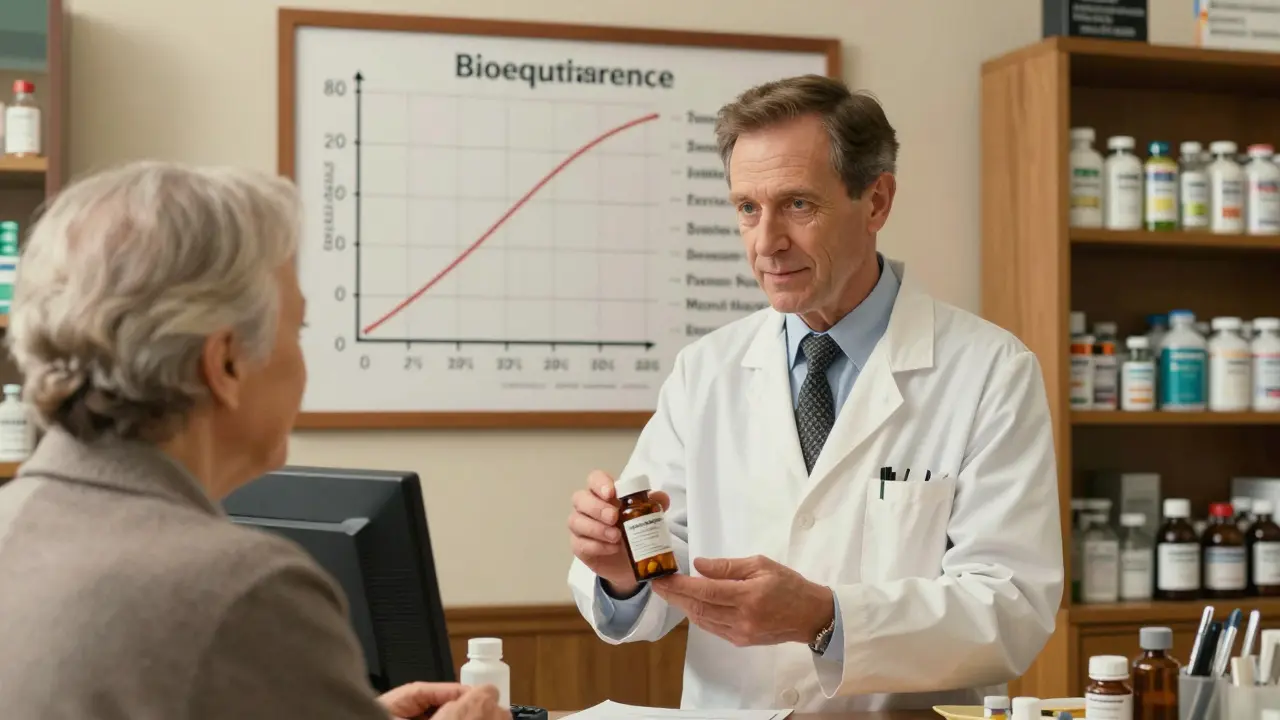
The Numbers That Matter: Cmax and AUC
Two key numbers determine success:
- Cmax: The highest concentration of the drug in the blood. This tells you how fast the drug is absorbed.
- AUC(0-t): The total exposure over time, from dosing until the last measurable concentration. AUC(0-∞) is used if the full elimination curve is captured.
These values are log-transformed-because drug concentrations follow a logarithmic scale-and then analyzed using ANOVA (analysis of variance). The model includes effects for sequence, period, treatment, and subject.
The result? A 90% confidence interval for the geometric mean ratio of test to reference product.
For most drugs, the rule is simple: if that interval falls between 80.00% and 125.00% for both Cmax and AUC, the drugs are bioequivalent.
But for narrow therapeutic index drugs-like warfarin, levothyroxine, or phenytoin-the range tightens to 90.00%-111.11%. A small difference here could mean underdosing (risk of clotting or seizure) or overdosing (risk of bleeding or toxicity).
What Happens If It Doesn’t Pass?
Failure isn’t rare. About 35% of early studies fail, according to FDA data. Common reasons:
- Washout period too short-residual drug still in the system.
- Sampling schedule misses the peak or doesn’t capture enough elimination.
- Statistical analysis errors-wrong model, not accounting for period effects.
- Analytical method isn’t validated properly.
One CRO professional on PharmaGuru shared a story: a study for a drug with a 72-hour half-life failed because they only waited 72 hours between doses. The drug was still present. They had to restart. Cost: $250,000 and three months.
BioAgilytix’s 2023 white paper found that 22% of bioequivalence studies face delays due to analytical method issues. Each delay costs an average of $187,000.
That’s why pilot studies are critical. Experts like Dr. Jennifer Bright (former FDA Office of Generic Drugs director) say pilot studies reduce failure rates from 35% to under 10%. A small pilot with 8-12 subjects helps fine-tune the sampling schedule, dosing, and analytical method before launching the full study.
When the Blood Test Isn’t Enough
Not all drugs can be measured in blood. Some act locally-like inhalers, creams, or eye drops. For those, bioequivalence can’t rely on plasma concentrations.
In those cases, regulators accept alternative approaches:
- Pharmacodynamic studies: Measure the drug’s effect. For example, a generic asthma inhaler might be tested by measuring lung function changes after dosing.
- Clinical endpoint studies: Directly measure therapeutic outcomes. The FDA requires this for some topical products-like a generic acne cream-by comparing reduction in acne lesions over weeks.
- In vitro dissolution testing: For certain drugs (BCS Class I-highly soluble and permeable), you can skip human studies entirely. If the generic dissolves the same way as the brand in simulated stomach and intestinal fluids, it’s considered bioequivalent. About 27% of 2022 FDA approvals used this waiver.
The FDA says you must use “the most accurate, sensitive, and reproducible approach available.” For systemic drugs, that’s almost always pharmacokinetics.

What Makes a Generic Ready for Market
It’s not just about the study. The product itself must match.
The reference product used in the study must be a single batch from the original brand. Regulators require the test product to come from a commercial-scale batch-either 1/10th of planned production size or 100,000 units, whichever is larger.
Dissolution testing is mandatory. The generic must dissolve similarly across pH levels (1.2 to 6.8) using at least 12 units per test. The similarity factor (f2) must be above 50.
Documentation is massive: protocol, analytical validation reports, statistical analysis plan-all following ICH E9 and E10 guidelines. The FDA received over 2,500 bioequivalence submissions in 2022. The median review time? 10.2 months.
The Future of Bioequivalence
The field is evolving. Modeling and simulation (like PBPK models) are growing fast. The FDA reports a 35% increase in their use since 2020. These tools predict how a drug behaves in different populations without running more human studies.
Regulators are also pushing for more complex product guidance-for inhalers, injectables, and transdermal patches. The FDA’s 2023 draft guidance covers over 1,500 drug substances.
But the core hasn’t changed. The 90% confidence interval between 80% and 125%? Still the global standard. The crossover design? Still the gold standard. The goal? Still the same: safe, effective, affordable medicine for everyone.
Real-World Impact
In 2022, the FDA approved 936 generic drugs-all based on bioequivalence data. That’s 98% of all generic approvals that year. No safety signals were found in a 2023 FDA meta-analysis of 1,200 approved generics.
Teva’s 2021 approval of generic Januvio (sitagliptin) succeeded on the first try with just 36 subjects. Alembic’s 2022 attempt at a generic Trulicity failed because Cmax values were inconsistent across studies.
Bioequivalence isn’t just science. It’s trust. It’s the quiet promise that when you pick up a generic, you’re getting the same medicine-no compromises.

 Dec, 21 2025
Kathryn Weymouth
December 23, 2025 AT 05:10Just read this and had to pause. The level of precision here is staggering. I never realized how much math and biology go into proving a generic pill is safe. The 80-125% confidence interval thing? Mind blown. And the fact that they use LC-MS/MS to detect nanograms? That’s like finding a single grain of salt in an Olympic pool. I’m genuinely impressed.
Also, the washout period detail? So many people think generics are just ‘copy-paste’ drugs. This is science at its most meticulous.
Nader Bsyouni
December 24, 2025 AT 14:35So we’re telling me the government spends billions to prove a pill works the same as another pill but charges you less for it and calls it a win
Meanwhile my rent went up 40 percent and my coffee is $7 but hey at least the generic aspirin dissolves at 82.3 percent of the rate of the brand
Capitalism is a joke
Julie Chavassieux
December 26, 2025 AT 10:11Wow.
Just... wow.
I didn’t know. I mean-I didn’t know. I just thought generics were cheaper. But this? This is like... the quiet hero of modern medicine. No fanfare. No ads. Just science. And it’s saving trillions. And no one talks about it.
I’m crying. Not joking. This is beautiful.
Someone please make a documentary.
Herman Rousseau
December 27, 2025 AT 15:56This is such a great breakdown! Seriously, props to whoever wrote this.
And for anyone thinking generics are ‘inferior’-this should shut that down. The fact that they use crossover designs and validate every single step? That’s not laziness, that’s precision.
Also, pilot studies reducing failure rates from 35% to under 10%? That’s huge. Big shoutout to the CROs and FDA scientists working behind the scenes. 👏
Generics = unsung heroes. Let’s appreciate them.
Vikrant Sura
December 28, 2025 AT 19:3235% failure rate? That’s a lot. And the cost per delay? $187k? Someone’s making bank here. Probably not the patient.
Candy Cotton
December 29, 2025 AT 01:10It is absolutely unacceptable that the United States allows foreign entities to manufacture critical pharmaceuticals under such loosely defined standards. This entire system relies on foreign laboratories, foreign regulators, and foreign supply chains. We are putting the health of American citizens at risk for the sake of cost savings. This is not science. This is negligence. The FDA must enforce stricter domestic manufacturing mandates immediately. Our sovereignty is being eroded by generic pills.
Johnnie R. Bailey
December 30, 2025 AT 11:11What’s wild is how this whole system is built on a single, elegant idea: if your body can’t tell the difference, then neither should the law.
It’s like two identical pianos. One’s a Steinway, one’s a knockoff. You play them blindfolded. If the notes are the same, the music is the same. You don’t need to hear the whole symphony again to know the knockoff isn’t broken.
That’s bioequivalence. It’s not about brand loyalty. It’s about physics. Chemistry. Biology. And it’s one of the most beautiful examples of regulatory wisdom I’ve ever seen.
Also, the fact that they use log-transformed ANOVA? That’s poetry in statistics.
Tony Du bled
December 31, 2025 AT 14:14Just read this while waiting for my generic blood pressure med to kick in. Wild how much work goes into something you swallow in 2 seconds. The fact that they track drug levels for days for some meds? That’s insane. Respect to the volunteers and the labs.
Art Van Gelder
December 31, 2025 AT 21:59Let’s go deeper. The crossover design isn’t just clever-it’s philosophically profound. It says: the best control for a human is the human themselves. Not a placebo. Not a group. Not a statistic. YOU. Your body, your metabolism, your rhythm. The study doesn’t try to average out your uniqueness-it uses it as the baseline.
And then there’s the AUC. Area under the curve. A mathematical ghost of your body’s interaction with the drug. It’s not just concentration over time. It’s your life, measured in nanograms. The drug enters. It does its work. It leaves. And we trace it like a comet across a dark sky.
They call it bioequivalence. I call it a quiet, scientific hymn to the human body. And for a drug that costs $3 instead of $300? That’s not just economics. That’s justice.
Jamison Kissh
January 2, 2026 AT 16:59One thing this doesn’t mention: what happens when the reference drug is discontinued? The FDA allows using an older batch as reference, but if the original maker stops production, how do you validate a new generic? There’s a whole gray zone here. I’ve seen cases where generics get approved with reference products that no longer exist in the market. It’s a loophole waiting for a crisis.