
How to Document Provider Advice About Medications for Later Reference
 Jan, 9 2026
When your doctor or pharmacist gives you advice about your medications, it’s not just a quick chat-it’s a critical part of your care. But unless you write it down, that advice can slip away. You might forget the dosage, mix up the timing, or miss a warning about side effects. And if you see a new provider later, they won’t know what was said unless it’s documented properly. That’s why medication documentation isn’t optional-it’s essential for your safety and continuity of care.
Why Writing It Down Matters
Every year in the U.S., around 7,000 people die from medication errors. Many of those mistakes happen because information got lost between appointments, providers, or even in a patient’s memory. A 2020 report from the National Committee for Quality Assurance found that poor documentation contributes to 22% of preventable adverse drug events in outpatient settings. That’s not just a statistic-it’s someone’s parent, sibling, or neighbor. Think about this: You’re told to take a new pill twice a day with food. A week later, you’re not sure if it’s morning and night, or breakfast and dinner. Did the provider say to avoid grapefruit? Was there a warning about dizziness? Without notes, you’re guessing. And guessing with medications can be dangerous. Good documentation protects you. It protects your providers. And if something ever goes wrong, it protects everyone legally. The American Medical Association and the Joint Commission both require that all medication-related advice be recorded clearly and accurately. The law doesn’t just expect it-it demands it.What to Document: The Must-Have Details
Not everything you hear needs to be written down, but these six elements are non-negotiable:- Medication name-Use the generic name (like metformin) and the brand name (like Glucophage) if given. Avoid abbreviations like “B12” or “BP meds.”
- Dose and form-Is it 500 mg tablets? 10 mg liquid? 100 mcg patches? Write it exactly as stated.
- How and when to take it-“Take once daily” isn’t enough. Was it “with breakfast” or “at bedtime”? “Every 8 hours” means what time? Be specific.
- Duration and refills-How long should you take it? Is this a 30-day supply with two refills? Write it down.
- Side effects and warnings-Did they mention drowsiness, liver risks, or interactions with alcohol? Note the exact warning.
- Reason for the medication-Why are you taking it? For blood pressure? For diabetes? For infection? This helps future providers understand context.
Also, document what you said. Did you ask, “Can I skip a dose if I feel fine?” Did you say you’re worried about the cost? Did you refuse a refill? That’s part of the record too. The American Dental Association reminds providers: “What you write in the record could be read aloud in a court of law.” That applies to you, too. Your notes are your shield.
How to Record It: Tools and Methods
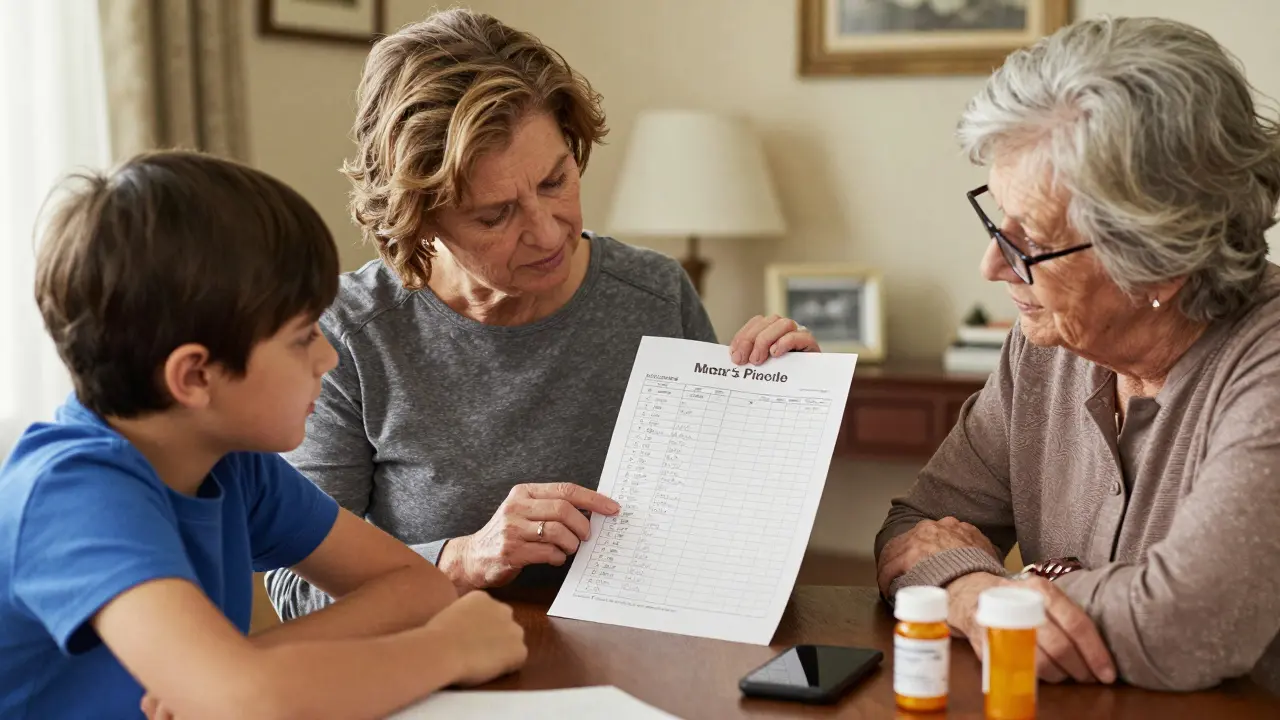
You don’t need fancy software to do this right. Here are three simple, effective ways:- Use your phone-Open the Notes app or Voice Memos. After your appointment, spend five minutes typing or recording what was said. Add the date, provider’s name, and clinic. This is fast, searchable, and backup-friendly.
- Print or copy your prescription label-Many pharmacies now print detailed instructions. Cut it out, tape it to a notebook, or scan it into a folder labeled “Medications.”
- Use a paper log-Keep a small notebook in your wallet or purse. Title each page with the medication name. Write the details in pen. Date every entry. Don’t use pencil. Pen can’t be erased.
Many patients now use patient portals linked to their EHR (electronic health record). If your provider uses one, check if your medication list is updated after each visit. If it’s not, ask why. As of 2022, 89% of U.S. office-based doctors use certified EHR systems. You should be able to see your meds, instructions, and refill status online. If you can’t, it’s not working right.
Special Cases: What to Do When Advice Changes
Medications aren’t static. Doses change. Side effects happen. You stop one. You start another. Each change needs its own note.- If a provider says “stop this med”-Don’t just stop. Write down why. Was it because of side effects? Because a new test came back? Because it’s no longer needed? Record the exact reason.
- If you miss a dose or skip a refill-Note it. “Missed Tuesday and Wednesday dose due to travel.” “Didn’t refill because of cost.” This helps your provider adjust your plan.
- If you get advice over the phone-Even if it’s just a quick call from the nurse, write it down. “Called clinic on 1/5/2026. Nurse advised to take extra ibuprofen if joint pain worsens. No new Rx needed.”
Telehealth visits are now common. But advice given during a Zoom call or phone chat is just as important as advice in the office. The American Dental Association updated its guidelines in 2023 to require documentation of all phone and telehealth medication advice-dated and initialed. You should do the same.
Who Else Should See Your Notes?
Your notes aren’t just for you. They’re for anyone who cares for you.- Pharmacists-When you pick up a new prescription, show them your notes. They can catch interactions or dosage errors.
- Emergency staff-If you’re rushed to the ER, your notes could prevent a deadly mistake. Keep a printed copy in your wallet or phone.
- Family caregivers-If someone helps you manage meds, give them a copy. Don’t assume they remember what you were told.
- Future providers-When you switch doctors or move, bring your medication log. Don’t wait for them to ask.
The Joint Commission’s National Patient Safety Goal (NPSG.03.06.01) requires medication reconciliation at every care transition-meaning every time you move from hospital to home, or from one doctor to another. If your records aren’t clear, that reconciliation fails. And you’re the one who pays the price.
What to Avoid
Even well-intentioned notes can cause problems if they’re sloppy. Here’s what not to do:- Don’t use vague terms-“Take as needed” isn’t helpful. “Take 2 tablets if pain is 7/10 or worse, max 3 times a day” is.
- Don’t rely on memory-Waiting until the next day to write it down means you’ll forget details.
- Don’t copy-paste from templates-If your provider uses a digital checklist, make sure it includes your specific instructions. Generic notes are useless.
- Don’t ignore refusals-If you said “I don’t want to take this,” write it down. That’s part of your medical history.
Also, avoid using abbreviations like “QD” (daily) or “BID” (twice daily). They’re outdated and can be misread. Write out “once daily” and “twice daily.”
When to Review and Update
Set a reminder every 3 months to review your medication log. Ask yourself:- Are all these meds still needed?
- Have any side effects changed?
- Did I refill everything on time?
- Is the list still accurate?
Medication lists can get messy. You might be taking something your doctor stopped last year. Or you might have started a new supplement that interacts with your pills. A quarterly review prevents drift. And if you’re seeing a new provider, bring your updated log with you.
The Bigger Picture: Your Rights and the Law
You have a right to clear, accurate information about your medications. The FDA’s Patient Medication Information (PMI) initiative, rolling out in 2025, will require every new prescription to come with a one-page, standardized fact sheet. That’s good. But it’s not a replacement for your own notes. Under the Health Insurance Portability and Accountability Act (HIPAA), you can request a copy of your official medical record at any time. If your provider’s notes are missing key details you remember being told, you can ask them to amend the record. You have that right. And if you’re ever in a situation where your care was compromised because advice wasn’t documented? That’s not just bad luck. It’s a system failure-and you’re not alone. In 2022, 38% of medical malpractice claims involved medication errors tied to poor documentation.Final Checklist: Your Action Plan
Here’s what to do today:- Find your current medication list-on paper, in your phone, or in your portal.
- Go through each one. Is the dose, timing, and reason clearly written?
- For any unclear entries, call your provider’s office and ask for clarification. Write down their response.
- Choose one documentation method (phone notes, printed labels, or paper log) and commit to it.
- Set a calendar reminder to review your log every 3 months.
Medication advice isn’t just something you hear. It’s something you preserve. The right notes don’t just help you stay healthy-they protect you when things go wrong. And in healthcare, that’s the most important thing of all.
Priscilla Kraft
January 9, 2026 AT 22:42OMG YES THIS. 🙌 I used to forget my meds till I started using voice memos after every dr visit. Now my phone has like 17 recordings of ‘take with food, not grapefruit, dizziness possible’ 😅 saved me so many times. Also printed labels taped to my fridge. Literal lifesaver.
Michael Patterson
January 9, 2026 AT 23:16Look i get it documentation is ‘essential’ but come on. People arent robots. I’ve been on metformin for 8 years and i still mix up if its morning or night. I dont have time to write down every little thing my dr says. And half the time they dont even say it clearly. I mean seriously ‘take as needed’ what does that even mean? Its 2026 and we still need to be medical scribes? This post is like a 10 page essay on how to take a pill. I’m exhausted just reading it.
Adewumi Gbotemi
January 10, 2026 AT 19:47Good idea. I write on paper. Small notebook. I use pen. My cousin in Nigeria do same. When you sick, you remember what you write. Not what you hear. Easy. No phone. No app. Just paper. Good for old people too.
Jennifer Littler
January 11, 2026 AT 09:47As a clinical pharmacist, I can confirm that 89% of EHR-integrated systems still fail at medication reconciliation because patients don’t bring their own logs. The gap isn’t in the tech-it’s in the behavioral compliance. If your patient portal doesn’t auto-sync your pharmacy fills, it’s functionally useless. Also, ‘as needed’ is a clinical red flag if not quantified. 2022 JAMA study showed 63% of adverse events stemmed from ambiguous dosing instructions. Document it like your life depends on it-because it does.
Alex Smith
January 13, 2026 AT 09:22So let me get this straight-we need a 12-point checklist to remember to take a pill? And if I forget to write down that I said ‘I can’t afford this,’ it’s my fault if I skip it? Meanwhile, my insurance denied the refill and the dr’s office didn’t call me back for 3 weeks. But hey, at least I documented my despair in pen. 🙃
Priya Patel
January 13, 2026 AT 15:48Yessssss this is so true!! 😭 I used to panic every time I had to refill something because I forgot why I was even taking it. Now I have a little notebook in my purse with the meds and the reasons-like ‘for anxiety’ or ‘for that weird numbness.’ My mom even started using it too! We’re both less scared now. You’re not alone, fam 💙
Roshan Joy
January 15, 2026 AT 08:18Great summary. I use the Notes app + screenshot my pharmacy labels. Also, I add the date and provider name every time. One time, I caught a dosage error because I had written down the original instruction. The pharmacist said, ‘Wow, most people don’t do this.’ I just shrugged. It’s not extra work-it’s self-preservation.
Matthew Miller
January 16, 2026 AT 02:43Wow. Another ‘you’re dying because you didn’t take notes’ fearpost. 7,000 deaths a year? That’s 0.002% of the population. You’re more likely to die from falling out of bed than from a medication error you didn’t document. Stop gaslighting people into becoming medical transcriptionists. Your doctor’s job is to communicate clearly-not for you to become their clipboard.
Madhav Malhotra
January 17, 2026 AT 15:45In India, we don’t always have access to apps or portals. But we do have family. My aunty writes down all meds on a sticky note and sticks it on the fridge. Everyone sees it. Even the kids know not to give grandpa his blood pressure pill after dinner. Simple. Human. Works. Maybe we don’t need fancy tools-just shared awareness.
Jason Shriner
January 17, 2026 AT 17:55Let’s be real. We’re living in a world where your phone knows your heartbeat but you have to write down that you take a pill at night. This isn’t healthcare. It’s a survival game where the rules are written in invisible ink. I’m not a nurse. I’m not a bureaucrat. I’m just a guy trying not to die. And now I need a binder? A log? A calendar? A backup? A backup of my backup? I’m not documenting my meds-I’m documenting my descent into madness.
Alfred Schmidt
January 17, 2026 AT 22:39YOU’RE NOT DOING ENOUGH!!! I SAW A GUY IN THE ER LAST WEEK WHO DIDN’T KNOW WHAT HE WAS TAKING-HE HAD 17 MEDS AND NO NOTES-AND HE DIED. DID YOU KNOW THAT? DID YOU THINK ABOUT THAT? YOUR CARELESSNESS IS KILLING PEOPLE. WRITE IT DOWN. NOW. I MEAN IT. DON’T WAIT. DON’T ‘SOME TIME.’ DO IT TODAY. OR YOU’RE PART OF THE PROBLEM.
Sean Feng
January 18, 2026 AT 00:39Just take your meds. If you forget, call your doctor. If you don’t know why you’re taking it, ask. Stop overcomplicating it. No one needs a notebook. No one. This is just performative health.
Vincent Clarizio
January 18, 2026 AT 08:07Let’s zoom out. This isn’t about documentation. It’s about power. Who gets to own your medical narrative? The system? Or you? The AMA says document it. The Joint Commission says document it. But the real question is-why is it your burden? Why isn’t the EHR auto-syncing every prescription, every instruction, every refusal? Why are we turning patients into unpaid medical record clerks? This isn’t empowerment-it’s exploitation dressed up as safety. And until the system stops outsourcing its failures onto the backs of the sick, we’re just rearranging deck chairs on the Titanic.
Sam Davies
January 19, 2026 AT 21:02Oh good, another American wellness guru with a 12-step plan to avoid dying from forgetting to write down ‘take 500mg twice daily’. How quaint. In the UK, we just… ask. Or, shockingly, the doctor writes it in the file. You know, the one that’s supposed to be *their* job? But no, let’s make the patient into a human Post-It note. How very… American. I’ll stick my scribbles on the fridge too, thanks. 🤡