
Immunogenicity in Biosimilars: Why Immune Responses May Differ from Reference Biologics
 Dec, 16 2025
When you hear the word biosimilar, you might think it’s just like a generic drug-cheaper, same effect, no big deal. But that’s not true. Unlike generics, which are exact chemical copies of small-molecule drugs, biosimilars are made from living cells. They’re complex, delicate, and even tiny changes in how they’re made can change how your body reacts to them. One of the biggest concerns? Immunogenicity-the chance your immune system will recognize the drug as foreign and attack it.
What Does Immunogenicity Actually Mean?
Immunogenicity isn’t just about side effects. It’s when your body builds antibodies against the drug itself. These are called anti-drug antibodies, or ADAs. For some biologics, up to 70% of patients develop them over time. That might sound scary, but not all ADAs are dangerous. Some just float around in your blood and do nothing. Others? They block the drug from working. These are called neutralizing antibodies, and they can turn a life-changing treatment into a useless one. Take cetuximab, for example. Some patients had severe allergic reactions-like anaphylaxis-because their immune system reacted to a sugar molecule (galactose-α-1,3-galactose) stuck to the drug. That sugar isn’t found in humans. It came from the cells used to grow the drug. And that’s the problem with biosimilars: even if they look identical on paper, the way they’re made can leave behind tiny fingerprints your immune system notices.Biosimilars Aren’t Copies-They’re Close Relatives
Think of a biologic like a handmade sweater. The reference product is the original. The biosimilar is made by a different knitter using the same pattern, same yarn, same needles-but maybe they twist the stitches a little differently, or the yarn has a slightly different dye lot. To your eyes, they look the same. But if you’re allergic to that specific dye? You’ll feel it. Biosimilars are made in living cell cultures-usually Chinese hamster ovary (CHO) cells or human cell lines. These cells add sugars, fold proteins, and modify structures in ways we can’t fully control. Even small differences in sialylation (adding sialic acid) or galactosylation (adding galactose) can change how the drug interacts with your immune cells. These changes affect just 15-20% of the protein, but that’s enough to matter. And it’s not just the protein itself. Impurities matter too. If a biosimilar has more than 5% protein aggregates-clumps of misfolded proteins-its risk of triggering an immune response jumps 3.2 times. Host cell proteins left over from manufacturing? If they’re above 100 parts per million, ADA rates go up 87%. That’s not a typo. It’s science.How Your Body Reacts: Two Paths to Antibodies
Your immune system doesn’t just randomly attack drugs. It follows two main paths to make antibodies. The first is T-cell dependent. It’s slow. It needs your immune system to recognize the drug as foreign, present it to T cells, and then tell B cells to make high-quality antibodies. This is how most ADAs form-after months of treatment. It’s why some patients don’t develop antibodies until they’ve been on the drug for over a year. The second is T-cell independent. It’s fast. If the drug has repeating patterns on its surface-like a barcode made of protein-you can trigger B cells directly. No T cells needed. This often happens with drugs that have long, symmetrical structures. And yes, biosimilars can have different patterns than the reference product, even if they’re nearly identical. Here’s the kicker: even fully human antibodies-designed to look exactly like your own proteins-can still cause immune reactions. Why? Because the parts that bind to your disease (called CDRs) are new to your immune system. Your body sees them as invaders. It’s like wearing a mask that looks like your face-but your immune system knows it’s not you.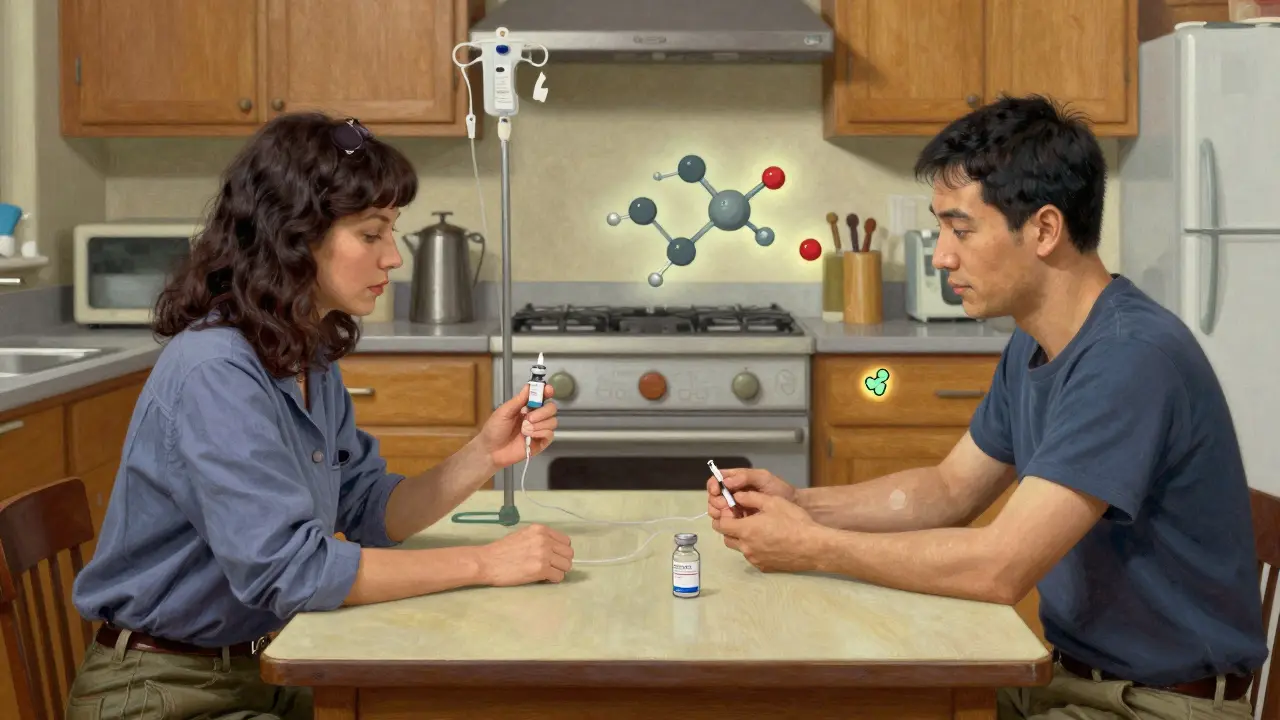
What Makes Some People More Likely to React?
It’s not just the drug. It’s you. Your immune system is unique. Some people are just more likely to react. Here’s what increases your risk:- Disease state: People with rheumatoid arthritis are 2.3 times more likely to develop ADAs than healthy volunteers. Your immune system is already on high alert.
- Genetics: If you carry the HLA-DRB1*04:01 gene, your risk of developing antibodies to certain biologics jumps nearly fivefold.
- How you get the drug: Injecting under the skin (subcutaneous) has a 30-50% higher risk than getting it through an IV. More exposure to immune cells in the skin = more chance of a reaction.
- Other meds: Taking methotrexate with a TNF inhibitor cuts ADA risk by 65%. It’s like putting a blanket over your immune system so it doesn’t notice the drug.
- Immune status: People with weakened immune systems-like those on chemotherapy-develop fewer ADAs. Their bodies just don’t have the firepower to respond.
Real-World Evidence: Do Biosimilars Really Cause More Reactions?
The data is messy. Some studies say no difference. Others say yes. The NOR-SWITCH trial in 2016 followed 481 patients who switched from originator infliximab to its biosimilar. The biosimilar group had slightly more ADAs (11.2% vs. 8.5%), but no drop in effectiveness. No flare-ups. No extra side effects. Then there’s the Danish registry study on adalimumab. The reference drug (Humira) had 18.7% ADA rates. The biosimilar (Amgevita) had 23.4%. Statistically different. But again-patients still responded just as well. Their disease didn’t get worse. A 2021 study of 1,247 rheumatoid arthritis patients found zero difference in ADA rates between the reference infliximab and its biosimilar CT-P13. 12.3% vs. 11.8%. Not even close to significant. And then there are the patient stories. One Reddit user reported severe injection site reactions after switching to a biosimilar etanercept. Another said they switched between reference and biosimilar rituximab three times over three years and felt nothing different. The American College of Rheumatology surveyed 347 rheumatologists in 2022. Two-thirds said immunogenicity concerns are overblown. But 22% said they’d seen real, clinically meaningful differences in practice. So what’s the truth? It’s probably this: for most people, biosimilars are safe. But for a small group-maybe 5-10%-a switch could trigger a reaction. It’s not common. But it’s real.
How Regulators Make Sure Biosimilars Are Safe
The FDA and EMA don’t just approve biosimilars based on lab tests. They demand proof. Every biosimilar must go through a “totality of evidence” review. That means:- Ultra-detailed chemical analysis (comparing structure, purity, stability)
- Functional tests (does it bind the same way? does it kill cells the same way?)
- Animal studies
- And crucially-a head-to-head clinical trial comparing immunogenicity
What’s Next? Better Tools, Fewer Surprises
The future of biosimilars isn’t about guessing. It’s about measuring. By 2027, advanced mass spectrometry will let scientists map the exact sugar patterns on biologics with 99.5% accuracy. That means we’ll know if a biosimilar’s glycosylation matches the reference product down to the last molecule. Some labs are already combining proteomics (protein analysis), glycomics (sugar analysis), and immunomics (immune response mapping) to predict immunogenicity before a drug even reaches patients. Trials are underway at UCSF and other centers using these multi-omics platforms. The goal? To stop surprises. To make sure that when you switch from Humira to Amgevita, or from Remicade to its biosimilar, your immune system doesn’t notice a difference. Right now, biosimilars are saving billions in healthcare costs. In Europe, 85% of infliximab prescriptions are for biosimilars. In the U.S., adoption is slower-but growing. The message isn’t that biosimilars are dangerous. It’s that they’re complex. And we need to treat them with respect-not as generics, but as sophisticated medicines that demand careful handling.What Should You Do If You’re Considering a Biosimilar?
If you’re on a biologic and your doctor suggests switching to a biosimilar:- Ask if your current drug has caused any immune reactions in the past.
- Ask what the biosimilar’s manufacturing process is and whether it’s been tested head-to-head with your current drug.
- Ask if your insurance requires a switch-and if you have the option to stay on the original if you prefer.
- Keep track of symptoms. New fatigue? More joint pain? Injection site redness? Tell your doctor. It might be nothing. Or it might be your immune system speaking.
Can biosimilars cause more side effects than the original biologic?
In most cases, no. Large studies and real-world data show that side effect rates are very similar between biosimilars and their reference products. But for a small subset of patients-especially those with certain genetic markers or autoimmune conditions-switching can trigger new immune reactions like injection site reactions, fatigue, or reduced drug effectiveness due to anti-drug antibodies. These reactions are rare but real, which is why monitoring after a switch is important.
Why are biosimilars more likely to cause immune reactions than generics?
Generics are chemically identical to their brand-name counterparts-they’re made from simple molecules and can be replicated exactly. Biosimilars are made from living cells and are large, complex proteins. Even tiny differences in how they’re folded, modified with sugars, or contaminated with leftover cell material can make them look slightly different to your immune system. These differences don’t make them unsafe, but they can trigger immune responses that generics never do.
Do all biosimilars have the same risk of immunogenicity?
No. Immunogenicity risk varies by product, manufacturer, and even formulation. For example, biosimilars made in human cell lines may have different glycosylation patterns than those made in CHO cells. Some use different stabilizers (like polysorbate 80 vs. 20), which can affect protein clumping. Even the dose, frequency, and route of administration (shot vs. IV) change the risk. That’s why each biosimilar must be evaluated individually-not all are created equal.
How do doctors test for anti-drug antibodies?
Doctors use a three-step process: first, a screening test to detect any antibodies in the blood; second, a confirmatory test to make sure the signal is real and not a false positive; and third, a neutralizing antibody test to see if those antibodies block the drug from working. The most sensitive tests use electrochemiluminescence (ECL), but cell-based assays are often preferred because they show actual biological impact, even if they’re less precise.
Can I switch back to the original biologic if I have a reaction to a biosimilar?
Yes. If you develop new symptoms, reduced effectiveness, or confirmed anti-drug antibodies after switching to a biosimilar, your doctor can switch you back to the original biologic. Most insurance plans allow this if there’s a documented medical reason. It’s not uncommon-especially in patients who had stable disease on the original drug and then experienced a flare after switching.
Radhika M
December 16, 2025 AT 20:27Biosimilars aren't generics. That's the key. If your body reacts to a protein with a weird sugar tag, it's not the drug's fault-it's biology. Simple as that.
BETH VON KAUFFMANN
December 18, 2025 AT 14:41Let’s be real-the whole immunogenicity debate is just pharma’s way of justifying $20,000 vials. If a biosimilar passes all the regulatory hoops, why are we still acting like it’s radioactive? The data says it’s fine for 95% of people. The rest? They’re outliers, not a population-level concern.
Martin Spedding
December 20, 2025 AT 09:44the danish study showed higher ada rates but no clinical impact. so why are we panicking? the system works. stop overthinking.
Donna Packard
December 21, 2025 AT 03:44It’s amazing how much science goes into something most people think is just a cheaper version. Really gives you respect for the process.
Erik J
December 21, 2025 AT 04:22Does anyone know if the glycosylation profiles of biosimilars are publicly available? I’d love to see how closely they match the reference across different manufacturers.
CAROL MUTISO
December 22, 2025 AT 21:13Oh honey, we’re treating proteins like they’re LEGO bricks. You think snapping two pieces together the same way means they’ll behave the same? Nah. Proteins have moods. They have memory. They remember the hamster they grew up with. And if your biosimilar’s CHO cell had a bad day in 2021? Your immune system remembers. It’s not science-it’s emotional biology.
Anna Giakoumakatou
December 24, 2025 AT 16:18Of course the FDA approves these. They’re not here to protect you-they’re here to let corporations save $10 billion while you become a walking antibody factory. Welcome to capitalism, where your immune system is just another cost center.
Sam Clark
December 26, 2025 AT 15:56While the data shows minimal clinical differences, we must acknowledge that immunogenicity remains a biologically plausible risk. For patients with autoimmune conditions, even subtle changes in protein conformation may alter pharmacokinetics. Therefore, individualized monitoring remains prudent, and shared decision-making should be prioritized over blanket substitution policies.
Philippa Skiadopoulou
December 27, 2025 AT 03:07Regulatory standards are robust. The totality of evidence approach ensures comparability. The notion that biosimilars are somehow less safe is a myth perpetuated by misinformation. Clinical outcomes are equivalent. The science is clear.
Pawan Chaudhary
December 28, 2025 AT 02:22Man, I’m so glad we’re getting cheaper options. My cousin’s on Humira and it was killing her budget. If biosimilars work just as well, why not give them a shot? Life’s too short to stress over tiny protein differences.
Jonathan Morris
December 28, 2025 AT 11:03Did you know that polysorbate 80 in one biosimilar was linked to a 17% spike in anaphylaxis in a 2020 Phase IV trial that was buried in the FDA’s supplemental filing? The public never saw it. The regulators approved it anyway. Coincidence? I think not.
Raven C
December 28, 2025 AT 20:27It’s not just about the protein-it’s about the *soul* of the molecule. The cell line, the bioreactor’s temperature fluctuations, the humidity in the cleanroom… these aren’t variables-they’re echoes of unseen trauma. Your immune system doesn’t just detect antigens-it feels the history of the drug’s creation. And if that history is… messy? It will respond accordingly. You can’t quantify that with mass spectrometry.
amanda s
December 30, 2025 AT 08:11So you’re telling me some rich country lets a cheap Indian biosimilar into their bodies? That’s why America’s health system is collapsing-because we let foreign labs play God with our immune systems. We should ban all biosimilars made outside the US. End of story.
Peter Ronai
December 31, 2025 AT 03:05Everyone’s acting like this is new. Newsflash: this has been happening since 2005. The EMA knew. The FDA knew. But they let it slide because the money was too good. Now you’re shocked? You’re not a patient-you’re a consumer who got lazy. The science was always there. You just didn’t read the footnotes.
Patrick A. Ck. Trip
January 1, 2026 AT 03:51Thank you for this thoughtful breakdown. I’ve been on a biosimilar for 18 months and had no issues. But I appreciate the nuance-this isn’t a one-size-fits-all issue. I hope more doctors take the time to explain this to patients before switching. Small changes matter, and so do patient voices.