
Occupational Lung Diseases: Silicosis, Asbestosis, and How to Prevent Them
 Dec, 17 2025
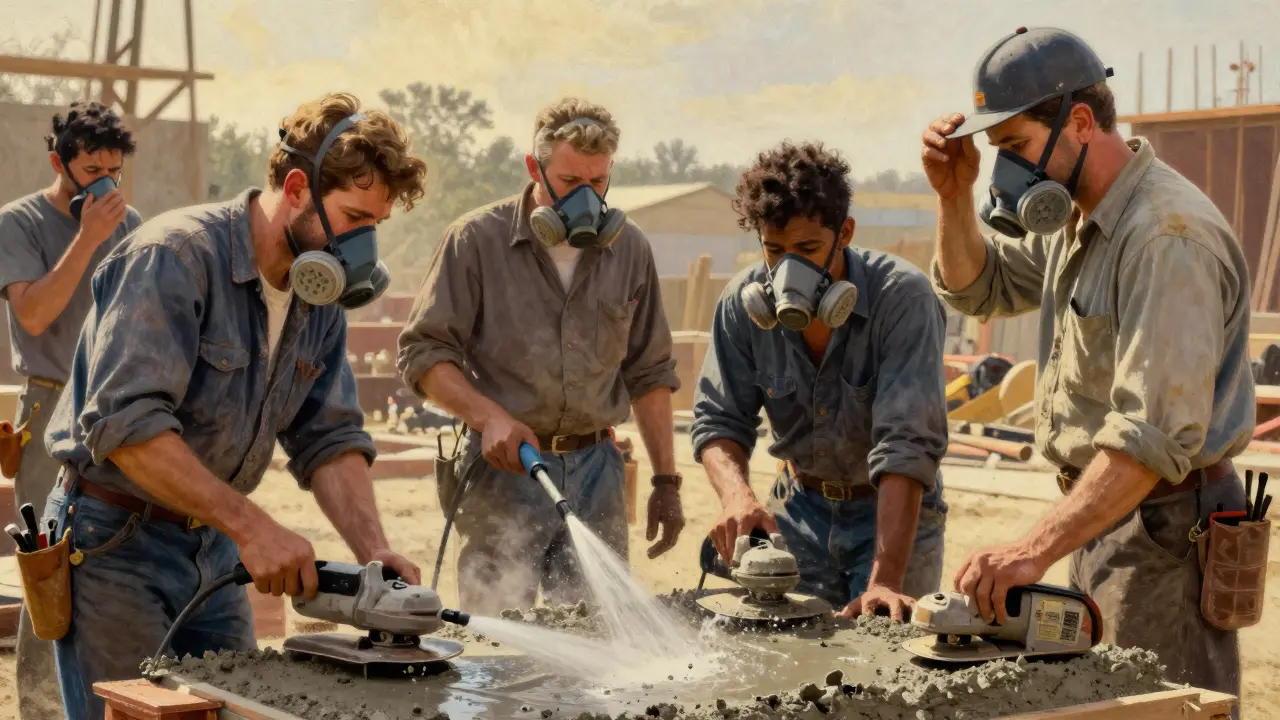
Every year, over 2,000 workers in the U.S. die from lung diseases caused by things they breathed in at work. Not from smoking. Not from pollution. But from dust and fibers they were never told to fear. Silicosis and asbestosis aren’t rare anomalies-they’re preventable tragedies happening right now in construction sites, factories, and demolition zones. And the worst part? We’ve had the tools to stop them for decades.
What Silicosis and Asbestosis Actually Do to Your Lungs
Silicosis starts when you breathe in tiny pieces of crystalline silica-found in sand, stone, concrete, and engineered countertops. These particles don’t dissolve. They don’t get cleared. They settle deep in your lungs and scar the tissue. Over time, your lungs stiffen. Breathing becomes harder. You cough more. Eventually, you can’t get enough air-even walking to the mailbox feels like climbing a mountain.
Asbestosis works the same way, but with asbestos fibers. These microscopic threads, once used in insulation, roofing, and brake pads, get lodged in lung tissue. They cause inflammation that turns into permanent scarring. Unlike some diseases, there’s no cure. Once the damage is done, it only gets worse. And the symptoms? They often don’t show up until 10, 20, or even 30 years after exposure. By then, it’s too late.
These aren’t just old-school problems. In 2022, the CDC reported 1,200 deaths from silicosis and over 1,100 from asbestosis in the U.S. alone. Most victims were construction workers, miners, or demolition crews. Many were under 60. Some were in their 30s.
Why Prevention Isn’t Just a Good Idea-It’s the Only Option
You can’t un-breathe silica or asbestos. Once those particles are in your lungs, they’re there for life. That’s why prevention isn’t about reducing risk-it’s about eliminating exposure entirely. And we know exactly how to do it.
The most effective way? Engineering controls. That means changing the job so the hazard doesn’t reach the worker in the first place. Wet cutting concrete? Reduces silica dust by 90%. Local exhaust ventilation on a grinder? Cuts exposure by 70-80%. Sealing off work areas? Keeps 95% of dust contained. These aren’t fancy gadgets. They’re simple, proven, and affordable-costing $2,000 to $5,000 per workstation, with payback in under two years from lower workers’ comp claims.
Yet, in 2021, OSHA issued over 1,000 citations to construction companies for silica violations. Why? Because shortcuts still happen. Workers skip water on saws because it’s slower. Managers don’t install ventilation because it’s ‘not urgent.’ And too often, workers aren’t trained to demand better.
The Hierarchy of Controls: What Actually Works
Not all protection is created equal. The CDC and NIOSH rank prevention methods in order of effectiveness:
- Elimination-Don’t use silica or asbestos at all. Substitute with safer materials like engineered stone without crystalline silica.
- Substitution-Use a less toxic alternative when elimination isn’t possible.
- Engineering controls-Ventilation, wet methods, enclosed systems. These reduce exposure by 80-90%.
- Administrative controls-Limiting exposure time, rotating workers. Reduces exposure by 50-70%.
- PPE-Respirators. Only 40-60% effective if used perfectly-and most aren’t.
Respirators are the last line of defense-not the first. N-95 masks filter 95% of particles 0.3 microns in size. P-100s filter 99.97%. But if the mask doesn’t fit, if it’s uncomfortable in 90-degree heat, or if you’re not trained to check the seal, it’s useless. A 2022 CDC report found 68% of worker complaints about respirators were about fit and comfort. And 32% of workers admitted they modified their masks to make them easier to wear-making them less safe.
Who’s at Risk-and Where It’s Happening Today
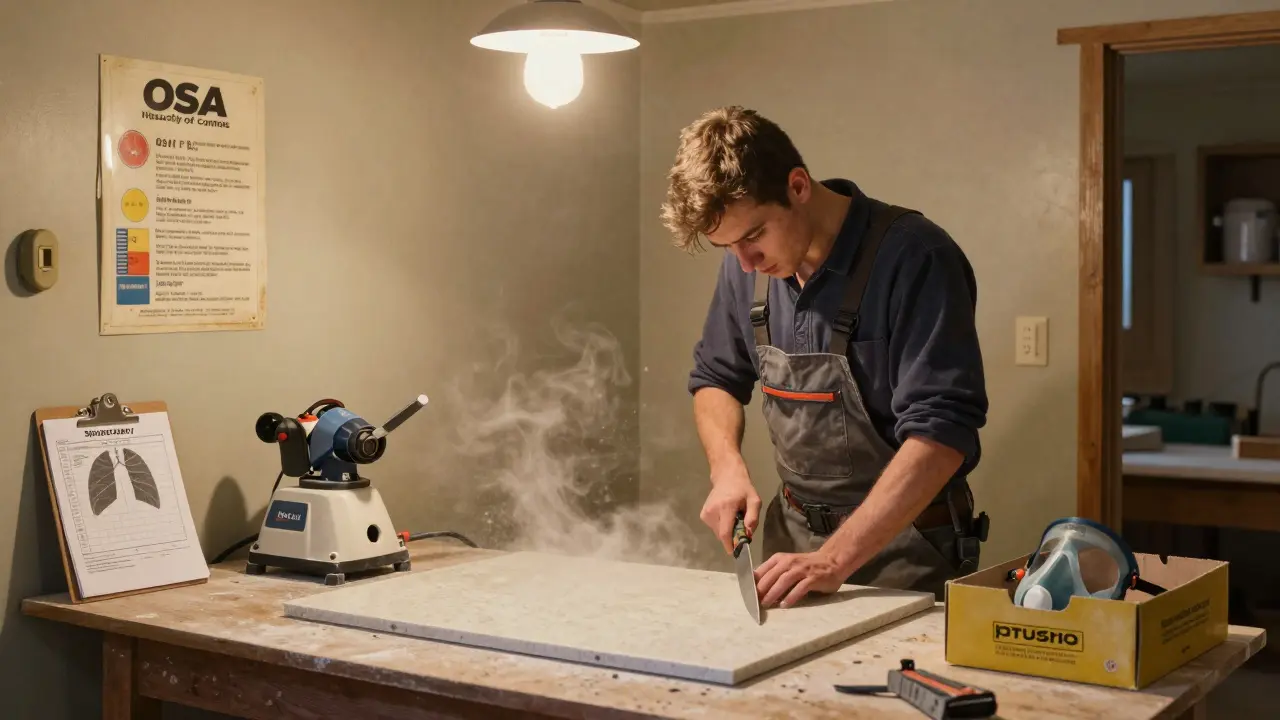
Silicosis is surging in new places. It’s not just miners anymore. It’s tile installers cutting countertops. Landscapers grinding stone. Auto mechanics sanding brake parts. Even nail salon workers using abrasive bits on artificial nails are at risk.
Asbestosis is still showing up in older buildings. Schools, hospitals, and apartment complexes built before 1980 often have asbestos in insulation, floor tiles, pipes, and ceilings. When those materials are disturbed during renovation or demolition, fibers become airborne. The EPA estimates 733,000 public buildings in the U.S. still contain asbestos. And many workers aren’t told.
Small businesses are especially vulnerable. In Wisconsin, 78% of companies with fewer than 20 employees had no formal respiratory protection program in 2021. No training. No fit testing. No monitoring. Just hope.
What Real Prevention Looks Like-On the Ground
It’s not just about gear. It’s about culture.
One construction company in Ohio reduced respiratory incidents by 65% over three years by doing three things:
- Supervisors wore respirators every single day-no exceptions.
- Workers got 6 hours of initial training, not the OSHA minimum of 2.
- They created a system where anyone could shut down a job if they saw unsafe dust.
Fit testing is non-negotiable. OSHA requires it annually. But many companies skip it until an inspector shows up. A worker on Reddit wrote: ‘I’ve been in demolition for 15 years and never had a proper respirator fit test until OSHA showed up last month.’ That’s not safety-that’s luck.
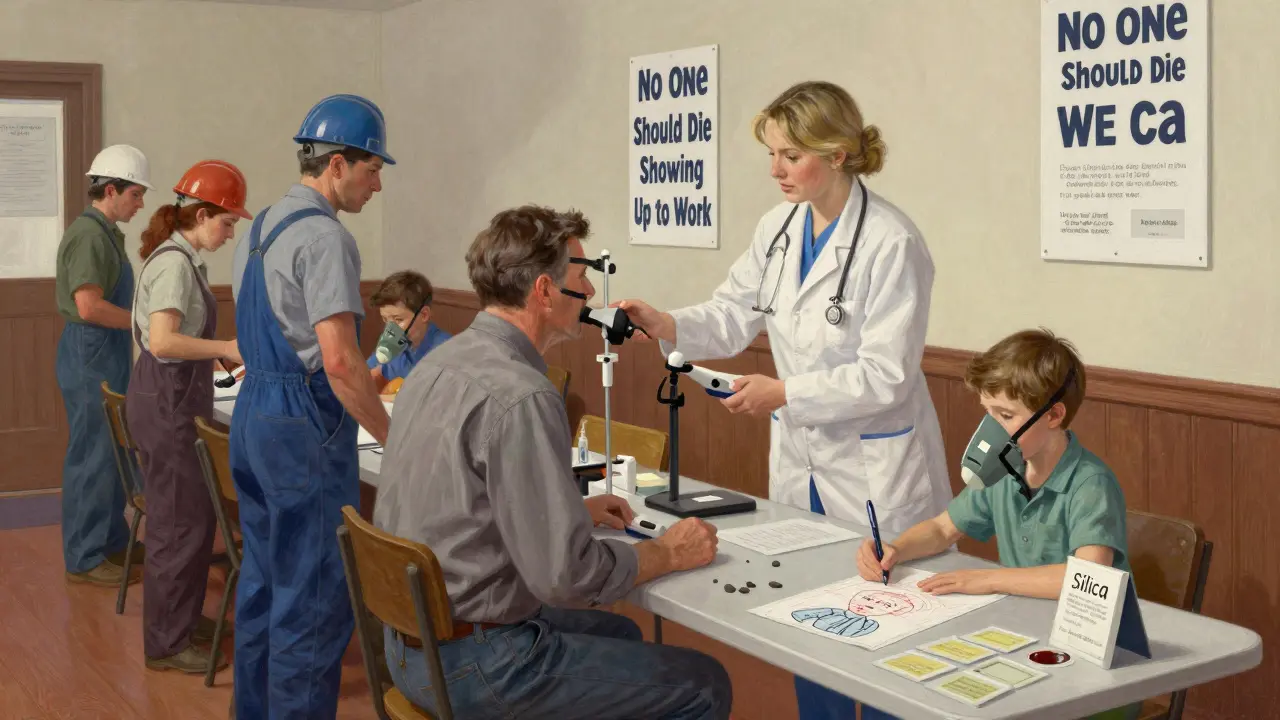
Health monitoring matters too. Spirometry tests-breathing tests that measure lung function-should be done at hire and every five years. For those with existing conditions, every year. These tests catch decline before you feel it. And catching it early can slow disease progression by 30-50%.
The Bigger Picture: Why This Keeps Happening
Dr. Paul Blanc, a leading expert in occupational lung disease, called the continued rise of silicosis ‘a fundamental failure of workplace safety systems.’ And he’s right.
We have the science. We have the tools. We have the laws. But enforcement is patchy. Training is rushed. Culture is slow to change. And too many workers still believe ‘it won’t happen to me.’
Meanwhile, the global market for respiratory protection is growing fast-projected to hit $11.3 billion by 2027. That’s billions spent on masks, filters, and ventilation. But if the mindset doesn’t shift, it’s just putting Band-Aids on a broken system.
The European Respiratory Society set a goal: eliminate occupational lung diseases by 2030. Germany’s pilot programs are already showing 55% fewer new cases through mandatory health checks and exposure monitoring. It’s possible. It’s being done.
What You Can Do-If You’re a Worker, Boss, or Advocate
If you’re a worker:
- Ask for wet cutting, ventilation, or enclosed systems.
- Insist on a fit test for your respirator-and check the seal every time you put it on.
- Report unsafe conditions. OSHA protects whistleblowers. Use that right.
If you’re a supervisor or business owner:
- Invest in engineering controls. They pay for themselves.
- Train for 4-6 hours, not 2. Make it real.
- Model proper PPE use. No exceptions.
- Get spirometry testing for your team.
If you’re an advocate or policymaker:
- Push for mandatory health monitoring in all high-risk industries.
- Support funding for small business grants to cover ventilation costs.
- Demand transparency in material safety data sheets-no hidden silica or asbestos.
The truth is simple: No one should die because they showed up to work. Silicosis and asbestosis aren’t inevitable. They’re the result of choices. And we can make better ones.
Can you get silicosis from one-time exposure?
While silicosis usually develops after years of exposure, acute silicosis can occur after just a few weeks or months of intense exposure to very high levels of silica dust-like during sandblasting without protection. This form progresses rapidly and is often fatal. Even brief, high-level exposure can cause permanent damage.
Is there a safe level of asbestos exposure?
No. According to the International Agency for Research on Cancer (IARC), there is no safe level of asbestos exposure. Even tiny amounts can cause asbestosis, lung cancer, or mesothelioma. That’s why experts say the only safe approach is zero exposure.
Do N-95 masks protect against asbestos?
N-95 masks are not sufficient for asbestos. They filter 95% of particles 0.3 microns in size, but asbestos fibers can be smaller and more persistent. P-100 respirators, which filter 99.97% of particles, are required by OSHA for asbestos work. Always use the right-rated respirator for the hazard.
Can you test your lungs for early signs of silicosis or asbestosis?
Yes. Spirometry and chest X-rays or CT scans can detect early scarring before symptoms appear. Workers exposed to silica or asbestos should get baseline testing at hire and regular follow-ups every 1-5 years, depending on exposure level. Early detection doesn’t reverse damage-but it stops it from getting worse.
Are younger workers at risk?
Absolutely. With the rise of engineered stone countertops, younger workers in fabrication shops are being diagnosed with silicosis in their 20s and 30s. This is not an ‘old worker’ problem. It’s a modern workplace hazard that’s accelerating.
What’s the difference between silicosis and COPD?
Silicosis is caused by inhaling silica dust and causes scarring (fibrosis) in the lungs. COPD (chronic obstructive pulmonary disease) is usually caused by smoking and involves damaged airways and air sacs. While both cause shortness of breath, silicosis is an occupational disease with a clear exposure link. Smoking worsens silicosis-workers exposed to silica who smoke have a 50-70% higher risk of developing severe disease.
Is there a cure for asbestosis or silicosis?
No. There is no cure. Treatment focuses on managing symptoms-oxygen therapy, pulmonary rehab, quitting smoking, and preventing infections. The only effective strategy is prevention. Once the lung tissue is scarred, it cannot heal.
Final Thought: This Isn’t Just About Rules-It’s About Respect
Every worker deserves to go home at the end of the day with their lungs intact. Silicosis and asbestosis aren’t accidents. They’re failures. Failures of training, enforcement, leadership, and sometimes, compassion.
The technology to stop them exists. The laws are on the books. What’s missing is the will to use them consistently-every shift, every job, every company.
It’s time to stop treating prevention as an expense. It’s time to see it for what it is: the bare minimum we owe to the people who build our homes, fix our cars, and keep our world running.
Monte Pareek
December 17, 2025 AT 12:03Look I've been on demolition sites for 18 years and I've seen guys drop like flies because they thought a dust mask was enough
Engineering controls aren't optional they're the baseline
Wet cutting costs pennies per job but saves lives
If your boss won't pay for it then he's not your boss he's a liability
I've trained three crews in the last two years and every single one now has a shutdown protocol
You don't need a PhD to understand that if you're breathing dust you're already losing
OSHA citations are just paper trophies until someone dies
Stop treating PPE like a magic shield and start treating exposure like the enemy it is
Gloria Parraz
December 17, 2025 AT 22:47My uncle worked in a tile shop in '09. Diagnosed with silicosis in '21. He was 42.
They never gave him a respirator fit test. Said he "looked fine".
He's on oxygen now. Can't play with his grandkids without stopping to breathe.
This isn't theoretical. It's someone's dad. Someone's brother.
Lynsey Tyson
December 19, 2025 AT 13:46Reading this made me cry. Not because it's surprising but because it's so preventable.
We talk about climate change like it's the only thing killing us.
But the person next to you on the job site is dying from something we could have stopped with a hose and a ventilation fan.
Why aren't we screaming about this?
holly Sinclair
December 21, 2025 AT 09:20It's fascinating how deeply embedded the myth of individual responsibility is in occupational safety culture.
We blame workers for not wearing masks while ignoring systemic failures in procurement, training, and enforcement.
The hierarchy of controls isn't just a model-it's a moral framework.
When you prioritize PPE over engineering controls, you're essentially saying the worker's body is the acceptable barrier between hazard and environment.
This isn't negligence-it's institutionalized harm disguised as pragmatism.
And the real tragedy? The same companies that cut corners on silica controls are the ones donating to political campaigns that weaken OSHA.
The market for respirators is growing because the market for prevention is being starved.
It's capitalism with a side of death.
We need to reframe this not as a health issue but as a civil rights issue-every worker deserves the right to breathe without being slowly poisoned by the very work they do.
And until we treat exposure like the crime it is, nothing will change.
Germany's 55% reduction isn't luck-it's policy enforced with teeth.
Here? We have posters. And hope.
Hope doesn't filter dust.
Systems do.
Mark Able
December 22, 2025 AT 00:19Wait so you're telling me if I'm cutting countertops I could get lung cancer from dust even if I'm 25?
My cousin just started doing that. He's in his 20s.
And he uses a regular N95 from Home Depot.
That's terrifying.
Why isn't this on TV?
Kelly Mulder
December 22, 2025 AT 22:45It is simply inexcusable that in the year 2024, workers are still being exposed to known carcinogens because of cost-cutting and incompetence.
Let us be perfectly clear: There is no such thing as "acceptable risk" when it comes to silica or asbestos.
The fact that 78% of small businesses in Wisconsin have no respiratory program is not a statistic-it is a moral indictment.
And the notion that "it won't happen to me" is the most dangerous delusion in industrial history.
These diseases are not "old man problems"-they are the direct consequence of corporate negligence and worker silence.
It is not enough to "do better"-you must do everything.
Every supervisor who skips fit testing is complicit.
Every manager who delays ventilation installation is a murderer in slow motion.
And every worker who accepts a substandard mask is participating in their own slow execution.
There is no excuse.
Only accountability.
anthony funes gomez
December 24, 2025 AT 05:26Exposure dynamics of crystalline silica are non-linear and dose-dependent-yet regulatory thresholds remain archaic.
The NIOSH REL of 50 μg/m³ is outdated-new epidemiological data suggests no safe threshold exists even below 10 μg/m³.
Engineering controls aren't "nice to have"-they're the only scientifically valid intervention.
Administrative controls like job rotation? Ineffective when exposure is airborne and pervasive.
PPE? A band-aid on a hemorrhage.
And the fact that 32% of workers modify their masks? That's not ignorance-it's systemic failure.
OSHA's 2022 enforcement data shows 73% of violations occurred in firms under 50 employees.
Small biz grants? Necessary but insufficient.
We need mandatory real-time dust monitoring with IoT sensors linked to OSHA's database.
And liability reform-hold executives personally accountable when preventable exposure leads to disease.
This isn't about safety protocols.
It's about redefining corporate personhood.
Kathryn Featherstone
December 25, 2025 AT 05:40I work in HR for a small construction firm. We started doing spirometry tests last year.
One guy had early signs of scarring-he'd been working for 8 years.
We moved him to admin. Gave him a raise.
He cried.
He said no one had ever cared enough to check.
That’s the thing no one talks about.
It’s not just about lungs.
It’s about being seen.
Edington Renwick
December 26, 2025 AT 10:15Wow. Just wow.
I used to think these diseases were just sad stories from the past.
Now I realize they're happening right now-in the next town, in the next shop, to someone's son.
And we're all just scrolling past it.
It's not just about laws.
It's about us.
What are we willing to ignore?