
Perception vs Reality: Why Generics Seem Less Effective Than Brand-Name Drugs
 Dec, 22 2025
Have you ever been handed a generic pill and felt something was off? Maybe your doctor switched you from a brand-name drug to a cheaper version, and suddenly you swear it just doesn’t work the same. You’re not alone. Millions of people feel this way-even though the science says otherwise.
What’s Really in a Generic Pill?
Generic drugs aren’t knockoffs. They’re not diluted. They’re not made in sketchy labs. By law, they must contain the exact same active ingredient, in the exact same strength, as the brand-name drug. The FDA requires them to deliver that ingredient into your bloodstream at the same rate and to the same extent. That’s called bioequivalence. The allowed variation? Just 80% to 125% of the brand-name drug’s absorption. That’s not a loophole-it’s a scientifically proven range where no meaningful difference in effect occurs. For example, if you take a brand-name version of sertraline (Zoloft), your body absorbs 100 units of the active ingredient. The generic version? It absorbs between 80 and 125 units. That’s not a big swing. It’s like driving 55 mph instead of 60 mph-your destination doesn’t change. All manufacturers, whether they make brand-name or generic drugs, must follow the same strict rules: Current Good Manufacturing Practices (cGMP). The same inspections, the same quality controls. The FDA doesn’t treat generics like second-class medicine. In fact, over 90% of all prescriptions filled in the U.S. are generics. That’s not because they’re cheap-it’s because they work.Why Do People Think Generics Don’t Work?
Here’s the real problem: perception. Not science. Not data. Perception. Think about it. You’ve been told for years that your brand-name drug is the one your doctor trusts. You see ads for it on TV. You remember the name. You feel safe with it. Then, one day, you get a different-looking pill. Smaller. White. No logo. The bottle says “Sertraline Hydrochloride.” Suddenly, your brain says: Is this real? This isn’t just about looks. It’s about trust. And trust is shaped by culture, money, and fear. Studies show that 13% of Americans believe brand-name drugs are more effective. 20% think generics cause more side effects. In some rural communities, people believe generics are “for poor people” or “not real medicine.” In one study, Black patients were nearly twice as likely as white patients to doubt generics. Why? Because the system has failed to communicate clearly. And when people don’t understand, they fill the gap with fear. Even doctors aren’t immune. One in nine physicians admit they have doubts about generic effectiveness. That’s not because they’re wrong-it’s because they’ve never been trained to explain it well. When a doctor just says, “It’s the same,” without showing proof, patients hear: “It’s cheaper, so it’s worse.”The Nocebo Effect: When Belief Hurts You
There’s a powerful psychological phenomenon called the nocebo effect. It’s the opposite of the placebo effect. Instead of feeling better because you believe a treatment works, you feel worse because you believe it won’t. A 2023 study in JAMA Network Open proved this. Two groups of patients were switched to generic antidepressants. One group was told, “This generic is just as effective as the brand.” The other was told nothing. The group that was reassured had 34% better adherence. The group that wasn’t told anything? They reported more side effects and were more likely to quit taking the drug-even though both groups got identical pills. Your mind doesn’t distinguish between real and perceived differences. If you think the generic won’t work, your body responds as if it’s true. That’s why people report anxiety returning, blood pressure spiking, or seizures worsening after switching-when the actual drug hasn’t changed at all.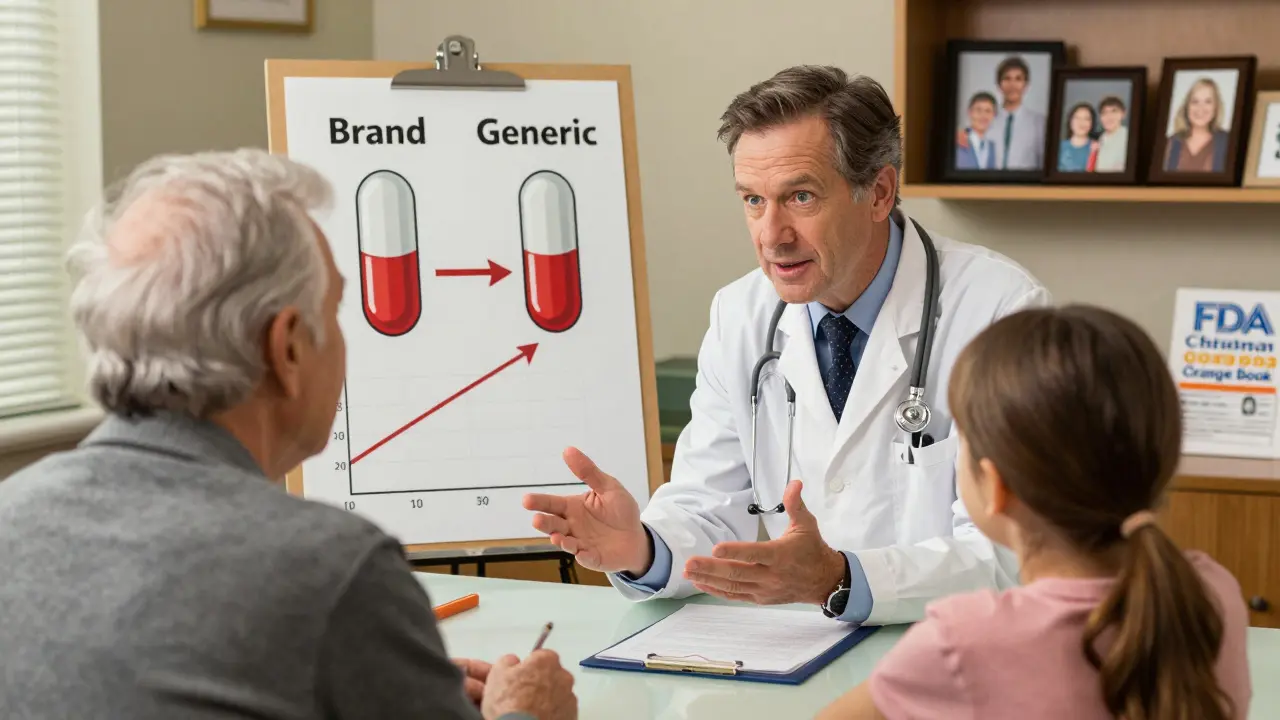
What About Those Rare Cases?
You’ve probably heard stories. “My mom switched to generic levothyroxine and her TSH levels went crazy.” “My husband’s seizure control dropped after the switch.” Yes, those cases exist. But they’re rare. And they’re not proof that generics are inferior. They’re proof that some drugs need extra care. Drugs with a narrow therapeutic index-like warfarin, levothyroxine, or certain epilepsy meds-require very precise blood levels. Even tiny changes can matter. That’s why the FDA has extra oversight for these. But even here, the evidence shows generics perform just as well. A 2020 review of 17 studies on levothyroxine found no difference in outcomes between brand and generic versions. So why do some people have issues? Often, it’s not the drug. It’s the switch itself. If you’ve been stable on one brand for years, switching-even to an identical generic-can disrupt your body’s rhythm. It’s like changing your coffee brand. You might notice a difference in taste, even if the beans are the same. The fix? Don’t switch back and forth. Stick with one version. If you must switch, do it under your doctor’s supervision. Monitor your levels. Don’t assume the generic is the problem before you’ve given it time.Who’s Profitting From the Doubt?
Here’s the uncomfortable truth: some companies benefit from you thinking generics are worse. Brand-name drug makers spend billions every year on marketing that doesn’t say, “Our drug is better.” Instead, they say things like, “Trust the name you know,” or “Your health is worth more than a savings.” Subtle. But powerful. A 2021 investigation found that brand-name companies spent $1.8 billion annually on campaigns designed to create doubt about generics-without ever making a false claim. They don’t need to. They just need you to feel uneasy. Meanwhile, the savings are massive. Generics cost 80-85% less. Since 2009, they’ve saved the U.S. healthcare system over $1.7 trillion. That’s money that could pay for insulin, mental health care, or cancer treatments for people who can’t afford them.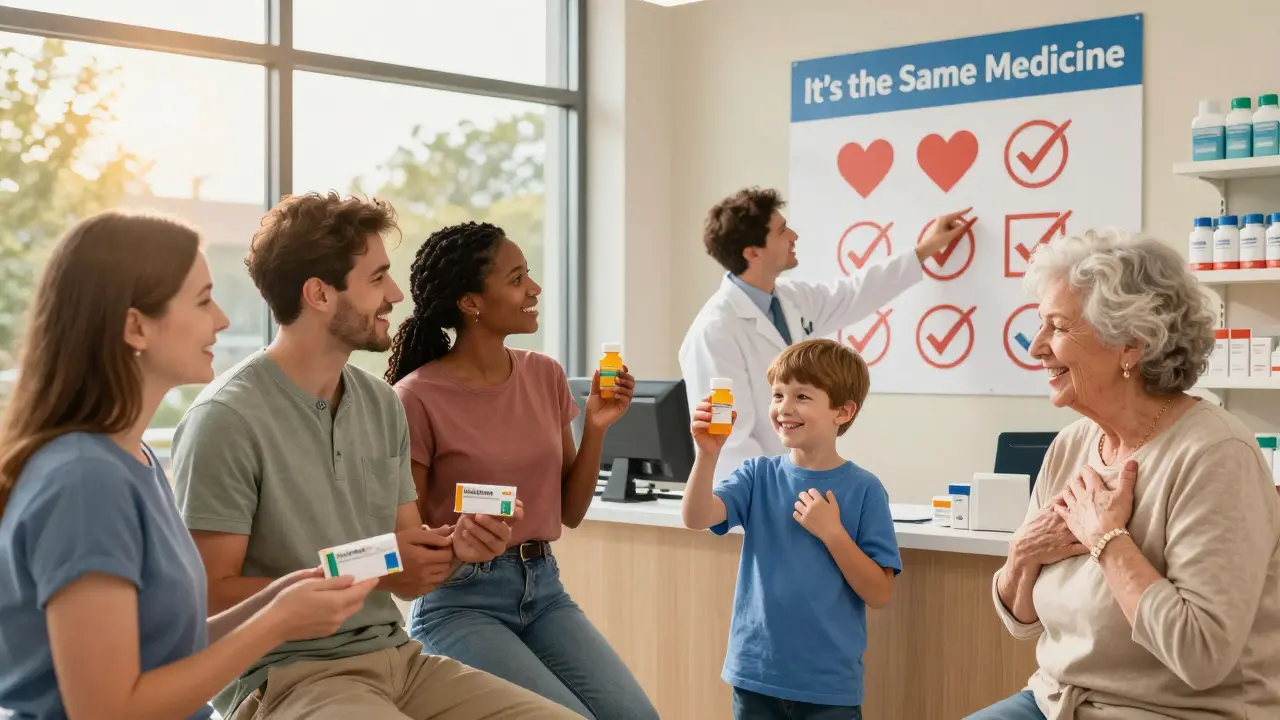
How to Know for Sure It’s Working
If you’re worried about your generic drug, here’s what to do:- Check the label. Look for the active ingredient. If it matches your brand-name drug exactly, you’re getting the same medicine.
- Ask for the FDA’s “Orange Book.” It lists all approved generics and their equivalence ratings. Your pharmacist can show you.
- Track your symptoms. Write down how you feel before and after the switch. Don’t assume a bad day means the drug failed.
- Don’t switch back and forth. Consistency matters more than the brand name.
- Ask your doctor to explain it. A simple, clear conversation-“This is the same medicine, just cheaper”-can boost adherence by 87%.
Abby Polhill
December 23, 2025 AT 18:56Okay but let’s be real-when you’ve been on Zoloft for 8 years and your doc swaps it for a generic that looks like a Tic Tac, your brain goes full conspiracy mode. It’s not about the science, it’s about the ritual. The pill shape, the color, the little logo on it-that’s your brain’s security blanket. Remove that, and suddenly your anxiety isn’t chemical, it’s existential.
And don’t even get me started on the pill bottles. Brand-name comes in those sleek, hushed white bottles with the foil seal. Generic? Comes in a plastic tub with a sticker that says ‘Sertraline HCl 50mg’ like it’s a bulk buy from Costco. No wonder people feel like they’re being given leftovers.
It’s not that generics don’t work-it’s that we’ve been trained to equate cost with quality. And in a culture where ‘premium’ means ‘safe,’ cheap automatically means ‘risky.’ We need better packaging. Better branding. Maybe even a generic version with a logo. Just one. Just to make people feel like they’re not taking medicine from a shadow pharmacy.
Also, the FDA’s Orange Book? No one knows what that is. That’s like saying ‘check the ISO standards’ when someone’s confused about their Wi-Fi password. We need plain language. Like, ‘This pill has the same active ingredient as your old one. Same factory standards. Same results. Just no marketing budget.’
Rachel Cericola
December 25, 2025 AT 12:24Let me just say this as someone who’s been managing bipolar disorder for 15 years: I switched from brand-name lamotrigine to generic five years ago and I haven’t had a single episode since. Not one. I’ve tracked my mood, my sleep, my energy levels. I’ve even done blood tests. The numbers are identical. The only thing that changed? My wallet. And my peace of mind.
People think generics are ‘lesser’ because they’re not marketed like luxury products. But here’s the truth: the same company that makes the brand-name drug often makes the generic too-just under a different label. The FDA doesn’t cut corners. The manufacturing lines are identical. The inspectors are the same. The only difference is that the generic doesn’t pay for a Super Bowl ad.
And the nocebo effect? Real. I’ve seen patients quit their meds because they ‘felt different’ after switching-even when their labs showed zero change. Their minds were screaming ‘this isn’t the same!’ and their bodies believed them. That’s not the drug’s fault. That’s a communication failure. We need doctors to sit down and say, ‘This is not a downgrade. This is an upgrade in access.’
Also, if you’re on a narrow-therapeutic-index drug like levothyroxine? Fine. Switch once, monitor closely, stick with it. But don’t blame the pill. Blame the narrative. The system has failed to educate, so people fill the void with fear. And fear doesn’t care about bioequivalence percentages.
Generics saved my life financially. They didn’t compromise my health. And if you’re still skeptical? Try tracking your symptoms for 60 days after switching. Not 3. Not 7. 60. You might be surprised.
Blow Job
December 26, 2025 AT 05:59Y’all are overthinking this. It’s the same damn pill. Same active ingredient. Same FDA stamp. Same manufacturing rules. The only thing different is the price tag and the logo.
I switched my dad from brand-name metoprolol to generic after his insurance dropped coverage. He was convinced he’d have a heart attack. Six months later? He’s hiking in the Rockies. His BP is better than it’s been in a decade.
It’s not magic. It’s math. And fear. People think if it doesn’t look like the TV ad, it’s not real. That’s not science. That’s branding brainwashing.
Stop letting corporations tell you what your medicine should look like. The pill doesn’t care if it has a logo. Your body does.
Also, ‘generic’ doesn’t mean ‘cheap junk.’ It means ‘smart choice.’
Christine Détraz
December 26, 2025 AT 16:02I get why people are uneasy. I used to be one of them. I switched to generic sertraline and had this weird, low-grade anxiety for two weeks-like I was cheating on my meds. But then I started journaling. Wrote down how I felt every day. And guess what? Day 15? I felt better than I had in months.
Turns out, the ‘difference’ I felt was just grief for the brand I’d trusted. Not the drug. The packaging. The ritual. The name.
Also, I live in a rural town where people still think generics are ‘for the poor.’ It’s embarrassing, but it’s real. We need more pharmacists to say, ‘This is your medicine. Same as before. Just cheaper.’ Not ‘it’s equivalent.’ Say ‘same.’ Simple word. Powerful.
And if you’re worried? Ask your pharmacist to show you the Orange Book. It’s not scary. It’s just a list. And it’s on the internet. You can look it up. No judgment. Just facts.
Generics aren’t a compromise. They’re a correction. The system was rigged to make us think we needed to pay more to feel safe. We don’t.
Also, I love my generic pills now. They’re tiny. I don’t even notice them. Which, honestly? Is the point.
EMMANUEL EMEKAOGBOR
December 27, 2025 AT 17:31It is with profound respect for the scientific integrity of pharmaceutical regulation that I offer this reflection. The assertion that generic medications are therapeutically inferior is not merely incorrect-it is a profound disservice to public health and the rigorous standards upheld by global regulatory authorities.
In my country, Nigeria, where access to essential medicines is often constrained by economic barriers, the availability of bioequivalent generics has been nothing short of life-saving. To suggest that these formulations are less effective is to misunderstand both pharmacology and the socioeconomic realities of millions.
The FDA’s 80–125% bioequivalence range is not a loophole; it is a scientifically validated margin of clinical equivalence. Variations within this range are smaller than those observed between different batches of the same brand-name drug.
Moreover, the psychological dimension-what you term the nocebo effect-is not trivial. It is a well-documented phenomenon in medical anthropology and clinical psychology. Fear, when unaddressed, becomes a physiological reality.
I urge healthcare providers to treat patient concerns with dignity, not dismissal. Education, not coercion, is the path forward.
Generics are not a second-class option. They are the cornerstone of equitable healthcare.
CHETAN MANDLECHA
December 27, 2025 AT 20:31Bro, I took generic atorvastatin for 3 years. My cholesterol went from 220 to 140. No issues. No side effects. My doctor didn’t even tell me it was generic until I asked. I was like, ‘Wait, this is the same as Lipitor?’ He said yes. I was like, ‘Then why’s this $4?’
Turns out, I’ve been paying $200 a month for a logo. That’s wild.
Also, I’m from India. We’ve been using generics for decades. Our entire public health system runs on them. No one’s dropping dead from ‘fake pills.’
Stop letting marketing scare you. Your body doesn’t care about the color of the pill.
Ajay Sangani
December 28, 2025 AT 06:51ok but what if the FDA is lying? what if the bioequivalence is just a trick? what if the inactive ingredients are actually toxic and they’re hiding it? i read on a forum that the fillers in generics cause inflammation and that’s why people feel worse. also, the FDA gets funding from big pharma so they’re biased. i think they’re all in on it. i switched to herbal supplements and now i feel better. also, my cousin’s friend’s dog took a generic and it got sick. so.
science is a cult. trust your gut.
also, why does the pill look different? that’s not a coincidence. that’s a signal.
Pankaj Chaudhary IPS
December 29, 2025 AT 19:04As an officer who has seen the human cost of untreated chronic illness, I can say without hesitation: access to affordable medication is not a privilege-it is a right. Generics are not a compromise. They are a cornerstone of justice in healthcare.
In India, we have seen millions of diabetic and hypertensive patients survive and thrive because of low-cost generics. To question their efficacy is to question the very foundation of public health progress.
The nocebo effect is real. But so is the power of education. When a doctor takes five minutes to explain that the pill inside is chemically identical, adherence increases. Trust is restored.
Let us not allow corporate marketing to weaponize fear. Let us not let stigma around affordability become a barrier to survival.
Generics are not ‘cheap medicine.’ They are ‘smart medicine.’ And they are saving lives every single day.
Thank you for writing this. It is time we spoke plainly, honestly, and with compassion.
bharath vinay
December 31, 2025 AT 04:32They say it’s the same but they don’t tell you the generic manufacturers use cheaper fillers that are linked to autoimmune flare-ups. And the FDA only tests 1 in 500 batches. The rest? Uninspected. Big Pharma owns the regulators. They want you on meds forever, but they don’t want you spending money. So they push generics so you’ll take them longer and never question it. The logo is gone, but the control remains.
I switched to generic metformin and my blood sugar spiked. I switched back and it dropped. Coincidence? I don’t think so. The FDA doesn’t test long-term effects. Only short-term absorption. That’s a loophole. A dangerous one.
Also, why do all generics look like chalk? Why no color? Why no branding? Because they’re trying to hide the fact that it’s not the same. They want you to feel ashamed for needing it. That’s psychological warfare.
Don’t be fooled. This is not science. It’s corporate control.
Wilton Holliday
December 31, 2025 AT 22:33Just wanted to say THANK YOU for writing this. I’ve been trying to explain this to my mom for years. She refused to take her generic blood pressure med because ‘it’s not the real one.’ I printed out the FDA’s equivalence chart and showed her the exact same active ingredient. She cried. Said she felt stupid.
Then she took it. And her BP dropped. And she’s been fine for 8 months.
It’s not about the pill. It’s about feeling like you’re being cheated. And sometimes, all it takes is someone saying, ‘I believe you. And here’s the proof.’
Also, if you’re scared? Talk to your pharmacist. They’re the real MVPs. They know all the details. And they don’t get paid to sell you fear.
❤️
Spencer Garcia
January 2, 2026 AT 00:54Same pill. Different label. Stop overthinking it.
Lindsey Kidd
January 3, 2026 AT 09:05Okay but what if the generic is made in China? 😳
I mean, I know they say it’s the same but… like… what if the quality control is just… different? 🤔
I just need to know I’m not taking a pill that was packed by a robot in a warehouse with no AC.
Also, my cousin’s friend’s neighbor’s cat took a generic and it became a different cat. Like, more… chill. Like, too chill. 🐱💤
Just saying. 🌿💊
Blow Job
January 4, 2026 AT 13:08^ This. My doctor switched me to generic and I felt weird for a week. So I went back to brand. Then I Googled it. Found out the brand was made in the same factory as the generic. Same line. Same machines. Just a different sticker.
I switched back. No issues. Now I save $180/month.
Turns out my brain was the problem. Not the pill.