
Perioral Dermatitis Triggers and Gentle Skin Care Routine
 Jan, 27 2026
What Is Perioral Dermatitis?
Perioral dermatitis is a red, bumpy rash that shows up around the mouth, often spreading to the area near the nose and eyes. It looks like small red bumps or tiny pus-filled spots, but unlike acne, there are no blackheads or whiteheads. The skin right on the lip border usually stays clear, which is a key sign doctors use to tell it apart from other rashes. It mostly affects women between 16 and 45, and men rarely get it-about 9 out of 10 cases are female.
People with this condition often feel burning or itching, especially after washing their face or applying products. The bumps are usually 1 to 2 millimeters wide, and in worse cases, they can show up around the eyes too. Even though it’s not contagious, it can be really frustrating. A 2022 survey found that 78% of people with perioral dermatitis felt self-conscious or anxious about how their skin looked.
The Top Triggers Behind the Rash
The biggest trigger by far is topical steroids. Whether it’s hydrocortisone cream you used for a rash, a face cream with hidden steroids, or even a prescription ointment, using these on your face for more than two weeks sets off a cycle. At first, the redness improves-so you keep using it. Then, when you stop, the rash comes back worse. About 85% of cases are directly linked to this pattern, and 92% of people who used steroids for over two weeks end up stuck in this loop.
Another major culprit is your skincare and makeup. Heavy moisturizers with ingredients like petroleum jelly, dimethicone, or beeswax trigger flare-ups in 45% of cases. Foundations and concealers? They’re responsible in 68% of cosmetic-related cases. Even sunscreens can cause problems-physical ones with zinc oxide or titanium dioxide above 10% concentration affect 22% of people.
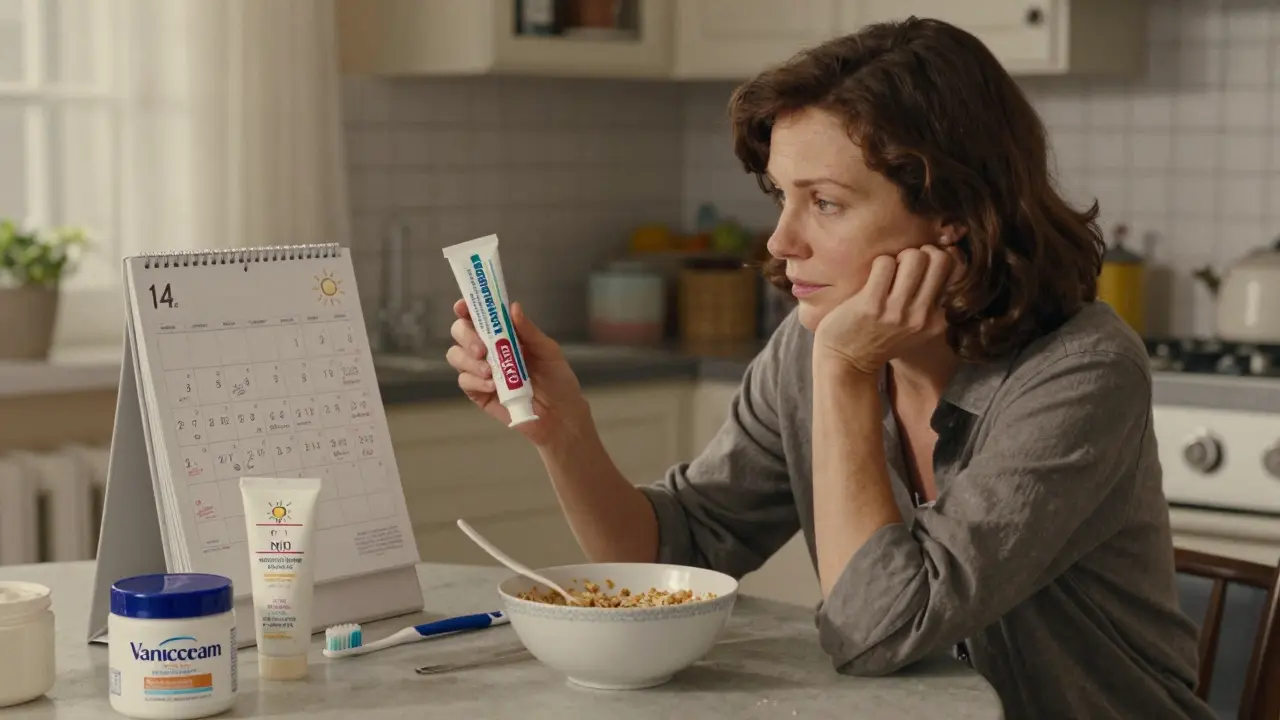
Surprisingly, your toothpaste might be the issue. Fluoridated toothpaste with sodium fluoride at 1,000-1,500 ppm causes reactions in 37% of people. The same goes for chewing gum and dental fillings, which trigger symptoms in 19% and 12% of cases, respectively. If you’ve tried everything else and the rash won’t go away, check your oral care routine.
Hormones play a role too. About 55% of women notice their rash gets worse before their period, and 72% report premenstrual flare-ups. Oral contraceptives are linked to 28% of hormonal triggers. Sun and wind make it worse for 63% and 41% of people, respectively. Even stress and heat can push the rash into overdrive.
What Gentle Skin Care Actually Means
"Gentle" doesn’t mean using "natural" or "hypoallergenic" products off the shelf. It means stripping everything back to the bare minimum and choosing only what’s proven not to irritate.
First, stop all topical steroids-even if your skin gets worse for a week or two. That initial flare is normal. It’s your skin reacting to being freed from dependency. Around 75% of people see symptoms get worse before they improve, usually within 7 to 14 days.
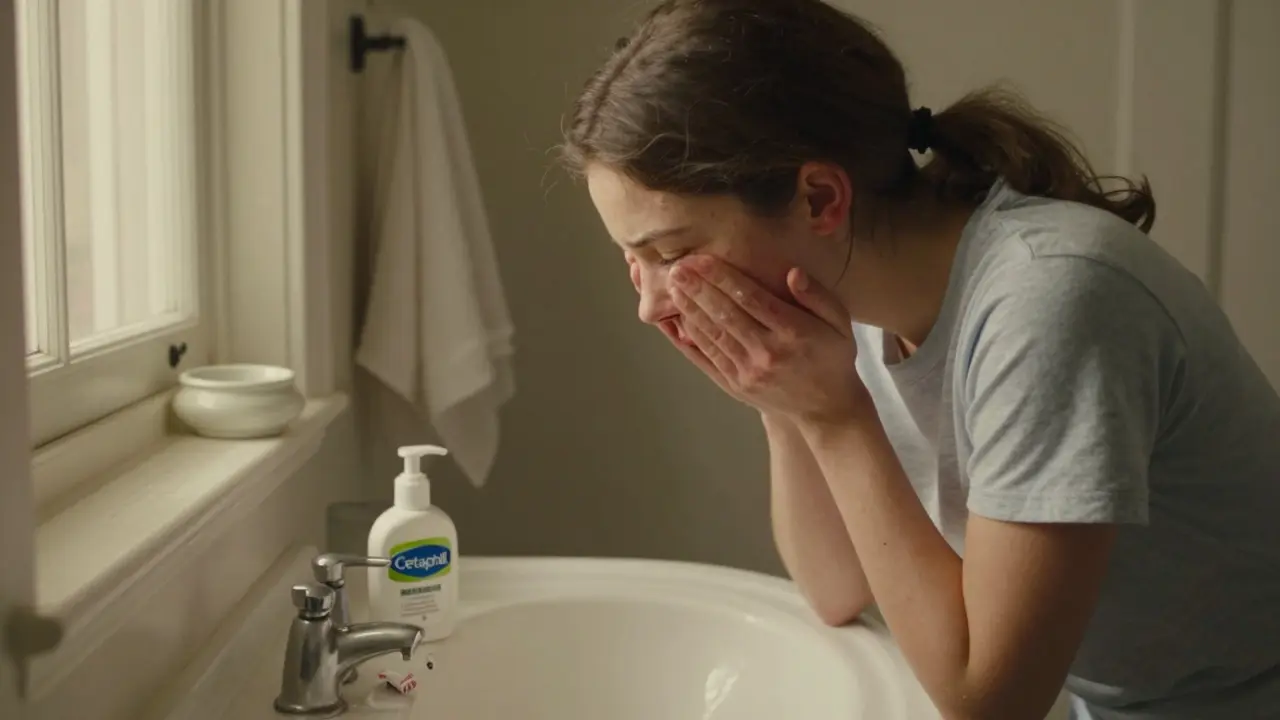
Wash your face only once a day, preferably at night. Use a non-foaming cleanser with a pH between 5.5 and 6.5. Foaming cleansers, even gentle ones, strip your skin’s barrier. Avoid anything with sulfates, alcohol, or acids. Cetaphil Gentle Skin Cleanser is one of the most recommended options because it’s simple and doesn’t foam.
Moisturize sparingly. Skip thick creams. Look for lightweight lotions with ceramides between 0.5% and 2%, and hyaluronic acid under 1%. Avoid anything with petrolatum, mineral oil, or silicones. Vanicream Moisturizing Cream is a common pick because it’s free of dyes, fragrances, and common irritants.
Sunscreen is tricky. Most mineral sunscreens are too heavy. Go for a liquid or gel formula with zinc oxide under 5%. EltaMD UV Clear Broad-Spectrum SPF 46 (with 4.7% zinc oxide) is frequently cited in patient forums as a winner. But even then, some people still react. If sunscreen triggers your skin, try a wide-brimmed hat instead.
What to Avoid in Makeup and Skincare
Makeup isn’t off-limits, but you need to be picky. Avoid anything labeled "comedogenic" or that contains isopropyl myristate above 0.5%. Foundations with titanium dioxide over 3% can cause problems. Stick to tinted moisturizers or sheer mineral powders that are fragrance-free and labeled "non-comedogenic."
Never use exfoliants. That means no scrubs, no AHAs, no BHAs, no retinoids. Your skin barrier is already damaged. Adding acids or physical scrubbing will make it worse. Same goes for essential oils, witch hazel, and toners-even those marketed as "alcohol-free."
Even products labeled "for sensitive skin" can be dangerous. Many still contain hidden irritants. Read the ingredient list. If you don’t recognize it, or if it ends in "-ate," "-ide," or "-ol," be cautious.
Toothpaste and Oral Care Changes
Switch to a non-fluoridated toothpaste. Look for brands that use calcium carbonate or silica as abrasives instead of sodium fluoride. Avoid toothpaste with sodium lauryl sulfate (SLS)-it’s a foaming agent that irritates the skin around your mouth. SLS levels should be under 0.1%.
Some people report improvement just from changing toothpaste. In Dr. Dropin’s 2023 clinical data, 62% of patients with toothpaste-triggered dermatitis saw their rash clear up in 4 to 6 weeks after switching. Don’t overlook this step-it’s simple, cheap, and often overlooked.
Medical Treatments That Work
While gentle skin care is the foundation, medical treatments can speed things up.
Topical metronidazole 0.75% gel works for 70% of people after 8 weeks of twice-daily use. It’s applied like a moisturizer and rarely causes side effects. Pimecrolimus 1% cream is another option-it’s not an antibiotic, so it’s safer for long-term use and helps 65% of patients with fewer risks.
For moderate to severe cases, oral antibiotics are used. But not the old-school high-dose ones. The modern approach uses low-dose doxycycline-40mg modified-release-taken once daily. It clears 85% of cases in 12 weeks, with only 12% of users reporting stomach upset. Compare that to the old 100mg dose, which caused side effects in nearly half of patients.
Treatment usually takes 6 to 12 weeks. Stopping too early? That’s why 40% of cases come back. Stick with it. Even if your skin looks better at week 6, keep going.

Diet, Microbes, and Controversies
Some people swear by gluten-free diets. In Dr. Dropin’s case series, 43% of patients with confirmed gluten sensitivity saw their rash disappear after cutting out gluten. But Cleveland Clinic says diet changes only help 12% of people overall-so it’s not a universal fix. If you suspect food is involved, talk to a doctor about testing before going on a restrictive diet.
Demodex mites are found in 83% of perioral dermatitis cases, compared to 45% in people without the rash. But no one’s sure if the mites cause the rash or just live in the same irritated environment. Treatments targeting mites (like ivermectin cream) are being studied, but aren’t yet standard.
There’s also disagreement among doctors. The American Academy of Dermatology recommends 8-12 weeks of antibiotics. The European Dermatology Forum says 6 weeks is enough to avoid resistance. Both sides have data. Your doctor should tailor the plan to your case.
Real Stories, Real Results
On Reddit’s r/SkincareAddiction, users consistently report that the hardest part is the first 2-3 weeks after quitting steroids. One user wrote: "It looked like I had a bad sunburn. I cried every morning. But by day 18, the redness started fading. Now, 3 months later, my skin is clearer than it’s been since I was 16."
The most common successful routine? Cetaphil cleanser, Vanicream moisturizer, EltaMD SPF. Only three products. No makeup. No toners. No serums. Just enough to protect and hydrate without irritating.
One of the biggest mistakes? Using "facial" steroid creams without realizing. Hydrocortisone 1% is sold over the counter. People use it for "dryness" or "itching"-not knowing it’s making things worse. About 72% of users in forums admitted they used it for more than two weeks before figuring it out.
What to Expect and How to Stay on Track
Healing takes time. Don’t expect overnight results. The first two weeks are the toughest. Your skin might feel tight, raw, or more inflamed. That’s not failure-it’s part of the process.
Keep a simple routine: one cleanser, one moisturizer, one sunscreen. Write down everything you put on your face. If you introduce something new, wait two weeks before deciding if it helped or hurt.
Track your symptoms. Note if your rash flares after eating gluten, using a new toothpaste, or being out in the sun. Patterns emerge over time.
And remember: this isn’t a cosmetic issue. It’s a medical condition that responds well to the right approach. Eighty-five percent of patients report major quality-of-life improvements after 12 weeks of proper care. You can get there too.
matthew martin
January 28, 2026 AT 05:40Turns out my toothpaste was the silent killer. Switched to Tom’s of Maine without fluoride and boom-no more red ring around my mouth. Who knew?
Jeffrey Carroll
January 28, 2026 AT 20:54doug b
January 30, 2026 AT 16:19Rose Palmer
February 1, 2026 AT 06:56Timothy Davis
February 1, 2026 AT 13:49John Rose
February 1, 2026 AT 18:55Amber Daugs
February 2, 2026 AT 01:41Ambrose Curtis
February 3, 2026 AT 21:49Robert Cardoso
February 4, 2026 AT 09:31jonathan soba
February 5, 2026 AT 06:52Katie Mccreary
February 5, 2026 AT 23:01SRI GUNTORO
February 6, 2026 AT 21:48Kevin Kennett
February 7, 2026 AT 16:34Jess Bevis
February 9, 2026 AT 04:00Howard Esakov
February 9, 2026 AT 13:50