
Probiotics and Immunosuppressants: Infection Risks and Clinical Guidance
 Feb, 27 2026
When you're taking immunosuppressants - whether after a transplant, for autoimmune disease, or during chemotherapy - your body is already walking a tightrope. Your immune system is turned down on purpose to stop it from attacking your new organ or your own tissues. But that same weakened defense makes you vulnerable to things most people brush off: a common cold, a stomach bug, or even a probiotic supplement.
Probiotics are often marketed as harmless, even helpful. They’re in yogurt, capsules, powders - sold as a way to improve digestion, boost immunity, or calm your gut. But for someone on immunosuppressants, "beneficial" doesn’t mean "safe." In fact, in some cases, probiotics can trigger life-threatening infections. This isn’t theoretical. It’s documented in hospital records, medical journals, and patient case reports. And the risk isn’t the same for everyone. It depends on what drug you’re taking, how weak your immune system is, and which strain of probiotic you’re using.
How Probiotics Can Turn Dangerous
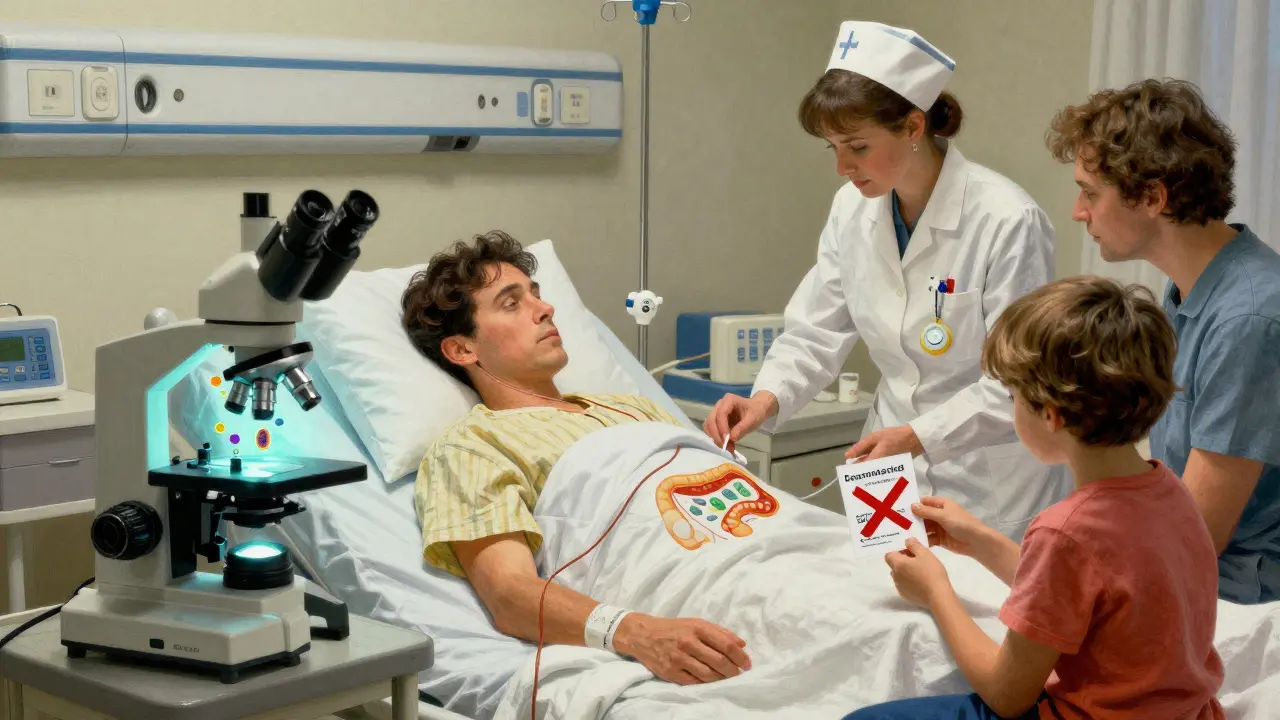
Probiotics aren’t magic pills. They’re live microbes - mostly bacteria like Lactobacillus and Bifidobacterium, or yeast like Saccharomyces boulardii. In healthy people, these organisms stay in the gut, help crowd out bad bacteria, and even train the immune system. But in someone with a suppressed immune system, that barrier can break. The gut lining, already stressed by disease or drugs, can let these microbes slip into the bloodstream. Once there, they find a perfect environment: no competition, plenty of nutrients, and no immune soldiers to stop them.
That’s when infections happen. Lactobacillus rhamnosus GG, one of the most common strains, has caused bloodstream infections in transplant patients. Saccharomyces boulardii, the yeast in many probiotic products, has led to fungal infections in the blood - a condition called fungemia. One 2018 review found that 22% of patients who developed S. boulardii fungemia didn’t survive. That’s not rare. Between 2000 and 2020, 47 cases of probiotic-related infections were recorded, and 83% of those patients were immunosuppressed. Over a third of those cases were fatal.
Who’s at the Highest Risk?
Not all immunosuppressed patients face the same danger. Risk varies wildly based on your condition and treatment.
- Stem cell transplant patients: Their immune systems are wiped out and rebuilt over months. During that time, even harmless microbes can cause sepsis. Studies show a 4.2-fold increase in probiotic-related bacteremia compared to non-users.
- Patients with central lines: If you have a catheter in your vein for IV meds or nutrition, S. boulardii can cling to it and grow. One study found a 27% higher risk of catheter-related bloodstream infections when using yeast-based probiotics.
- Neutropenic patients: If your neutrophil count drops below 500 cells/µL - common during chemotherapy - your body can’t fight off even small numbers of microbes. Eighty-seven percent of U.S. cancer centers advise against probiotics during this time.
- Early post-transplant: The first three months after a liver, kidney, or heart transplant are when immunosuppression is strongest. In this window, probiotics are not recommended.
On the other hand, some groups have lower risk. HIV patients with CD4 counts above 200 have shown minimal risk in studies. Liver transplant patients, surprisingly, may actually benefit - one 2022 analysis found probiotics reduced bacterial infections by 34% without increasing serious side effects. But even here, caution is needed. The strain matters. The dose matters. The timing matters.
Strain-Specific Risks: Not All Probiotics Are Created Equal
When you buy a probiotic, the label might say "Lactobacillus" or "Bifidobacterium." But that’s not enough. There are hundreds of strains within those genera, and their safety profiles differ drastically.
For example:
- Lactobacillus rhamnosus GG (ATCC 53103): The most studied, but also the most common cause of probiotic-related infections. Responsible for 28 of 47 documented cases between 2000-2020.
- Saccharomyces boulardii: The yeast strain. Highest risk for fungemia, especially with central lines. Now requires a FDA warning label.
- Bifidobacterium longum: Less commonly linked to infection, but data is limited.
Multi-strain products are riskier. A 2022 study found single-strain probiotics had 63% lower translocation risk than blends. Why? More strains mean more chances for one to cross the gut barrier. And if you’re on immunosuppressants, you don’t need extra variables.
What Do Experts Actually Recommend?
There’s no one-size-fits-all answer. But major medical groups have issued clear guidance:
- Infectious Diseases Society of America (IDSA) 2023: Uses a four-tier risk system. Category 1 (neutropenia, stem cell transplant, central lines) = absolute no-go. Category 2 (recent transplant, multiple immunosuppressants) = only use with infectious disease specialist approval. Category 3 (stable autoimmune disease on one drug) = possible with strain-specific caution. Category 4 (no immunosuppression) = fine.
- European Society for Clinical Nutrition and Metabolism (ESPEN) 2022: Strongly recommends against probiotics in critically ill immunocompromised patients.
- American Gastroenterological Association (AGA) 2021: Only conditionally recommends specific strains for liver disease (hepatic encephalopathy), not general immune support.
- ESPGHAN 2024: Updated pediatric guidelines to warn against probiotics in children on biologic immunosuppressants for IBD - 78% of pediatric probiotic infections occurred in this group.
Even among experts, there’s debate. Some say avoid all probiotics. Others argue for careful, strain-specific use in low-risk patients. The key is personalization. What’s safe for someone on methotrexate for rheumatoid arthritis might be dangerous for someone on tacrolimus after a lung transplant.

What Should You Do?
If you’re on immunosuppressants and thinking about probiotics, here’s what to do:
- Don’t start without talking to your doctor. Never self-prescribe. Even if your pharmacist says it’s "safe," your immune status is unique.
- Know your drug and your numbers. Are you on a single drug or multiple? What’s your absolute neutrophil count? CD4 count? When was your transplant? These numbers decide your risk level.
- Ask for the exact strain. If your doctor approves probiotics, insist on knowing the strain name (e.g., Lactobacillus rhamnosus GG ATCC 53103), not just the brand. Avoid multi-strain blends.
- Watch for fever. If you develop a temperature above 38.3°C (101°F) after starting a probiotic, stop it immediately and get blood cultures. Infection can develop fast.
- Consider alternatives. New research is looking at "postbiotics" - inactivated microbial cells and their metabolites. Early trials show they reduce infections like C. diff without the risk of live microbes. They’re not widely available yet, but they’re the future.
The Bigger Picture: Why This Isn’t Just About Supplements
Probiotics are a $52 billion global industry. Most are sold as dietary supplements - meaning the FDA doesn’t test them for safety in sick people before they hit shelves. That’s why you see products claiming to "boost immunity" on store shelves while hospitals warn patients to avoid them.
And insurance won’t cover most of them. Medicare only covers one prescription probiotic, VSL#3, for a very specific condition (pouchitis). The rest cost $38.50 a month on average. You’re paying out of pocket for something that could put you in the ICU.
Meanwhile, research is moving forward. The PROTECT registry, launched in 2023, is tracking 5,000 immunosuppressed patients across 47 centers. Its goal: build real-world data to tell us exactly which patients, if any, can safely use which strains. Results are expected in 2025.
For now, the safest rule is simple: If your immune system is turned down, don’t introduce live microbes unless your care team specifically says so - and even then, only if the evidence supports it for your exact situation.
Can I take probiotics if I’m on prednisone?
It depends. Prednisone alone carries lower risk than combination immunosuppressants. If you’re on a low dose for a stable condition (like asthma or mild autoimmune disease), some doctors may allow a single-strain probiotic after checking your blood counts. But if you’re on prednisone with another drug like azathioprine or mycophenolate, avoid probiotics. Always consult your specialist.
Is yogurt with live cultures safe for immunosuppressed patients?
Yogurt with live cultures is generally considered low risk because the bacterial load is much lower than in supplements. However, if you’re severely immunosuppressed - for example, within 3 months of a transplant or with neutrophils under 500 - even yogurt should be avoided. Stick to pasteurized, probiotic-free options during high-risk periods.
What should I do if I already took a probiotic and feel sick?
Stop the probiotic immediately. If you have a fever, chills, nausea, or unexplained fatigue, seek medical care right away. Tell the provider you took a probiotic. Blood cultures and possibly imaging will be needed. Early detection saves lives - probiotic infections can progress from mild symptoms to sepsis in under 48 hours.
Are there probiotics that are proven safe for transplant patients?
No probiotic is universally proven safe for all transplant patients. However, liver transplant recipients in stable condition may benefit from specific strains like Lactobacillus plantarum 299v under medical supervision. No strain is recommended for bone marrow or early-stage solid organ transplants. Always rely on your transplant team’s advice - not marketing claims.
Why do some doctors say probiotics are okay while others say no?
It’s because the evidence is mixed and context-dependent. Some studies show benefit in liver transplant patients; others show harm in bone marrow recipients. Doctors who support probiotics often see them in patients who are stable and on single-drug therapy. Those who oppose them prioritize safety in high-risk groups. The key is individualized care - not blanket rules.
Aisling Maguire
February 28, 2026 AT 09:08So I just got off the phone with my transplant nurse and she basically said if I so much as glance at a probiotic yogurt, I’m basically signing up for a one-way ticket to ICU. Honestly? I’m relieved. I’ve been scrolling through Reddit like a fool thinking "maybe it’ll help my bloating" - turns out my gut’s not worth the risk. Thanks for laying this out so clearly.
Lisa Fremder
March 1, 2026 AT 07:51Probiotics are a scam sold to scared people by corporations that don’t care if you die as long as you buy another bottle. The FDA lets this trash fly under the radar because Big Health doesn’t want to regulate profit. I’ve seen people in my support group get sepsis from yogurt. It’s criminal.
Justin Ransburg
March 3, 2026 AT 01:40This is an incredibly important and well-researched piece. As a healthcare professional, I’ve seen firsthand how easily well-intentioned patients can be misled by marketing claims. The data here is not just alarming - it’s actionable. I’ve started sharing this with my immunocompromised patients, and the response has been overwhelmingly positive. Knowledge is power, and this is a vital resource.
Full Scale Webmaster
March 4, 2026 AT 04:05Let’s be real - this whole probiotic industry is built on the back of people who are desperate enough to believe that a $40 jar of powder is going to fix their immune system. And guess what? It doesn’t. It kills. The fact that Saccharomyces boulardii is still on shelves with zero warning labels beyond a tiny footnote? That’s not negligence - that’s corporate malice. I read about a guy who got fungemia from a probiotic he bought at Whole Foods. He died three days later. His family had no idea. The FDA should shut this down. Period. End of story. No more "natural" euphemisms. These are live pathogens being sold as wellness products. We’re not talking about kombucha here. We’re talking about microbial terrorism disguised as health.
Sophia Rafiq
March 4, 2026 AT 21:39My oncologist told me to avoid anything with live cultures after my chemo. I thought he was being overly cautious until I read this. Now I get it. Even yogurt’s a no-go if your neutrophils are below 500. I’m switching to pasteurized oat milk with no cultures. Postbiotics sound like the future though - wish they were available now. Also side note: why does every probiotic label say "supports immune health" when we know it’s basically a grenade in immunocompromised guts?
Martin Halpin
March 5, 2026 AT 19:16You’re all missing the point. The real issue isn’t probiotics - it’s that doctors are too scared to let patients make their own choices. I’m on tacrolimus after a kidney transplant, and I’ve been taking L. rhamnosus GG for two years. No issues. My CRP’s down. My gut’s happy. Why? Because I’m not a statistic. I’m a person. The studies say 83% of cases are fatal? Great. That means 17% survive. Maybe I’m one of them. You’re all so busy being scared you’re ignoring individual biology. My doctor says I’m fine. Why should I listen to some random internet article that says I’m not?
Charity Hanson
March 5, 2026 AT 19:40Y’all need to stop panicking. I’m from Nigeria and in my village, we’ve been eating fermented milk for generations - no probiotic pills, just good old fermented cow milk. My uncle had a transplant and he still drinks it. He’s 72 and still walking. Maybe it’s not the probiotic - maybe it’s the dose? The strain? The context? We need nuance, not fear.
Noah Cline
March 5, 2026 AT 21:10Probiotic-related fungemia is not a "risk" - it’s a predictable outcome of poor patient education and regulatory failure. The fact that multi-strain products are even sold without strain-specific contraindications is indefensible. Lactobacillus rhamnosus GG accounts for over 60% of documented cases - yet it’s still the #1 selling strain. This isn’t science. It’s negligence wrapped in a supplement label. If you’re immunosuppressed and you’re not demanding the ATCC number from your pharmacist, you’re not being proactive - you’re being reckless.
Sumit Mohan Saxena
March 7, 2026 AT 01:13It is imperative to underscore the clinical significance of strain-specific risk stratification in immunosuppressed populations. The existing evidence base, particularly from the PROTECT registry and IDSA guidelines, unequivocally supports a tiered, context-dependent approach. For instance, while Lactobacillus rhamnosus GG demonstrates a documented translocation risk in neutropenic and early post-transplant cohorts, Lactobacillus plantarum 299v has demonstrated a favorable safety profile in stable liver transplant recipients under controlled conditions. Therefore, blanket contraindications may inadvertently deprive low-risk individuals of potential benefits. The key lies in precise molecular identification of strains, rigorous monitoring of immune parameters (including absolute neutrophil count and CD4+ T-cell enumeration), and mandatory consultation with infectious disease specialists prior to initiation. Further, the emerging paradigm of postbiotics - defined as non-viable microbial components and metabolites - holds substantial promise for mitigating infection risk while preserving microbiome-modulating effects. Until regulatory frameworks evolve to mandate strain-specific labeling and clinical risk categorization, patient autonomy must be guided by institutional protocols, not commercial marketing.