
The Purple Book: Biosimilars and Interchangeability Explained
 Feb, 16 2026
Biosimilar Substitution Checker
Check Substitution Rules
See if your state allows substitution of interchangeable biosimilars without prescriber approval
Enter a biosimilar name and select your state to check substitution rules
The Purple Book is not a book you can hold in your hands. It’s a live, searchable database run by the U.S. Food and Drug Administration (FDA) that tells you exactly which biological drugs are approved, which ones are biosimilars, and which ones can be swapped out like generics. If you’re a pharmacist, a doctor, or even a patient trying to understand your treatment options, this tool is critical. It’s the official source for figuring out what can be substituted, what can’t, and why.
What Exactly Is the Purple Book?
The Purple Book started in 2010 as part of the Biologics Price Competition and Innovation Act (BPCIA). Before this law, there was no clear path for approving follow-on versions of complex biological drugs like Humira, Enbrel, or insulin. Unlike small-molecule drugs, which are chemically synthesized and easy to copy, biologics are made from living cells - think proteins, antibodies, or vaccines. Copying them isn’t as simple as making a pill version.
That’s where biosimilars come in. These are highly similar versions of brand-name biologics. They’re not exact copies - no one can make an exact copy of a living cell product - but they’re close enough that there’s no meaningful difference in safety or effectiveness. The Purple Book lists all of these approved products in one place.
In 2020, the FDA merged two separate lists into one searchable database. Before that, you had to check one list for drugs regulated by CDER and another for biologics from CBER. Now, everything’s in one place. You can search by brand name, active ingredient, or approval status. The results show you the reference product, its biosimilars, and any that are interchangeable.
Biosimilars vs. Interchangeable: What’s the Difference?
Not all biosimilars are created equal. Every interchangeable product is a biosimilar, but not every biosimilar is interchangeable. That’s the key point.
A biosimilar has been proven to be highly similar to the reference product. It matches in structure, function, and clinical outcomes. The FDA requires extensive lab testing, animal studies, and clinical trials to prove there are no meaningful differences in safety or effectiveness.
An interchangeable product goes further. To earn that designation, the manufacturer must show that switching between the biosimilar and the original product - multiple times, even back and forth - doesn’t increase risk or reduce effectiveness. That means if a patient uses the reference drug for a month, switches to the biosimilar for a month, then switches back, their response stays consistent. No drop in performance. No new side effects.
This is why interchangeability matters. It’s not about being better. It’s about being predictable. The FDA says interchangeable biosimilars are just as safe and effective as the original - even when you switch.
How the Purple Book Shows This Information
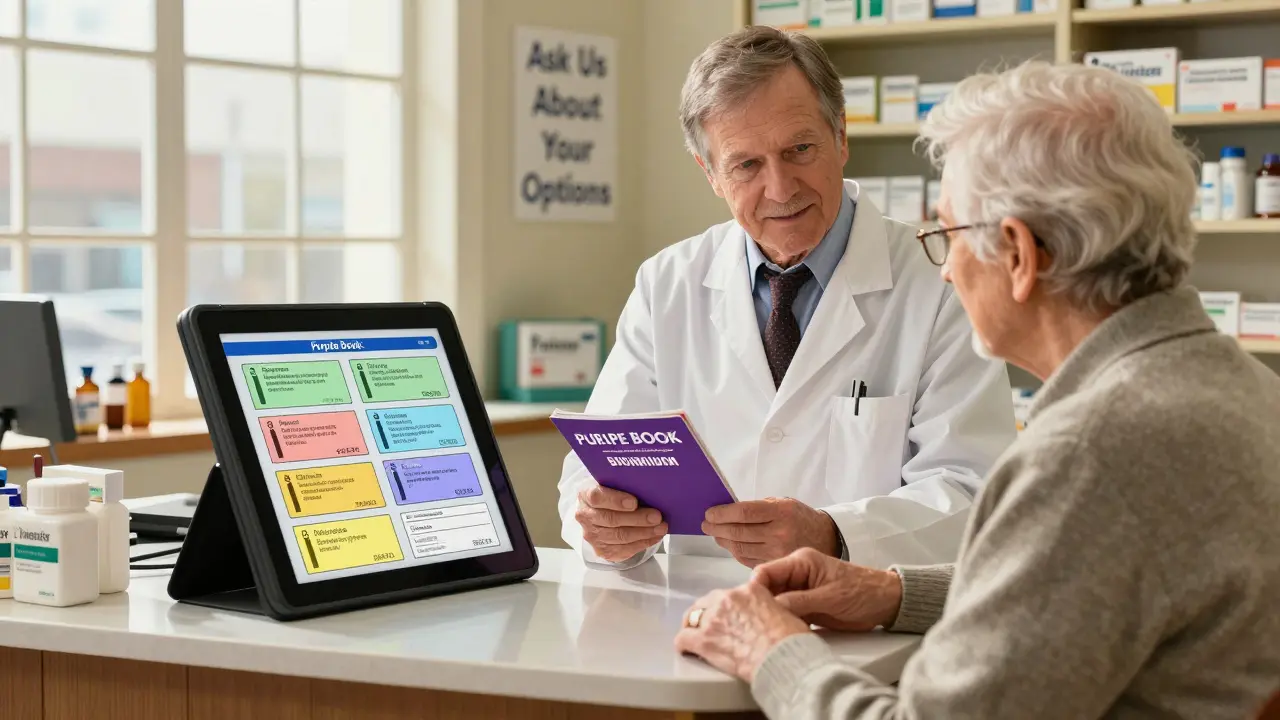
The Purple Book uses color-coded cards to make this easy. Each reference product has its own card. Underneath it, you’ll see cards for its biosimilars and interchangeable versions - all in matching colors. You can click on any card to see details like:
- When it was approved under section 351(a) of the Public Health Service Act
- Whether it’s a reference product, biosimilar, or interchangeable
- Whether it’s protected by exclusivity (meaning no biosimilar can be approved yet)
- What delivery method it uses - autoinjector, pre-filled syringe, IV bag
For example, if you search for adalimumab (the active ingredient in Humira), you’ll see the original product at the top. Below it, you’ll find multiple biosimilars like Amjevita, Cyltezo, and Hyrimoz. One of them - Amjevita - is marked as interchangeable. That means, under the right state laws, a pharmacist can swap it in without asking the doctor.

Why Interchangeability Isn’t Enough on Its Own
Just because the FDA says a product is interchangeable doesn’t mean a pharmacist can automatically swap it. Each state has its own rules.
As of 2023, 47 states and Puerto Rico allow pharmacists to substitute an interchangeable biosimilar without contacting the prescriber. But some states still require the doctor to approve the switch. Others require the patient to be notified in writing. A few even require the pharmacist to document the substitution in a special log.
This patchwork of rules creates confusion. A patient in Texas might get an interchangeable insulin without a problem. The same patient in New York might get the original brand because their state requires prescriber consent. The Purple Book tells you what the FDA says - but it doesn’t override state law.
It’s also important to know that the FDA doesn’t call interchangeable products “better.” They’re not more effective. They’re not safer. They’re just predictable when switched. The goal is cost savings and access - not superiority.
What Products Are Approved as Interchangeable?
As of late 2023, only seven biosimilars have received the interchangeable designation from the FDA. That number is growing, but slowly. Here’s what’s approved:
- Two insulin products - used for diabetes
- Three drugs for inflammatory conditions - like rheumatoid arthritis and Crohn’s disease
- Two treatments for eye conditions - used in retinal diseases
Most of these are for chronic conditions where patients stay on the drug for years. That’s why switching studies are so important - you can’t risk unpredictable responses in someone on long-term treatment.
The FDA continues to review new applications. Companies are pushing hard for interchangeability because it opens the door to automatic substitution - which means faster market entry and broader use. But the bar is high. Each application requires additional clinical data on multiple switches, which costs millions and takes years.
What the Purple Book Doesn’t Tell You
The Purple Book doesn’t cover unbranded biologics. These are products that are chemically identical to the reference product but were approved before the biosimilar pathway existed. The FDA considers them equivalent, but they’re not labeled as interchangeable. You won’t find them in the same section.
It also doesn’t list pricing. You can’t tell from the Purple Book how much a biosimilar costs compared to the brand. That info comes from pharmacies, insurers, and drug pricing databases.
And it doesn’t tell you which products are actually being used in clinics. Just because a biosimilar is approved doesn’t mean doctors are prescribing it. Some still prefer the original brand due to habit, patient preference, or lack of awareness.
Who Uses the Purple Book?
Pharmacists are the biggest users. When a prescription comes in for a biologic, they check the Purple Book to see if a biosimilar or interchangeable version is available - and whether their state allows substitution.
Prescribers use it too. When a patient asks if they can switch to a cheaper option, the doctor can look it up. Insurance companies use it to build formularies. Patient advocacy groups use it to explain treatment options.
Even manufacturers use it. If a company wants to develop a biosimilar, they need to know what’s already approved - and what’s protected by exclusivity. The Purple Book shows you exactly when the patent clock starts ticking.
What’s Next for the Purple Book?
The FDA is working on clearer labeling rules for biosimilars and interchangeable products. Right now, product names can be confusing. Some have similar names to the reference drug. The FDA is pushing for names that make it easier to track side effects and avoid mix-ups.
More interchangeable products are expected in 2025 and beyond. With insulin, autoimmune drugs, and cancer treatments on the horizon, the number of interchangeable options will likely double in the next two years.
But the biggest change won’t be in the database. It’ll be in how people use it. As awareness grows, so will substitution. The goal isn’t just to save money - it’s to make life-changing treatments more accessible to everyone.
Is the Purple Book only for U.S. patients?
Yes. The Purple Book is maintained by the U.S. FDA and only includes biological products approved in the United States. Other countries have their own databases - like the European Medicines Agency’s list of biosimilars - but the Purple Book is specific to U.S. regulations and pharmacy laws.
Can a pharmacist substitute a biosimilar without the doctor’s permission?
Only if the product is designated as interchangeable by the FDA AND your state allows substitution without prescriber approval. As of 2023, 47 states and Puerto Rico permit this. But in states like California or New York, the pharmacist may still need to notify or get consent from the prescriber. Always check your state’s pharmacy board rules.
Why aren’t more biosimilars interchangeable?
Because proving interchangeability requires extra clinical studies. Manufacturers must show that switching back and forth between the biosimilar and the original - multiple times - doesn’t change safety or effectiveness. These studies are expensive and take years. Many companies focus on just getting biosimilar approval first. Interchangeability is a second step - and not always worth the cost unless the market is big enough.
Does the Purple Book list generic versions of biologics?
No. Biologics can’t have generics the way small-molecule drugs do. Instead, they have biosimilars and interchangeable products. The term “generic” doesn’t apply because biologics are made from living cells, not chemicals. The Purple Book only lists products approved under the biosimilar pathway - never generics.
How often is the Purple Book updated?
The FDA updates the Purple Book weekly. New approvals, designations, and exclusivity changes are added as soon as they’re official. It’s a live database, not a static list. That means if a new interchangeable product is approved on a Monday, it’ll appear in the database by Friday.
Digital Raju Yadav
February 18, 2026 AT 06:28The FDA is just another tool of Western corporate control. This Purple Book nonsense? It's a distraction. Real medicine isn't regulated by databases - it's controlled by who owns the patents. India makes cheaper insulin that works better, but the US blocks it because they want you hooked on $1000 vials. This whole system is rigged to keep profits high and lives low.
Carrie Schluckbier
February 19, 2026 AT 06:15Did you know the Purple Book is secretly used by Big Pharma to track which biosimilars are getting traction? They use the data to sue competitors into oblivion. And those ‘interchangeable’ labels? Totally manufactured. I’ve seen internal memos - the FDA gets pressured to approve them so stock prices don’t crash. Wake up people. This isn’t healthcare. It’s financial engineering with syringes.
guy greenfeld
February 21, 2026 AT 02:05What if the Purple Book isn’t a tool at all - but a mirror? It reflects our society’s obsession with categorization. We want to label everything: biosimilar, interchangeable, reference - as if human biology can be neatly boxed into regulatory tiers. But life doesn’t work like that. A patient’s response isn’t determined by a checkbox on a government site. It’s shaped by sleep, stress, diet, trauma, and hope. We’ve outsourced empathy to a database. And now we wonder why people feel more alone than ever.
PRITAM BIJAPUR
February 22, 2026 AT 14:19Finally! A clear resource! 🙌 The Purple Book is a game-changer - especially for patients in rural areas who can’t afford brand-name biologics. I’ve personally helped three family members switch to interchangeable biosimilars - saved them over $8K/year. 💸 The FDA did something right for once. Let’s not overcomplicate it. This isn’t just data - it’s dignity. And yes, I used emojis because feelings matter too. ❤️🩹
Tony Shuman
February 24, 2026 AT 02:52Interchangeable? Please. If it were truly interchangeable, why do 80% of docs still prescribe the original? Because they know the biosimilars are different - just not enough to get sued. The FDA doesn’t care about outcomes. They care about paperwork. This whole system is a PR stunt. They slap a label on it, call it ‘interchangeable,’ and pretend the problem’s solved. Meanwhile, patients are guinea pigs in a cost-cutting experiment.
John Haberstroh
February 24, 2026 AT 07:59Love how the Purple Book uses color-coded cards. It’s like a medical version of Pokémon Go - find all the biosimilars, catch the interchangeable ones. 😄 Honestly though, it’s weirdly satisfying to see how many options there are now. I used to think biologics were these untouchable magic potions - now I see them as just… products. And products can be improved. Replaced. Challenged. That’s kinda beautiful.
Jonathan Ruth
February 24, 2026 AT 18:45So the purple book is just for the us right well duh what did you expect it to be a global thing the eu has its own thing china has its own and india just prints generics and calls it a day lol
Philip Blankenship
February 25, 2026 AT 00:47Just wanted to say thanks for this breakdown. I’m a nurse in Ohio and I use the Purple Book every day. My patients appreciate knowing they can save money without losing efficacy. One lady told me she switched from Humira to Cyltezo and now she’s able to take her grandkid to soccer practice again. That’s what this is really about - not politics, not patents - just people getting better. Keep sharing stuff like this.
Oliver Calvert
February 26, 2026 AT 04:43One thing missing from the Purple Book is the real-world data on switching outcomes. The FDA requires clinical trials but doesn’t mandate post-market surveillance tracking. If we had that, we’d know if patients on long-term biosimilars have higher hospitalization rates or not. Right now, we’re flying blind. Someone needs to push for that.
Kancharla Pavan
February 27, 2026 AT 15:47How can you possibly trust a system that lets a corporation like AbbVie monopolize a drug for 12 years before allowing biosimilars? The Purple Book is just a Band-Aid on a gaping wound. The real problem is patent trolling, regulatory capture, and the moral bankruptcy of a system that lets life-saving drugs cost more than a car. You think this database is helping? It’s just making us feel better while they keep stealing from the sick.
Logan Hawker
February 27, 2026 AT 18:07Let’s be real - the Purple Book is a performative transparency exercise. The FDA doesn’t have the bandwidth to audit every biosimilar’s manufacturing process. They rely on corporate self-reporting. And let’s not forget: the same consultants who help design the approval criteria also consult for the companies applying. It’s a closed loop of regulatory theater. The ‘interchangeable’ designation? It’s a marketing tier, not a clinical one.
James Lloyd
February 27, 2026 AT 20:30Great summary. One thing I’d add: the Purple Book’s weekly updates are actually a huge win for transparency. Most regulatory databases update quarterly - sometimes annually. The fact that new approvals show up within days means prescribers and pharmacists can respond in real time. That’s rare in government systems. It’s not perfect, but it’s one of the few public health tools that actually works as intended.
Adam Short
March 1, 2026 AT 08:50Why does the US even have this? In the UK, we just use the BNF. Simple. Clear. No color-coded cards. No ‘interchangeable’ nonsense. Just: is it approved? Yes? Then prescribe it. We don’t need a whole damn website to tell us what’s safe. This feels like American over-engineering at its finest.
Sam Pearlman
March 3, 2026 AT 02:28Wait - so if a biosimilar is interchangeable, but my state says I need the doctor’s permission… does that mean the FDA is lying? Or is the state? Or am I just a pawn in a bureaucratic war? I feel like I’m in a Kafka novel and my insulin is the trial.