
When to Give Fever Reducers After Your Child's Vaccines
 Jan, 15 2026
It’s normal to feel worried when your baby gets a fever after a vaccine. You want to help them feel better-fast. But giving fever reducers too soon might actually make the vaccine less effective. This isn’t just a theory. It’s backed by real studies, and major health groups like the CDC and the American Academy of Pediatrics now agree: don’t give fever reducers before or right after vaccines.
Why Fever After Vaccines Isn’t Always Bad
Fever is your child’s body doing exactly what it’s supposed to do: responding to the vaccine. Vaccines work by introducing a harmless piece of a virus or bacteria. Your child’s immune system sees it as a threat and starts building defenses. That process can raise body temperature. It’s not a sign something’s wrong-it’s a sign it’s working. Most vaccines cause fever in about 1 in 3 to 1 in 4 babies. Prevnar 13, for example, leads to fever in 24-35 out of every 100 infants. Pediarix (which combines DTaP, IPV, and HepB) causes fever in 28-39 out of 100. The MenB vaccine is even more likely to cause fever, which is why the UK’s NHS recommends giving paracetamol after this one specifically. Fever usually starts within 12 hours and lasts 1-2 days. Temperatures between 100°F and 102°F (37.8°C-39°C) are common and don’t need treatment. The real concern is when it hits 102°F or higher. That’s when you might consider medication-not before.The Problem with Giving Fever Reducers Too Early
In the early 2000s, many parents were told to give acetaminophen (Tylenol) right after vaccines to prevent fever. It made sense: less discomfort, fewer sleepless nights. But research changed everything. A landmark 2009 study in The Lancet showed that giving fever reducers before or right after vaccines reduced antibody levels. Follow-up studies confirmed it. One 2016 Polish study compared two groups: one got acetaminophen or ibuprofen at the time of vaccination and then again at 6 and 12 hours. The other group only got medicine if fever developed after 6-8 hours. The result? The group that got medicine right away had significantly lower antibody responses to multiple vaccine components-including pneumococcal, Hib, and tetanus antigens. The group that waited? No drop in immunity. The key window? Wait at least 4 hours after vaccination before giving any fever reducer. Studies show that giving medicine after this window doesn’t interfere with the immune response. That’s why experts now say: wait and see.When It’s Okay to Give Fever Medicine
You’re not supposed to just let your child suffer. If your baby is fussy, crying nonstop, has a temperature over 102°F (39°C), or is having trouble sleeping or eating, then yes-give medicine. Here’s what works:- Acetaminophen (Tylenol): Safe for babies over 12 weeks old. Dose: 1.25 mL for infants 6-11 months (18-23 lbs). Give every 4-6 hours, no more than 4 doses in 24 hours.
- Ibuprofen (Advil, Motrin): Only for babies over 6 months old. Dose: 2.5 mL for infants 6-11 months (18-23 lbs). Give every 6-8 hours, no more than 4 doses in 24 hours.

The One Big Exception: MenB Vaccine
Not all vaccines are the same. The MenB vaccine causes high fevers in up to 50% of babies. Because of this, the UK’s NHS recommends giving liquid paracetamol after the 8-week and 16-week MenB shots-not before, but right after. They suggest:- Give 2.5 mL (15 mg/kg) of paracetamol right after the shot
- Repeat every 4-6 hours for up to 3 doses
What to Do Instead of Medication
You don’t need pills to help your child feel better. Sometimes, simple things work best:- Keep them hydrated: Offer breast milk, formula, or water (if over 6 months). Dehydration makes fever feel worse.
- Dress lightly: Don’t bundle them up. Overheating traps heat and makes fever climb higher.
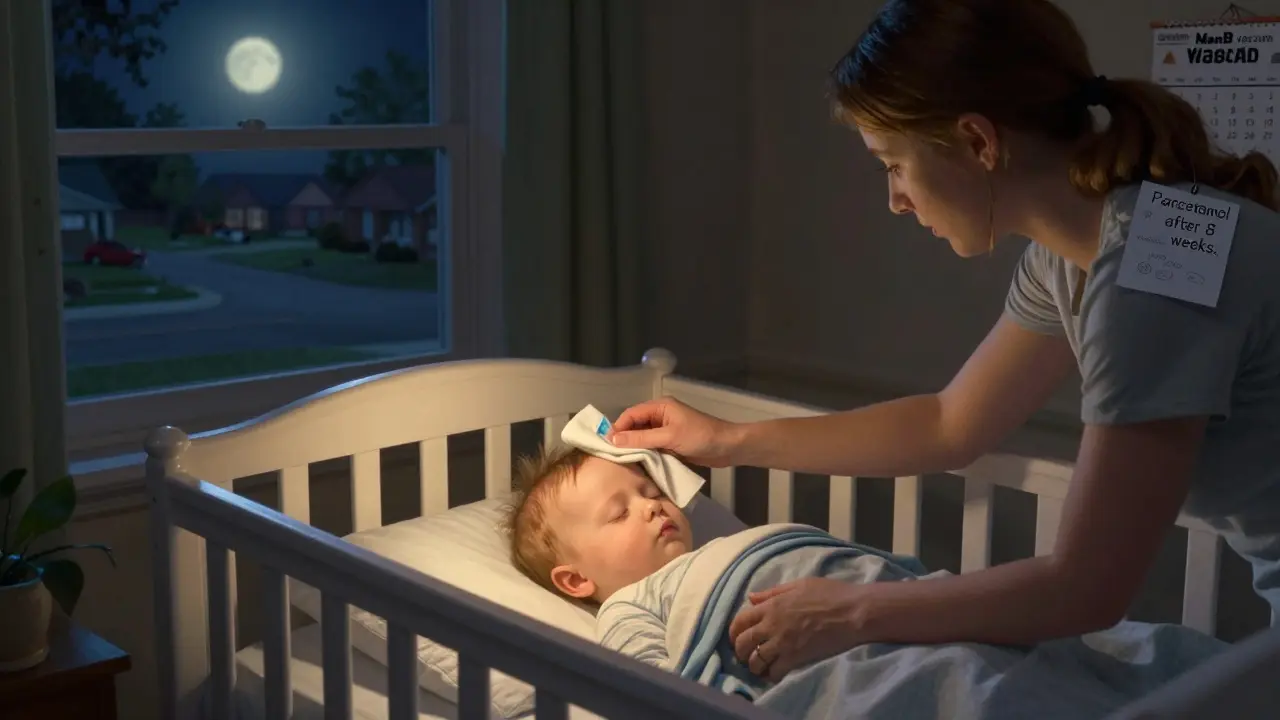
- Use a lukewarm sponge: Not cold water-just a damp cloth on the forehead or back of the neck. Cold baths can cause shivering, which raises body temperature.
- Let them rest: Sleep helps the immune system do its job.
- Monitor closely: Check their temperature every few hours. Watch for signs of dehydration (dry mouth, no wet diaper in 6+ hours) or unusual sleepiness.
What About If My Child Already Has a Fever Before the Vaccine?
If your child has a mild fever (under 101°F) or a cold, cough, or runny nose, they can still get vaccinated. The CDC says mild illnesses don’t reduce how well vaccines work. But if they have a high fever (102°F or above), it’s best to wait. Not because the vaccine won’t work-but because it’s harder to tell if the fever is from the illness or the vaccine. It’s safer to wait until they’re back to baseline.When to Call the Doctor
Most post-vaccine fevers are harmless. But call your pediatrician if:- Your baby is under 12 weeks old and has any fever (even 100.4°F)
- Fever lasts more than 48 hours
- Your child is lethargic, won’t drink, or has a rash
- They have a seizure (febrile convulsion)
- You’re just not sure
The Bottom Line
You don’t need to give fever medicine after every vaccine. Most kids do fine without it. Waiting 4 hours gives their immune system the time it needs to respond properly. If fever hits 102°F or higher, or your child is clearly uncomfortable, then it’s time to reach for Tylenol or Motrin-following the right dose and timing. The goal isn’t to prevent fever. It’s to protect your child’s health-both from disease and from unnecessary medication. Vaccines work. Your child’s body knows how to handle them. Sometimes, the best thing you can do is just wait-and watch.Can I give my baby Tylenol before their vaccines to prevent fever?
No. Giving acetaminophen or ibuprofen before vaccines can reduce the immune response. Studies show lower antibody levels when these medications are given right before or right after vaccination. Wait at least 4 hours after the shot before giving fever medicine.
Is it safe to give ibuprofen after vaccines?
Yes, but only if your child is over 6 months old. Ibuprofen is safe and effective for fever after vaccines when given at the correct weight-based dose. Don’t use it in babies under 6 months unless directed by a doctor. Always wait at least 4 hours after vaccination before giving it.
How long does vaccine fever usually last?
Most vaccine-related fevers last 1 to 2 days. They typically start within 12 hours of the shot and go away on their own. If fever lasts longer than 48 hours or keeps coming back, contact your pediatrician.
Should I give fever medicine if my child’s temperature is 101°F?
Not necessarily. A temperature between 100°F and 102°F is common after vaccines and doesn’t require medication. Focus on keeping your child comfortable with hydration and light clothing. Only use fever reducers if they’re uncomfortable, irritable, or have a fever over 102°F.
Why does the NHS recommend paracetamol after MenB but not other vaccines?
The MenB vaccine causes high fevers in up to half of babies, sometimes above 104°F, which increases the risk of febrile seizures. The NHS recommends giving paracetamol after this vaccine specifically to reduce that risk. For other vaccines, the fever is usually mild and the immune response is more important than comfort.
Can my child get vaccines if they’re already running a fever?
Yes-if the fever is mild (under 101°F) and they don’t look seriously ill. Colds, runny noses, and low-grade fevers don’t interfere with vaccine effectiveness. But if they have a high fever (102°F or above), wait until they’re better to avoid confusion about what’s causing the symptoms.
What if I accidentally gave Tylenol right after the vaccine?
Don’t panic. One dose right after vaccination is unlikely to completely block the immune response. Most children still develop good protection. But don’t repeat it. Going forward, wait at least 4 hours after vaccines before giving fever medicine.
Joie Cregin
January 16, 2026 AT 14:16My little one got her 12-month shots last week and spiked a fever right after. I held off on Tylenol like you said and honestly? She was just cuddly and sleepy. Like a tiny sleepy dragon. We rocked it out with extra snuggles and cool washcloths. No meds needed. Her immune system knew what it was doing 😌
Melodie Lesesne
January 16, 2026 AT 18:47So glad this got shared. I used to panic every time my kid hit 100.5°F after vaccines. Now I just whisper 'good job body' and hand her a sippy cup. The science makes so much sense-let the little warrior do its thing.
Corey Sawchuk
January 17, 2026 AT 01:59Wait 4 hours. That’s it. No more preemptive Tylenol. I used to give it before like a good parent. Turns out I was just dumb. Now I just watch and wait. Works fine. Kids don’t need to be medicated into calmness every time they breathe wrong
Stephen Tulloch
January 17, 2026 AT 10:03LMAO at all the parents who still give Tylenol before shots like it’s a ritual. 🤦♂️ You’re not protecting your kid-you’re sabotaging their immune training. The CDC and AAP aren’t conspiracy bots. They’re scientists. And your kid’s antibodies are counting on you not being a panic-bot. Stop the nonsense. 🧬
Henry Ip
January 17, 2026 AT 10:26This is the kind of info I wish I’d had with my first. I gave Motrin right after my daughter’s shots three times before I learned better. She’s fine now, but I wish I’d known the science earlier. Thanks for laying it out so clearly. Really helpful.
Kasey Summerer
January 19, 2026 AT 09:37Of course the UK recommends paracetamol after MenB. They’ve got NHS doctors who actually read studies. Meanwhile in the US we’re still arguing over whether vaccines cause autism like it’s 2008. 😅
Cheryl Griffith
January 20, 2026 AT 19:02I remember the first time my son got a fever after vaccines and I didn’t give him anything. I was terrified. But he slept through the night, woke up smiling, and I realized-fever isn’t the enemy. Fear is. Letting go of the need to ‘fix’ everything was the real breakthrough.
brooke wright
January 20, 2026 AT 21:29Wait so if I gave Tylenol 2 hours after the shot does that mean my kid is immune compromised now?? I’m so scared. I need to know if this is permanent. I’ve been googling for 3 hours. HELP.
Nick Cole
January 22, 2026 AT 20:42That’s the problem with modern parenting-we treat every minor symptom like a crisis. Fever is a sign of strength, not weakness. Stop medicating everything. Let their bodies do what they’re built to do. You’re not failing if they’re a little warm.
Isabella Reid
January 23, 2026 AT 19:27Love that the MenB exception is called out. It’s the only vaccine I’ve ever given paracetamol after-my daughter had a seizure scare at 104°F. The NHS got it right. But for everything else? I’m all in on the wait-and-watch. Trust the process.
Ryan Hutchison
January 25, 2026 AT 18:27Canada and the UK are telling us how to parent now? We don’t need their advice. In America we know best. We don’t need some foreign health agency telling us when to give Tylenol. We’ve got our own doctors here. And they know better.
evelyn wellding
January 25, 2026 AT 22:51YESSSSS this is everything!! 🙌 My baby got her 6-month shots and I didn’t give a single drop of Tylenol. She slept like a champ, woke up giggling, and I felt like a superhero. You’re not a bad mom if you don’t medicate. You’re a wise one 💪❤️
Chelsea Harton
January 27, 2026 AT 15:03fever = body working. meds = body confused. just let it happen. trust the process. its not about comfort its about immunity. i dont know why people dont get this