
Pharmacy Margin Economics: How Generics Drive Profits in Today's Drug Market
 Mar, 23 2026
Most people assume pharmacies make the most money off expensive brand-name drugs. That’s a myth. The truth? Pharmacies make nearly all their profit from generic drugs-the cheap, no-name pills that make up 90% of all prescriptions filled in the U.S. But here’s the twist: even though generics account for only about 25% of total drug spending, they generate over 96% of a pharmacy’s profit. How? It’s not about price. It’s about margins, structure, and who controls the system.
Why Generics Are the Real Profit Engine
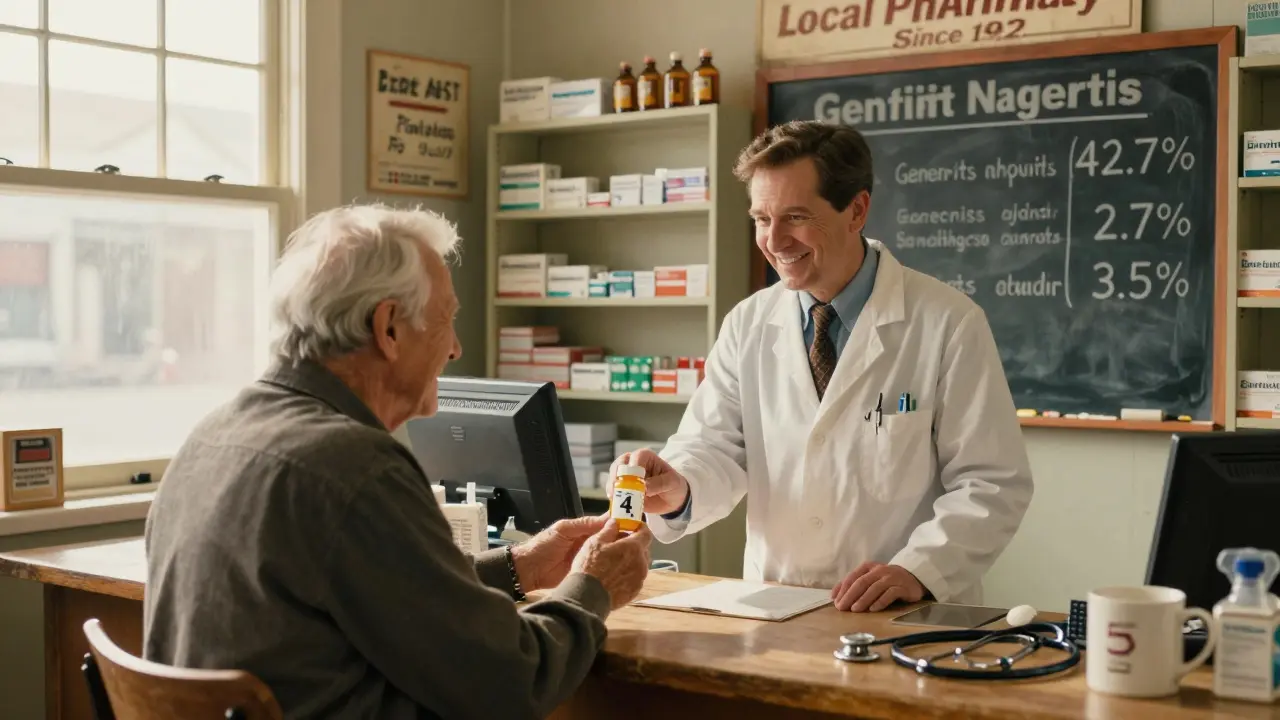
Generic drugs cost pennies to make. A 30-day supply of metformin might cost a manufacturer 15 cents. Yet, when you pick it up at your local pharmacy, you pay $4 or $10. That’s not because the pharmacy is marking it up wildly-it’s because the system is built this way. The gross margin on generics averages 42.7%, according to the Schaeffer Center’s 2022 analysis. Compare that to brand-name drugs, where gross margins for pharmacies are just 3.5%. That’s a 12x difference.Here’s the breakdown: for every $100 spent on a generic drug, the pharmacy walks away with about $32 in gross profit. For a brand-name drug? Just $3. And yet, brand drugs make up 71% of total prescription sales. So why do pharmacies care so much about generics? Because volume + margin = survival. A pharmacy might fill 100 prescriptions a day. If 90 of them are generics, even with thin net profits after rent, staff, and utilities, those 90 prescriptions are carrying the whole business.
The Hidden Math: Gross Margin vs. Net Profit
It’s easy to get fooled by gross margins. Yes, pharmacies make 42.7% gross profit on generics. But that’s before rent, payroll, insurance claims processing, and pharmacy software. After all that? Net profit is often less than 2% per prescription. That’s not a typo. A 2018 NACDS report found that after expenses, pharmacies net just 2% of the average retail price. So if you’re selling a $10 generic, you’re making 20 cents in profit after everything’s paid.That’s why independent pharmacies are bleeding. A pharmacy owner in Ohio told Pharmacy Times in 2023: “My net profit on generics dropped from 8-10% five years ago to barely 2% now. My overhead went up 35%.” That’s the reality. The gross margin looks great on paper. But the real squeeze comes from Pharmacy Benefit Managers (PBMs)-the middlemen between insurers, pharmacies, and drugmakers.
How PBMs Are Squeezing Pharmacies
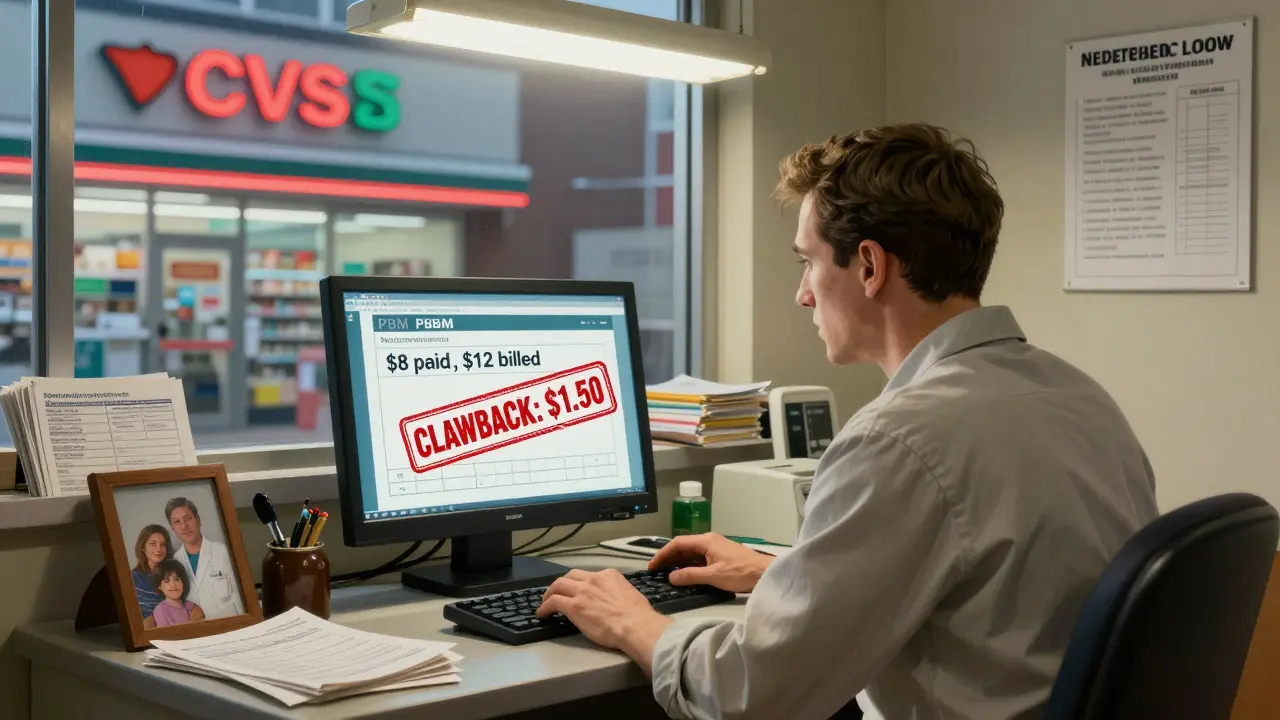
PBMs don’t just negotiate prices. They control reimbursement. Here’s how it works: when you pay $10 for a generic at the counter, the PBM tells the pharmacy it will reimburse them $8. But the PBM charges your insurance plan $12. That $4 difference? That’s called “spread pricing.” The PBM keeps it. And if your pharmacy is contractually obligated to accept that $8 reimbursement, you’re stuck.Even worse: “clawbacks.” That’s when the PBM later demands the pharmacy pay back money because the drug’s price dropped after you were paid. Imagine filling a prescription, getting paid $8, then getting a bill two weeks later for $1.50 because the generic’s price fell. That’s real. It’s happened to thousands of independent pharmacies.
Three PBMs-CVS Caremark, Express Scripts, and OptumRx-control 80% of the market. That kind of power means they set the rules. A 2023 NCPA survey found OptumRx scored 2.1/5 for transparency. Express Scripts? 4.2/5. The gap isn’t just about honesty. It’s about survival.
The Consolidation Crisis
Between 2014 and 2016, nearly 100 generic drug manufacturers merged. The top five now control 45% of the market, up from 32% in 2015. That’s not good news for competition. When only one company makes a generic, there’s no bidding war. Prices don’t drop. Sometimes they rise. In some cases, single-source generics now cost more than the brand-name version.Meanwhile, independent pharmacies are vanishing. Between 2018 and 2023, 3,000 closed. Why? They can’t compete with big chains that have their own PBMs, bulk purchasing power, and vertical integration. A chain like CVS can own the pharmacy, the PBM, and even the mail-order service. That’s not competition. It’s control.
Mail-Order vs. Retail: A Margin War
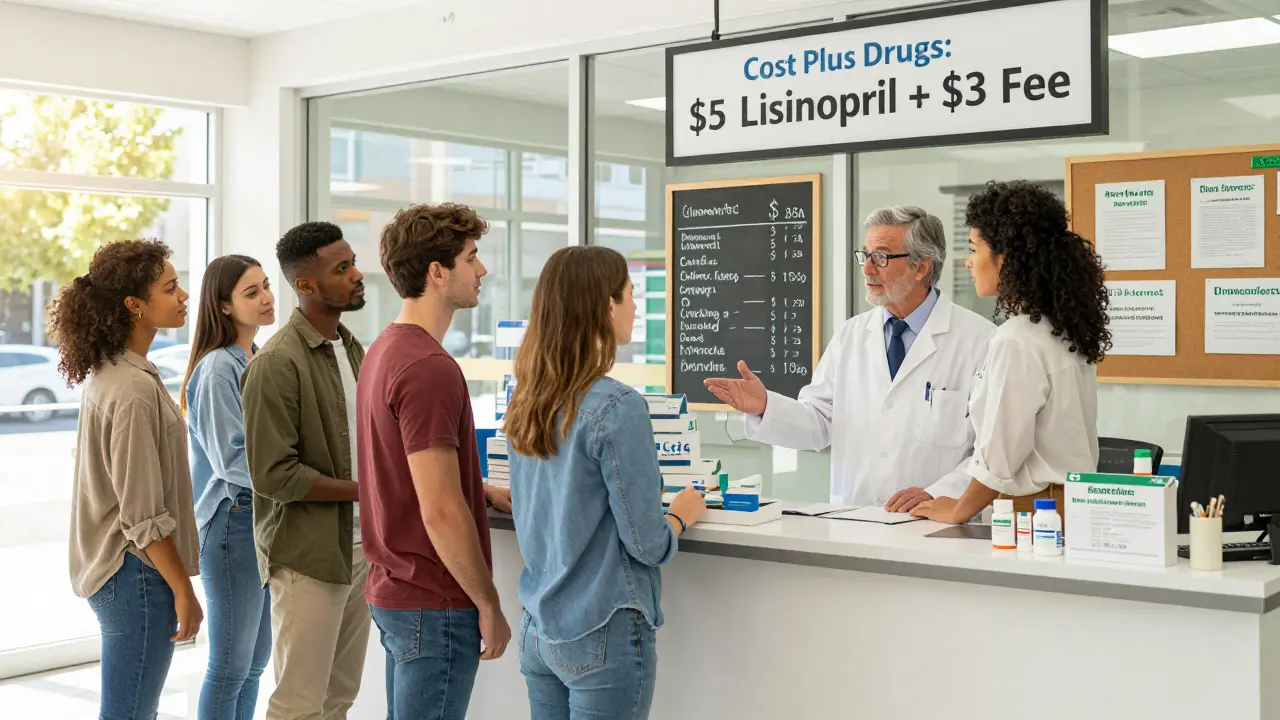
Mail-order pharmacies are the dark horse. For generics, their markup is more than four times higher than a grocery store pharmacy. For brand drugs? Mail-order margins can be 35 times higher. In some cases, they make 1,000 times more profit on a generic than a small pharmacy does. How? They don’t rely on insurance reimbursements. They bill directly to insurers and charge patients less upfront-while keeping the spread.That’s why Amazon Pharmacy and Mark Cuban’s Cost Plus Drug Company are shaking things up. Cost Plus charges $20 for a generic plus a $3 dispensing fee. Amazon lists exact costs: $5 for a 30-day supply of lisinopril. No spreads. No clawbacks. No mystery. They’re proving you don’t need to overcharge to make money. You just need transparency.
What’s Working: How Pharmacies Are Adapting
Some pharmacies are fighting back. They’re not just filling prescriptions anymore. They’re offering medication therapy management (MTM). That’s a service where pharmacists review your entire drug regimen, catch interactions, and help you save money. It’s not just advice-it’s billable. Pharmacies that offer MTM see 3-5% higher net margins.Others are going direct. Skip the PBM. Work directly with employers or set up cash-pay models for select drugs. One pharmacy in Texas started offering $5 insulin and $10 statins with no insurance needed. They lost volume on those items but gained loyal customers who then bought other products. Profit didn’t come from the drug. It came from trust.
The National Community Pharmacists Association (NCPA) runs a Rebuttal Academy that’s trained over 8,500 pharmacy staff to challenge unfair PBM reimbursement decisions. It’s not easy. But it’s necessary.
The Future: Reform, Regulation, and Risk
The Inflation Reduction Act’s drug price negotiation rules kick in 2026. That could lower overall spending-but it might also pressure generic margins further. The FTC is now investigating PBM practices. States like California and Texas passed laws requiring PBM transparency. That’s a start.But here’s the hard truth: if nothing changes, Goldman Sachs predicts 20-25% more independent pharmacies will close by 2027. The system is designed to favor scale, not service. The people who know your name, remember your allergies, and call you when your refill is ready? They’re the ones getting squeezed.
Generics aren’t just cheap drugs. They’re the backbone of pharmacy economics. But if we keep letting middlemen control the margins, we’ll lose the pharmacies that matter most-the local ones.
Why do pharmacies make more profit on generics than brand-name drugs?
Pharmacies make more profit on generics because their gross margins are much higher-around 42.7% on average-compared to just 3.5% on brand-name drugs. This happens because generics have low acquisition costs, so even small markups create large percentage profits. Brand-name drugs, while more expensive, have lower percentage markups due to complex reimbursement rules and PBM contracts that cap what pharmacies can earn.
What is spread pricing, and how does it hurt pharmacies?
Spread pricing is when a Pharmacy Benefit Manager (PBM) charges an insurance plan one price for a drug but reimburses the pharmacy a lower amount. The difference-the spread-is kept by the PBM as profit. This hurts pharmacies because they’re paid less than what the insurer is billed, and they often have no control over the reimbursement rate. Some pharmacies have been reimbursed $8 for a drug while the PBM billed the insurer $12, pocketing $4 per prescription.
Why are independent pharmacies closing faster than chain pharmacies?
Independent pharmacies lack the scale to negotiate favorable reimbursement rates with PBMs. Chain pharmacies often own their own PBMs or have deep financial backing to absorb low margins. Independents, on the other hand, rely on PBM contracts they can’t change. With rising overhead and declining reimbursement, many can’t cover rent, staff, or inventory costs. Between 2018 and 2023, over 3,000 independent pharmacies shut down.
Can pharmacies make money without relying on drug sales?
Yes. Many are shifting to services like medication therapy management (MTM), immunizations, and chronic disease coaching. These services are billable to insurers and offer more stable revenue than drug margins. Pharmacies that offer MTM report 3-5% higher net profits. Some also bypass PBMs entirely by offering cash-pay models for common drugs, building customer loyalty and avoiding reimbursement fights.
Are generic drug prices really falling because of competition?
Not always. When multiple manufacturers make the same generic, prices drop-sometimes by 20% after three years of competition, according to the FDA. But when only one company produces a generic (a single-source market), competition vanishes. In these cases, prices can rise, even above the brand-name version. Between 2014 and 2016, nearly 100 generic manufacturers merged, reducing competition and increasing the risk of price spikes.
How are companies like Cost Plus Drug Company changing the game?
Cost Plus Drug Company and Amazon Pharmacy are using transparent pricing: they show exactly what they paid for the drug, add a fixed dispensing fee (like $3), and charge the customer that total. No spreads. No clawbacks. No hidden markups. This model proves pharmacies can make money without exploiting reimbursement loopholes. As of 2024, Cost Plus processes over 1 million prescriptions monthly, showing growing consumer demand for honesty in drug pricing.
Katie Putbrese
March 25, 2026 AT 00:32These pharmacies are getting robbed. PBMs are just corporate vultures picking the bones of local businesses. I don’t care what the numbers say-when a mom-and-pop shop can’t afford to keep the lights on because some Wall Street firm is skimming $4 per prescription, that’s not capitalism. That’s theft.
And don’t give me that ‘market forces’ crap. This isn’t a free market. It’s a rigged game where the same three companies own the table, the cards, and the dealer. We need to break them up. Like, now.
My grandma’s pharmacy just closed. She used to know her meds by heart. Now she’s stuck with a mail-order robot that sends her pills in a box with no name, no face, no care. This isn’t progress. It’s erasure.
Jacob Hessler
March 25, 2026 AT 01:51generic drugs r the real profit engine?? lol no they aint. u think pharmacies make bank on $4 metformin? they lose money on it. the only reason they even stock it is b/c the pbm forces em to. if they could drop it they would. its called a loss leader. like walmart with milk. same thing. u dont get it do u?
Amber Gray
March 26, 2026 AT 12:52so pbms are just middlemen that steal from everyone?? 😳 like… literally??
that’s wild. i thought they were ‘negotiating’ prices but now i get it-they’re just pocketing the difference like it’s their damn job. no wonder pharmacies are dying. this is why i’m switching to cost plus. no games. no clawbacks. just price + $3. i feel like a rebel now 😎
Donna Fogelsong
March 27, 2026 AT 08:35They don’t want you to know this. The real story? PBMs are owned by insurance giants who also own the drug manufacturers. It’s not just a monopoly-it’s a closed loop. The same people who make the drug, control the reimbursement, and insure the patient. That’s not capitalism. That’s feudalism with spreadsheets.
And the FDA? They’ve been asleep at the wheel since 2010. Why? Because they’re paid off. Look up the revolving door between HHS and Express Scripts. It’s not conspiracy. It’s documented.
Next time you see a pharmacy, ask yourself: who’s really paying for your pills? And why are they so desperate to keep you from knowing?
Raphael Schwartz
March 29, 2026 AT 08:01pharmacies make 2% profit?? then why are they still open? they’re not. they’re zombies. walking dead. just waiting for the last pbn to suck out their last dime. time to burn it all down.
Grace Kusta Nasralla
March 31, 2026 AT 02:18It’s ironic, isn’t it? We treat medicine like a commodity, but we’re not treating people like people. The pharmacy that remembers your name, your dog’s name, and that you hate grapefruit juice-that’s the real healthcare. The rest? Just transactional ghosts in a machine designed to extract, not heal.
Maybe profit isn’t the problem. Maybe the problem is we forgot what healing looks like.
Korn Deno
March 31, 2026 AT 04:34The system isn’t broken. It’s working exactly as designed.
Pharmacies were never meant to be community institutions. They were meant to be distribution nodes in a supply chain that prioritizes efficiency over humanity. The fact that we romanticize the local pharmacy is a cultural delusion-a nostalgia for a model that was always unsustainable.
The real question isn’t how to save them. It’s whether we still want to live in a world where a pharmacist knows your name. Because if we do, we’ll have to dismantle the entire architecture that replaced them.
And I’m not sure we’re ready for that.
Aaron Sims
March 31, 2026 AT 23:27Ohhh, so now it’s ‘corporate greed’? How original. Let me guess-the next article will be about how ‘Big Tech’ is stealing your data and ‘Big Oil’ is melting the ice caps? Wow. Groundbreaking.
Maybe the real problem? You think a 30-day supply of metformin should cost $10. It costs 15 cents to make. That’s not a markup. That’s a charity. The real villain? You. For thinking you deserve cheap medicine. You don’t. You pay for the system. Accept it or move to Cuba.
Stephen Alabi
April 2, 2026 AT 02:14It is imperative to acknowledge, with the utmost scholarly rigor, that the prevailing economic paradigm within the retail pharmaceutical sector is not merely inefficient, but structurally pathological. The confluence of vertical integration, PBM-mediated reimbursement asymmetry, and the erosion of marginal utility in generic dispensing constitutes a systemic failure of market equilibrium.
Furthermore, the empirical evidence presented in the NACDS 2018 report, while statistically valid, fails to account for the latent externalities of community health infrastructure collapse. One must therefore posit a normative framework wherein the preservation of local pharmacy access is not a fiscal consideration, but a public good of constitutional dimension.
It is, therefore, not merely advisable-but ethically obligatory-to advocate for the immediate antitrust dissolution of the top three PBMs, in accordance with Section 7 of the Clayton Act.
Agbogla Bischof
April 3, 2026 AT 19:22As a pharmacist from Nigeria, I can say this: in Africa, generics are the only option. We don’t have PBMs. We don’t have spreads. We buy directly from manufacturers, sell at cost plus 10%, and people pay cash. No clawbacks. No insurance chaos.
Our pharmacies survive because we’re not trapped in your system. We’re not waiting for a PBM to decide if we can stay open. We just… serve.
Maybe the solution isn’t fighting PBMs. Maybe it’s skipping them entirely.
Pat Fur
April 3, 2026 AT 20:58I grew up in a small town where the pharmacist knew everyone’s meds, allergies, and kids’ birthdays. We didn’t have mail-order. We had trust.
Now my daughter’s pharmacy is run by an algorithm that sends her pills in a box with no name. She doesn’t even know who to call if she has a reaction.
I miss the human touch. And I think we all do.
Chris Crosson
April 4, 2026 AT 19:46So if mail-order makes 1000x more profit on generics, why aren’t they the only option? Why do we still have retail pharmacies at all? Is it just inertia? Or are people too stubborn to switch? I’m honestly curious.
Chris Farley
April 4, 2026 AT 20:57Let’s be real-the whole ‘independent pharmacy’ narrative is a distraction. These places are dying because they’re inefficient. They’re not ‘heroic small businesses.’ They’re outdated. The market evolved. Chains have logistics. PBMs have scale. You can’t cry about it. Adapt or die.
And stop pretending your local pharmacy is some sacred temple. It’s a business. It failed. Get over it.