
G6PD Deficiency and Medications: How to Prevent Hemolysis
 Jul, 20 2026
G6PD Medication Safety Checker
Start typing to see safety information
Common Medications & Risk Levels
You might have heard that G6PD deficiency is a condition where your body lacks a specific enzyme. But here is the real problem: taking the wrong medication can cause your red blood cells to burst. This process, called hemolysis, can drop your hemoglobin levels by more than half in just seven days. It sounds scary, but it is entirely preventable if you know what to avoid.
This guide cuts through the medical jargon to tell you exactly which drugs are dangerous, which ones are safe, and how to protect yourself during doctor visits. We will look at the latest guidelines from 2023 and 2024 so you have current information, not outdated warnings.
What Is G6PD Deficiency?
G6PD deficiency is an X-linked genetic disorder affecting approximately 400 million people worldwide. The enzyme Glucose-6-Phosphate Dehydrogenase helps keep your red blood cells healthy by protecting them from oxidative damage. Without enough of this enzyme, your cells become vulnerable when exposed to certain triggers.
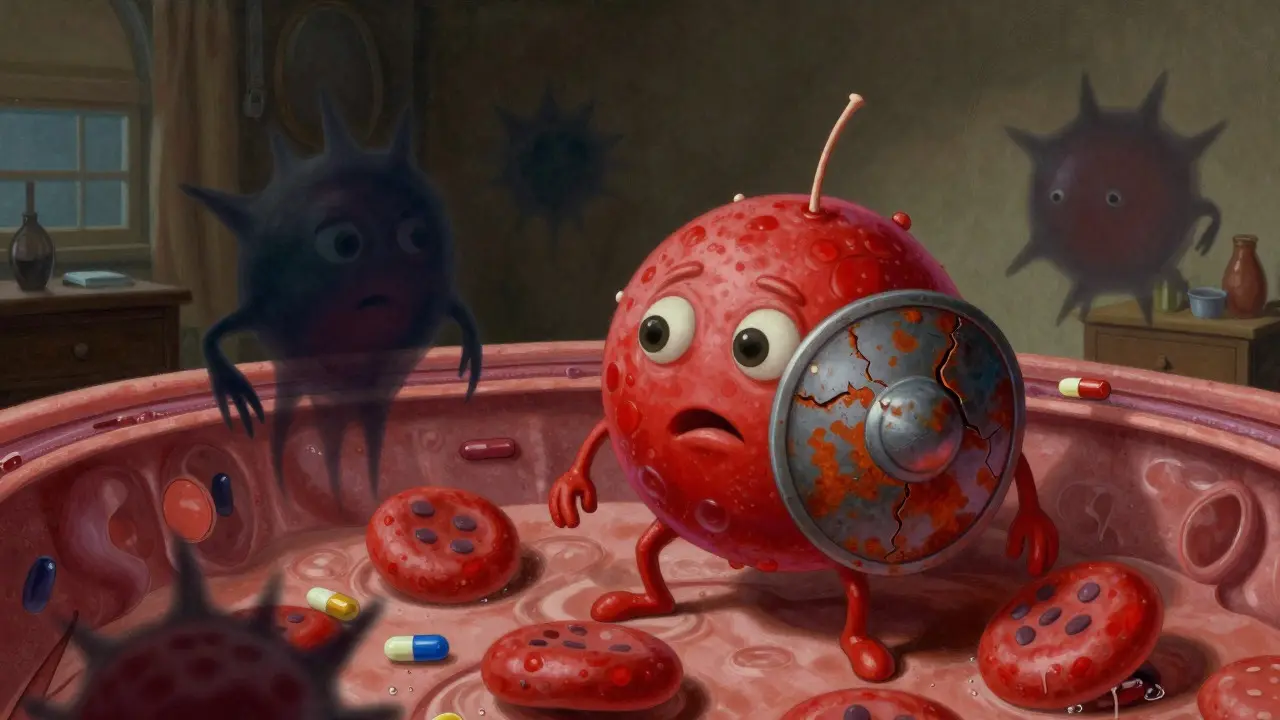
Think of the enzyme as a shield. When you take certain medicines or eat specific foods, they create "oxidative stress"-like rust forming on metal. In most people, the shield holds strong. In people with G6PD deficiency, the shield cracks, and the red blood cells break apart.
The severity varies. The World Health Organization classifies these variants into five classes:
- Class I: Severe deficiency with chronic hemolysis (rare, about 0.1% of cases).
- Class II: Severe deficiency with intermittent hemolysis (common in Mediterranean populations).
- Class III: Moderate deficiency (the most common type, comprising 80% of global cases).
- Class IV: Mild deficiency with no clinical symptoms.
- Class V: Increased enzyme activity (extremely rare).
The Danger Zone: Medications to Avoid
Not every medicine is off-limits. However, some drugs carry a high risk of triggering a hemolytic crisis. The American Society of Hematology’s 2023 guidelines emphasize avoiding oxidative stressors. Here are the big ones you need to know:
| Medication | Risk Level | Why It’s Dangerous |
|---|---|---|
| Rasburicase | Contraindicated | Causes hemolysis in nearly 100% of deficient patients. FDA Black Box Warning. |
| Methylene Blue | Very High | Severe hemolysis in 95% of deficient patients. Often used for methemoglobinemia. |
| Primaquine | High | Induces hemolysis in 100% of Class I and II patients at standard doses. |
| Dapsone | High | Causes hemolysis in 80% of patients at doses above 50mg daily. |
Rasburicase is particularly critical. It is used to treat tumor lysis syndrome in cancer patients. If a doctor prescribes this without knowing your status, the result can be catastrophic. A case reported in the American Journal of Emergency Medicine involved a patient whose hemoglobin dropped to 3.1 g/dL after receiving rasburicase without prior testing, requiring massive blood transfusions.
Methylene blue is another hidden danger. It is sometimes given for urinary tract infections or methemoglobinemia. Because it is less well-known to the general public, many people do not realize it is a major trigger. Always ask if a dye or blue-colored solution is being administered.
Safe Alternatives and Malaria Prevention
If you need treatment for malaria or other conditions, there are safe options. The key is substitution. For example, if you are traveling to a malaria-endemic region, primaquine is often recommended to kill dormant parasites. But for G6PD-deficient individuals, it is risky.
Instead, doctors often prescribe chloroquine or atovaquone-proguanil (Malarone). Chloroquine is considered safe in 100% of G6PD-deficient patients according to WHO 2023 guidelines. Atovaquone-proguanil was shown in a 2021 study of 1,245 travelers to prevent hemolysis in 95% of deficient users.
For radical cure of Plasmodium vivax malaria, tafenoquine is an option, but it requires mandatory G6PD testing before use. The FDA approved tafenoquine with the strict requirement that patients must be tested first. This highlights why testing is non-negotiable.
The Testing Debate: Do You Need It?
Here is a controversial point: many drug labels list dozens of medications as "use with caution" for G6PD deficiency. But Dr. David C. Rees of King's College London warns that many of these warnings are based on scarce evidence. For instance, warnings against sulfonylureas like glyburide are based on only 17 documented cases since 1965, yet appear in 92% of package inserts worldwide.
Does this mean you should ignore all warnings? No. It means you should focus on the high-risk drugs listed above. However, universal screening is gaining traction. The American Society of Hematology recommends universal G6PD testing for newborns in regions with prevalence above 5%. Saudi Arabia implemented this and saw a 78% reduction in hemolytic crisis admissions between 2010 and 2020.
In the United States, only 12 states mandate newborn screening. This leaves gaps. If you have African, Mediterranean, or Southeast Asian ancestry, consider asking for a test. The point-of-care fluorescent spot test provides results in 15 minutes with 98.7% sensitivity.

How to Talk to Your Doctor
Many healthcare providers are unaware of specific medication restrictions. A 2022 survey found that 42% of G6PD-deficient patients reported their doctors did not know about required restrictions. You need to be your own advocate.
- Carry a card: Keep a small card in your wallet stating "G6PD Deficiency - Avoid Rasburicase, Methylene Blue, Primaquine."
- Ask before every new prescription: Say, "I have G6PD deficiency. Is this medication safe for me?"
- Update your records: Ensure your electronic health record flags your condition. Systems like the one at UCSF automatically flag 87 high-risk medications, reducing inappropriate prescribing by 89%.
- Test timing matters: If you recently had a hemolytic episode, wait at least three months before testing. Enzyme activity recovers slowly, and testing too soon can give false-normal results.
Don't assume the doctor knows. Even experienced hematologists may miss a niche interaction. A nurse on Reddit described a case where a patient received methylene blue without testing, causing his hemoglobin to drop from 14.2 to 5.8 g/dL in 48 hours. Simple communication could have prevented this.
Emerging Treatments and Future Outlook
Science is moving fast. In January 2024, the FDA approved the first quantitative point-of-care G6PD test system, providing results in 8 minutes with 99.1% accuracy. This solves the problem of waiting days for lab results in emergency situations.
Research also shows promise in protective agents. A 2024 study in Blood Advances found that N-acetylcysteine (NAC) reduced hemolysis by 75% in vitro when administered with primaquine. While not a cure, it could offer a safety buffer in the future.
Long-term, the goal is clear. The Global Blood Disorders Initiative estimates that with proper screening and management, preventable mortality from G6PD deficiency could reach zero by 2035 in regions with established healthcare. The tools exist; we just need to use them consistently.
Is G6PD deficiency hereditary?
Yes, it is an X-linked genetic disorder. This means it is passed down through the X chromosome. Males are more frequently affected because they have only one X chromosome. Females can be carriers or affected, depending on X-chromosome inactivation patterns. About 15% of G6PD-deficient females can experience hemolysis.
Can I take aspirin if I have G6PD deficiency?
Generally, yes. Aspirin is considered safe in normal therapeutic doses. However, very high doses may pose a risk. Always consult your doctor, but unlike rasburicase or primaquine, aspirin is not strictly contraindicated for most G6PD-deficient individuals.
What foods should I avoid?
Fava beans are the most well-known dietary trigger. They contain vicine and convicine, which can cause oxidative stress. Some individuals may also react to large amounts of vitamin C supplements, though normal dietary intake is usually fine. Stick to a balanced diet and avoid excessive fava bean consumption.
How long does it take to recover from a hemolytic episode?
Recovery depends on the severity. Mild episodes may resolve in a few days with rest and hydration. Severe episodes requiring hospitalization can take weeks for hemoglobin levels to normalize. Bone marrow produces new red blood cells, but it takes time. Follow-up testing should be done at least three months post-episode for accurate enzyme measurement.
Do women with G6PD deficiency need to worry?
Yes. Historically, it was thought only men were affected. However, due to random X-chromosome inactivation (lyonization), up to 15% of female carriers can have low enough enzyme activity to experience hemolysis. Women should still get tested and follow precautions, especially if they have a family history.