
GMP for Generics: FDA Requirements for Manufacturing
 Mar, 17 2026
When you pick up a generic drug at the pharmacy, you expect it to work just like the brand-name version. That’s not luck. It’s the result of strict, legally enforced rules called Current Good Manufacturing Practices (CGMP). These aren’t suggestions. They’re the bare minimum standards the FDA requires every generic drug maker to follow - whether they’re based in Ohio or Mumbai. If a facility doesn’t meet these rules, its products can’t be sold in the U.S. And the stakes are high: 90% of all prescriptions filled in 2022 were for generics, worth over $105 billion. That means millions of people depend on these rules to keep their medications safe and effective.
What Exactly Are CGMP Requirements?
CGMP stands for Current Good Manufacturing Practices. The word "current" matters. It means manufacturers can’t just follow old methods. They have to use the best available technology and science at the time. These rules are written into federal law under 21 CFR Parts 210 and 211. They cover every single step of making a generic drug: from the raw ingredients to the final pill in the bottle.The FDA doesn’t treat generics differently from brand-name drugs. A generic tablet must be made under the exact same standards as its brand-name twin. That means:
- Every ingredient must be tested before use
- Equipment must be cleaned, calibrated, and maintained
- Workers must be trained and documented
- Every batch must be tested for strength, purity, and quality
- Manufacturing processes must be proven to work consistently
It’s not enough to say "we did it this way last time." Every step must be written down, monitored, and validated. This is what keeps a batch of metformin from being contaminated with NDMA - a cancer-causing chemical that led to a major recall in 2022.
Key Areas the FDA Inspects
The FDA breaks CGMP into 11 detailed subparts. Here are the most critical ones for generic drug makers:- Organization and Personnel (§211.25): Every facility needs a dedicated Quality Unit with real authority. This team can stop production if something’s wrong. Employees must have documented training - no exceptions.
- Buildings and Facilities (§211.46): Air quality, humidity, and cleanliness are controlled. Dust, mold, or unclean surfaces can ruin a batch. Cleanrooms aren’t optional for sterile products.
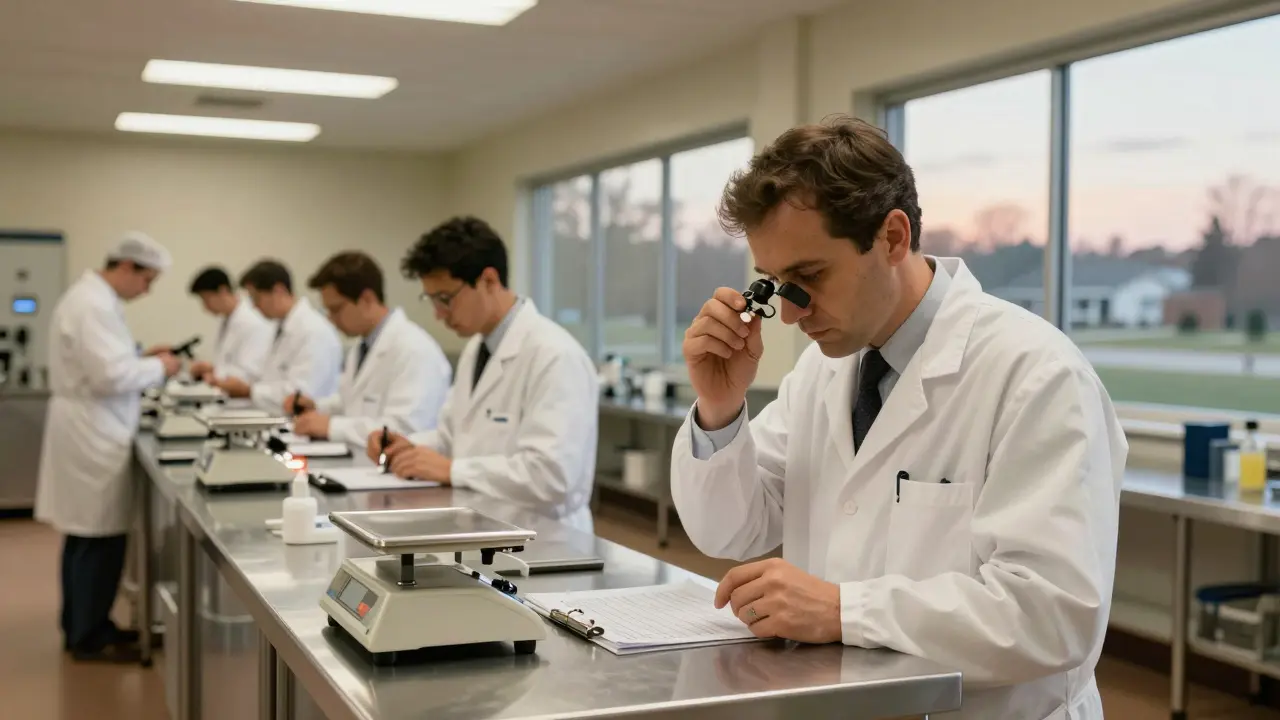
- Equipment (§211.68): All machines used in production must be cleaned, maintained, and calibrated. If a scale isn’t accurate, the dosage is wrong. Records must prove it was done.
- Control of Components (§211.84): Every single batch of active ingredient - even from overseas - must be tested. No assumptions. No shortcuts. In 2023, the FDA added new testing for toxic contaminants like diethylene glycol after deaths linked to contaminated ingredients.
- Production and Process Controls (§211.100-113): This is where most failures happen. Manufacturers must prove their process works every time. That means validating each step - from mixing to coating - with data. A single change in temperature or mixing speed requires re-validation.
- Laboratory Controls (§211.166): Stability testing isn’t optional. Drugs must be monitored over time to prove they don’t break down. If a pill loses potency after six months, it can’t be sold.
- Records and Reports (§211.180): Every record must be kept for at least one year after the drug expires. That includes batch records, test results, maintenance logs, and training files. Electronic records must follow Part 11 rules - meaning audit trails, secure access, and no backdating.
Why Do These Rules Exist?
In 2022, 12 generic metformin products were recalled because of dangerous chemical contamination. The FDA traced it back to one supplier’s failure to validate cleaning procedures. That’s not an isolated case. In 2023, the FDA issued over 1,000 warning letters to drug manufacturers - nearly half of them for CGMP violations. Most came from foreign facilities.These rules exist because patients can’t tell if a pill is bad. They don’t know if the active ingredient is 98% pure or 85%. They don’t know if the machine that pressed the tablet was last cleaned three weeks ago. CGMP is the invisible safety net. It ensures that every pill, no matter where it’s made, meets the same standard.
Dr. Robert Califf, FDA Commissioner, put it plainly: "Facilities that are in good condition, equipment that is properly maintained and calibrated, employees who are qualified and fully trained, and processes that are reliable and reproducible - these aren’t luxuries. They’re non-negotiable."
Challenges for Generic Manufacturers
Meeting CGMP isn’t easy - especially for smaller companies. A 2022 survey found that 68% of generic drug makers struggled with documentation. One company on Reddit spent $1.2 million and 14 months just to switch from paper records to electronic batch records. That’s the reality of Part 11 compliance.Other pain points:
- Data integrity: 78% of firms report trouble with audit trails. Tampering or deleting records is a top reason for FDA warning letters.
- Supply chain control: 43% of manufacturers had at least one batch of active ingredient fail testing in 2022.
- Inconsistent inspections: A 2023 survey found 57% of companies felt inspectors interpreted rules differently. One inspector might call a minor gap a violation. Another might not.
Foreign facilities face even tougher scrutiny. In 2022, 63% of all data integrity warning letters went to overseas plants. And while domestic facilities get inspected about 1.3 times per year on average, foreign ones get far fewer - despite supplying most of the U.S. generic market.
Success Stories and Failures
There are bright spots. Teva Pharmaceutical implemented continuous manufacturing for a generic heart drug in 2021. Instead of making pills in batches, they made them in a steady stream. The result? Batch failures dropped from 4.2% to 0.7% - all while staying fully CGMP compliant.But failures are costly. The 2022 metformin recalls weren’t just a product issue - they were a system failure. The supplier didn’t validate cleaning between batches. They didn’t test for contaminants. The FDA’s warning letter cited "inadequate process controls" - a direct violation of §211.100 and §211.113.
These aren’t theoretical risks. They’re real-world consequences. Patients lost access to a critical medication. Companies faced lawsuits. The FDA had to scramble to find alternative suppliers.
What’s Changing in 2024 and Beyond?
The FDA isn’t standing still. In 2023, they announced a new strategic plan with three big shifts:- More inspections overseas: 25% more resources will go to foreign facility checks.
- Modernizing manufacturing: Draft guidance for continuous manufacturing is expected in Q2 2024. This could change how generics are made - but it won’t change the rules. Even advanced manufacturing must meet CGMP.
- Stronger data rules: 73% of industry leaders expect tighter enforcement of Part 11. That means better audit trails, more secure systems, and fewer paper records.
Looking ahead, experts predict that by 2028, 65% of manufacturers will use AI and real-time analytics to predict quality issues before they happen. But even then, the core idea won’t change: if you don’t follow CGMP, you don’t sell in the U.S.
Final Thought: It’s Not About Cost - It’s About Trust
Some say CGMP is too expensive. It adds 12-15% to manufacturing costs. But ask yourself: what’s the cost of a patient taking a pill that doesn’t work? Or worse - one that harms them?The U.S. generic drug market thrives because patients trust it. That trust isn’t built on price. It’s built on the assurance that every pill, no matter who made it, was made the same way - with care, with science, and with accountability. That’s what CGMP delivers. And that’s why it’s not optional. It’s the foundation.
Are CGMP requirements different for generic drugs compared to brand-name drugs?
No. The FDA requires generic drugs to be manufactured under the exact same Current Good Manufacturing Practices (CGMP) as brand-name drugs. This is a legal requirement under the Hatch-Waxman Act. The only difference is that generics don’t need to repeat clinical trials - but their manufacturing must meet identical quality standards. A generic pill must have the same active ingredient, strength, dosage form, and be made under the same strict controls as its brand-name counterpart.
What happens if a generic drug manufacturer fails CGMP inspection?
If a facility fails a CGMP inspection, the FDA can issue a Warning Letter. This is public and triggers an investigation. The manufacturer must fix the issues within a set timeframe - usually 15 days to respond and months to fully correct problems. If they don’t, the FDA can block the facility from shipping products to the U.S. This means the drug is pulled from shelves. In serious cases, the company may face civil penalties, import bans, or even criminal charges. Over 1,000 warning letters were issued to drug manufacturers in 2022 alone.
How often does the FDA inspect generic drug facilities?
Domestic facilities are inspected, on average, every 18 months - roughly 1.3 times per year. Foreign facilities are inspected less frequently, with only about 15% of them inspected every five years. However, the FDA has announced plans to increase foreign inspections by 25% between 2023 and 2027. High-risk facilities - those with past violations or manufacturing complex drugs - may be inspected more often. The FDA uses a risk-based system, not a fixed schedule.
Do all generic drugs come from foreign countries?
No, but the majority do. As of 2022, the U.S. had 127 approved generic drug manufacturing facilities, while 1,843 were located overseas. India supplies about 38% of the U.S. generic market, and Europe supplies 22%. The U.S. still produces some generics - especially for high-demand or complex drugs - but most active pharmaceutical ingredients (APIs) come from abroad. The FDA inspects both domestic and foreign facilities under the same CGMP rules.
What’s the biggest challenge for small generic manufacturers?
The biggest challenge is the cost and complexity of compliance. Small firms often lack dedicated regulatory teams. Implementing electronic records (21 CFR Part 11), maintaining audit trails, validating processes, and training staff can cost over $2 million annually for mid-sized companies. Many struggle with documentation - 68% of manufacturers report difficulties. They also face inconsistent inspector interpretations and limited access to expert consultants, which can delay approvals or trigger warning letters.
How does the FDA ensure quality control for imported generic drugs?
The FDA uses a combination of inspections, sample testing, and import alerts. Before a drug enters the U.S., the agency reviews the manufacturer’s CGMP history. They also test incoming shipments - especially for high-risk ingredients like those used in metformin or blood pressure medications. If a facility has a history of violations, the FDA can place it on an import alert, meaning every shipment is automatically detained until proven safe. The agency also works with foreign regulators, but ultimately, the FDA has final authority over what enters the U.S. market.
Is CGMP compliance the same worldwide?
No. While the European Medicines Agency (EMA) and other regulators align with about 85% of FDA CGMP rules, differences exist. The FDA requires more detailed documentation, stricter data integrity controls (like Part 11), and mandatory quality units with veto power. The EMA allows more flexibility in some areas, like validation batch sizes. The FDA also acts faster on emerging risks - like the 2023 mandate to test for diethylene glycol in ingredients - while other agencies may take longer to respond. For a generic drug to be sold in the U.S., it must meet FDA standards, regardless of where it’s made.
Shameer Ahammad
March 17, 2026 AT 15:24Let me be perfectly clear: CGMP isn't a suggestion-it's a legal mandate, and anyone who thinks otherwise is either dangerously naive or willfully ignorant. Every batch of metformin must be traceable to its raw material source, with documented validation for every single process step. The FDA doesn't play games. If your facility in Mumbai skips a cleaning validation because it's "too expensive," you're not just cutting corners-you're endangering lives. And don't even get me started on the data integrity violations-audit trails aren't optional, they're non-negotiable. I've seen facilities get shut down over a single missing signature. This isn't about cost-it's about accountability.
Alexander Pitt
March 18, 2026 AT 01:39The FDA's inspection system is far from perfect, but the framework itself is solid. What's often missed is that CGMP applies equally to every facility, regardless of location. The real issue isn't foreign manufacturing-it's inconsistent enforcement. Domestic plants get inspected every 18 months on average. Foreign ones? Sometimes once every five years. That gap creates blind spots. We need risk-based prioritization, not geographic bias. If a facility has a history of violations, it should be inspected quarterly-not because it's overseas, but because it's high-risk.
Manish Singh
March 19, 2026 AT 12:31As someone who's worked in pharma manufacturing in India, I can tell you-this isn't just about rules. It's about culture. In smaller plants, there's pressure to cut costs, to rush batches, to skip documentation because "it's always worked before." But when you're making pills that millions rely on, "always worked" isn't good enough. I've seen teams stay up all night revalidating a mixing process because a single temperature fluctuation could mean a batch failure. It's exhausting, but it's necessary. The system works when people care enough to do it right-even when no one's watching.
Robin Hall
March 19, 2026 AT 16:29Let’s be honest-this whole system is a controlled illusion. The FDA claims to inspect every facility, but how many of those inspections are truly independent? How many are coordinated with the very companies they're supposed to be policing? I’ve seen reports where warning letters are issued, then quietly rescinded after "corrective actions" that were never verified. And don’t forget: the FDA relies on foreign regulators for preliminary checks. What if those regulators are compromised? What if data is falsified before it even reaches the U.S.? This isn’t about compliance-it’s about a manufactured trust. The pills you take? They could be anything.
jared baker
March 19, 2026 AT 20:45Simple truth: if you don’t follow the rules, you don’t get to sell. It’s that easy. The FDA doesn’t care if you’re big or small, rich or poor. If your scale is off, your batch is trash. If your records are sloppy, you’re shut down. No exceptions. No excuses. This isn’t about being harsh-it’s about being smart. One bad pill can hurt someone. That’s why every step matters. No fluff. Just facts.
Michelle Jackson
March 20, 2026 AT 21:20So let me get this straight-we trust pills made in India more than we trust our own healthcare system? Funny. I’ve seen people get sick from generics and then blame the doctor. Meanwhile, the same companies that make these drugs are lobbying Congress to cut inspections. And don’t even get me started on how "audit trails" are just fancy word for "we made up some numbers." I’m not paranoid-I’m just not stupid. And yes, I know someone who got hospitalized because their blood pressure med was 40% weaker than it should’ve been. It was a generic. And yes, the FDA knew. For months.
Suchi G.
March 21, 2026 AT 13:49I just want to say how deeply moved I am by the sheer humanity of this system. Every single pill, every single batch, every single calibration-it’s not just science, it’s a quiet act of care. I think about the workers in those cleanrooms, in places where the air is filtered ten times over, where they wear full-body suits just to press a tablet, and they do it day after day, year after year, without fanfare. I think about the young chemist in Hyderabad who stayed up until 3 a.m. retesting a batch because the humidity was off by 2%. That’s not a job. That’s a calling. And we don’t thank them. We don’t see them. We just take the pill. But they’re there. Always. And that’s what makes this work-not the laws, not the inspections-but the people who show up, even when no one’s watching. I’m crying. I’m just so proud of them.
becca roberts
March 22, 2026 AT 18:29So the FDA says they’re going to increase inspections overseas by 25%? Cute. That’s like saying you’re going to "try harder" to stop a leak with a toothpick. Meanwhile, 90% of our generics come from places where inspectors show up with 48-hour notice-and sometimes the company pays for their hotel. And let’s not forget: the same people who wrote the rules are the ones who now work for the manufacturers. Talk about a revolving door. I mean, really-do we think the FDA is suddenly going to magically become a global police force? Or are we just pretending to care until the next recall? At least the pills taste the same, right? 😒