
How Long Does the FDA Take to Approve Generic Drugs? 2026 Timeline Breakdown
 Mar, 10 2026
When a generic drug hits pharmacy shelves, it doesn’t just appear out of nowhere. Behind every affordable pill is a months-long review process by the U.S. Food and Drug Administration (FDA). For manufacturers, patients, and even insurers, knowing how long this takes isn’t just helpful-it’s critical. So how long does the FDA really take to approve a generic drug in 2026? The answer isn’t one number. It depends on the drug, the application, and whether the FDA has flagged it as a priority.
Standard Review: The 10-Month Clock
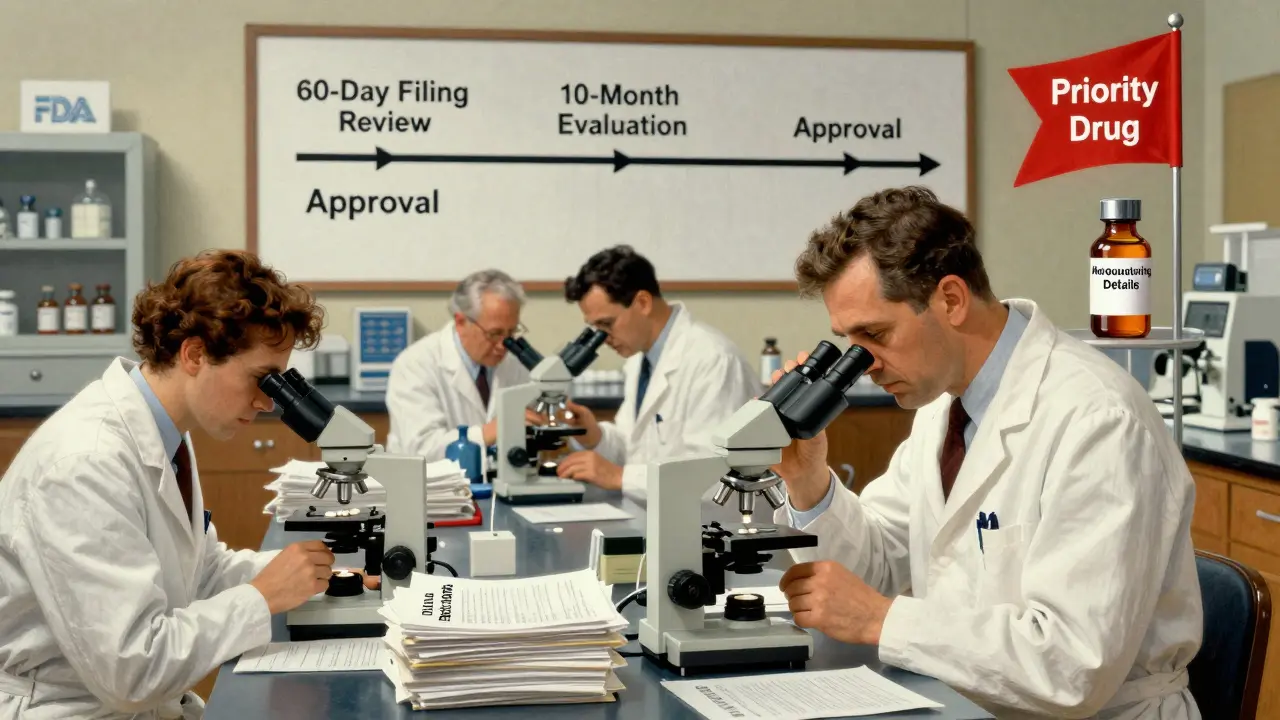
For most generic drugs, the FDA sets a 10-month review target. This clock starts ticking only after the agency accepts the Abbreviated New Drug Application (ANDA). That’s the paperwork manufacturers submit to prove their version is bioequivalent to the brand-name drug-same active ingredient, same dose, same way it works in the body.
But acceptance doesn’t mean instant approval. First, the FDA checks if the application is complete. This initial 60-day filing review looks for missing data, unclear chemistry, or incomplete manufacturing details. If it’s messy, the FDA sends back a Refuse to File letter. No clock starts. You have to fix it and resubmit.
Once accepted, the 10-month review begins. During this time, FDA scientists examine:
- How the drug is made (chemistry and manufacturing)
- Whether it breaks down the same way in the body (bioequivalence data)
- Labeling accuracy
- Facility inspections (yes, they show up unannounced at factories)
By the numbers: In 2025, the median approval time for standard generics was 25 days after the 10-month review window closed. That means most applications were approved right on time-or even early. But median doesn’t tell the whole story. Some drugs took longer. Why?
Why Some Generic Drugs Take Much Longer
Not all generics are created equal. A simple tablet? Easy. A nasal spray? A complex injectable? Those can take 18 to 24 months-sometimes more.
Complex generics are harder to copy. Think inhalers, patches, or drugs that need special delivery systems. The science behind proving they work the same as the brand isn’t straightforward. The FDA has to dig deeper. In 2025, one user on Reddit reported a 1,087-day approval timeline for a nasal spray generic. That’s nearly three years. Meanwhile, a basic doxycycline tablet got approved in under 300 days.
Why the gap? It’s not just science. It’s the application quality. If the manufacturer leaves out details, skips data, or submits messy documentation, the FDA issues a Complete Response Letter. This means: “We can’t approve this yet. Fix these issues.”
And here’s the catch: 42.3% of complete response letters come in the first review cycle (2025 data). That’s up from 37.8% in 2024. It means the FDA is getting better at spotting problems early-but it also means manufacturers are still submitting incomplete applications. Each response letter adds 3 to 6 months to the timeline. Multiply that by two or three rounds, and you’re looking at a 2-year wait.
Priority Review: Fast-Tracking for High-Impact Drugs
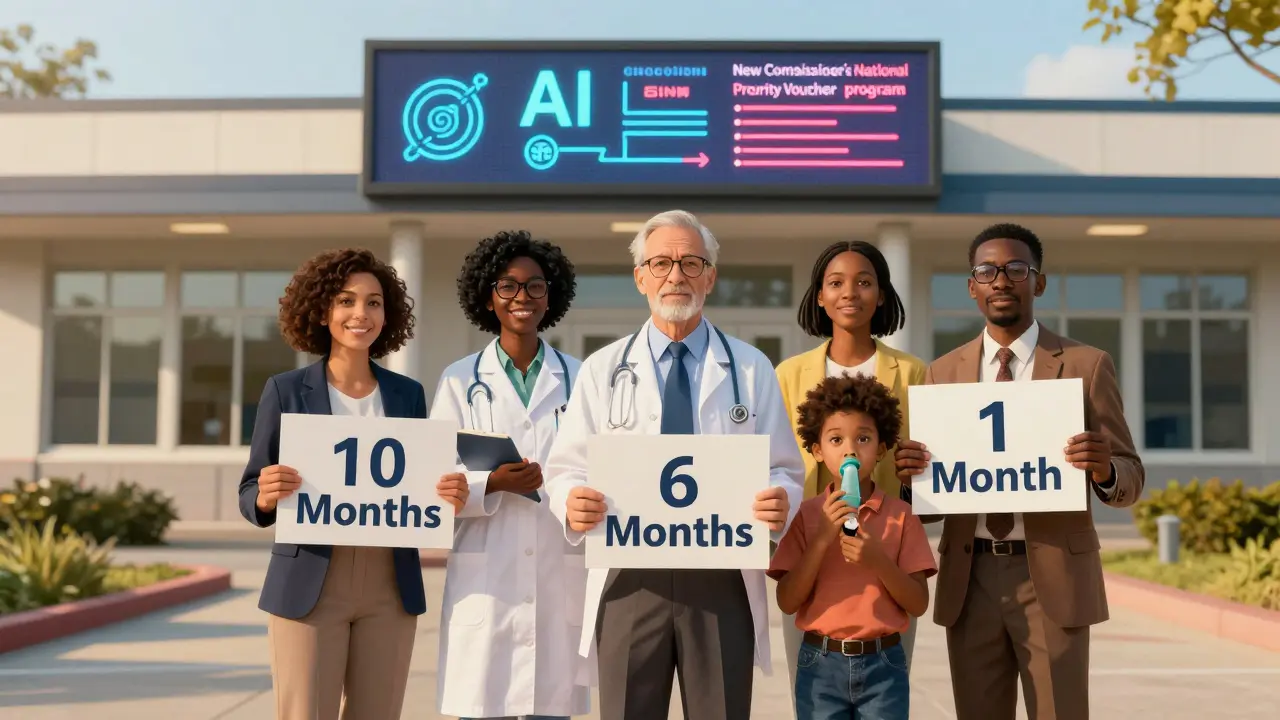
The FDA doesn’t treat every generic the same. If a drug treats a shortage, has no other generic version, or helps a large patient group, it can get priority review. This cuts the clock from 10 months to 6 months.
Priority status isn’t given out lightly. The FDA tracks which drugs are in short supply. In 2025, they prioritized generics for epinephrine injections, bosentan suspensions, and doxycycline oral liquids-drugs that hospitals and families rely on daily.
There’s also a new game-changer: the Commissioner’s National Priority Voucher (CNPV) program. Announced in late 2025, this initiative targets the most critical generics. If approved under CNPV, review time drops from 10 months to just 1 to 2 months. Think of it as a VIP lane for drugs that could save lives.
So far, only a handful of applications have qualified. But the FDA says it will expand the program in 2026. Expect more drugs for rare conditions, pediatric formulations, and those fighting shortages to get this fast-track treatment.
AI, Rolling Reviews, and the Future of Approval Speed
The FDA isn’t just relying on people to read papers anymore. In 2024, pilot programs using artificial intelligence reduced review times for standard generics by 15.8%. AI helps flag missing data, match chemistry patterns, and even predict inspection needs. By 2027, the FDA aims to cut median approval times to just 20 days for standard generics and 10 days for priority ones.
Another shift: rolling review. Instead of waiting to submit the whole ANDA at once, manufacturers can now send parts as they’re ready-chemistry first, then bioequivalence, then labeling. This reduces bottlenecks. One company using this method cut their approval time by 4 months.
And then there’s the data: Between 2020 and 2024, the median approval time for generics dropped by 18.7%. That’s not luck. It’s GDUFA-the Generic Drug User Fee Amendments. This system lets the FDA collect fees from manufacturers ($138,400 per application in 2025) and reinvest it in hiring more reviewers, upgrading tech, and speeding up inspections.
Who’s Getting Approved Fastest?
The big players know the system. Teva, Viatris (formerly Mylan), and Sandoz dominate the generic market. Together, they hold over 44% of approved generics. And they’re also the ones with the shortest approval times.
Why? They don’t just submit applications. They talk to the FDA before submitting. Pre-submission meetings let them ask: “Is our data clear? Are we missing anything?” This prevents costly rework. Teva, for example, reported a 32% reduction in review cycles for supplements between 2023 and 2025.
Small companies? They struggle more. Only 4.7% of ANDA submissions come from small businesses-and they’re more likely to get complete response letters. The FDA offers fee waivers for them, but without experience navigating the system, delays are common.
What This Means for You
If you’re a patient: The faster the FDA approves generics, the sooner you get cheaper drugs. In 2025, generics made up 90% of all prescriptions in the U.S.-but cost only 23% of total spending. That’s over $1.7 trillion saved in the last decade.
If you’re a manufacturer: The system rewards precision. A clean, complete application is your best shot at approval in 10 months. Don’t guess. Don’t cut corners. Use FDA guidance. Attend pre-submission meetings. And if your drug is complex? Start early. Talk to the FDA. Build relationships.
If you’re a policymaker or insurer: The system works-but it’s fragile. The FDA’s funding is tied to user fees. If Congress doesn’t renew GDUFA after 2027, timelines could stall. Experts warn that without more resources, the gains we’ve seen might plateau.
Common Myths About FDA Approval Timelines
- Myth: The FDA approves all generics in exactly 10 months. Truth: That’s the target-not the rule. Some take 6 months. Others take 2 years.
- Myth: Generic drugs are less safe. Truth: They must meet the same quality standards as brand-name drugs. The FDA inspects the same factories.
- Myth: More approvals mean lower quality. Truth: The FDA uses a risk-based approach. High-risk products get more scrutiny. Low-risk ones move faster.
How long does it take for the FDA to approve a generic drug?
For a standard generic drug, the FDA targets a 10-month review after accepting the application. But the actual approval time varies. Simple tablets often get approved in 10 to 12 months, while complex drugs like nasal sprays or injectables can take 18 to 24 months or longer. Priority reviews cut this to 6 months, and under the new CNPV program, some critical generics are approved in just 1 to 2 months.
What is an ANDA?
ANDA stands for Abbreviated New Drug Application. It’s the paperwork a generic drug manufacturer submits to the FDA to prove their product is bioequivalent to a brand-name drug. Unlike brand-name drugs, generics don’t need new clinical trials. Instead, they must show they deliver the same amount of active ingredient into the bloodstream at the same rate. The ANDA is the legal pathway to market a generic version.
Why do some generic drugs get approved faster than others?
It depends on complexity and priority. Simple oral tablets are easier to copy and review. Complex products-like inhalers, patches, or liquids with special delivery systems-require more testing and scrutiny. The FDA also prioritizes generics that treat drug shortages, have no competition, or serve vulnerable populations. These get fast-tracked with priority review or even the new CNPV program, which can slash approval time to just weeks.
What happens if the FDA sends a Complete Response Letter?
A Complete Response Letter means the FDA found issues that prevent approval-missing data, unclear manufacturing details, or problems with bioequivalence. The manufacturer must fix these and resubmit. Each round adds 3 to 6 months to the timeline. In 2025, 42.3% of these letters were issued in the first review cycle, meaning many applications still aren’t submitted cleanly. The best way to avoid this? Submit a complete, well-documented application from the start.
Can AI really speed up FDA approval?
Yes. In pilot programs during 2024, AI tools helped reduce review times for standard generics by 15.8%. The software scans applications for inconsistencies, flags missing data, and even predicts inspection needs. While human reviewers still make the final call, AI acts like a powerful assistant-catching errors early and freeing up scientists to focus on complex science. By 2027, the FDA expects AI to play a major role in meeting its goal of approving standard generics in just 20 days.
Alexander Erb
March 11, 2026 AT 21:24Just got my generic insulin approved after 8 months - honestly, I’m shocked it wasn’t longer. 🙌 The FDA’s been killing it lately, especially with those priority tracks. My pharmacist said they’ve been getting shipments in 2 weeks faster than last year. Crazy how much GDUFA funding actually helped. No more waiting 18 months for a simple tablet anymore. 🥳
Denise Jordan
March 12, 2026 AT 18:46Yeah right. 10 months? More like ‘we’ll get to it after we finish reviewing the 3rd submission of the same damn application.’ I’ve seen this movie before. They ‘prioritize’ stuff until it’s not trendy anymore. Then it sits for a year. Don’t sell me the fairy tale.
Gene Forte
March 13, 2026 AT 10:29Every pill you take today that costs less than $5 is a small miracle. Behind that number is years of science, paperwork, and quiet dedication from regulators who never get thanked. We talk about speed like it’s a game - but this is about people who can’t afford brand drugs. Every day saved matters. Keep pushing forward.
Kenneth Zieden-Weber
March 14, 2026 AT 09:17So let me get this straight - the FDA’s using AI to catch typos in chemistry docs… but still can’t figure out why small companies keep getting slapped with Complete Response Letters? 😏 Maybe instead of fancy software, they should just give new applicants a 1-hour Zoom call with a real human who’s been doing this for 15 years. Just a thought.
Chris Bird
March 15, 2026 AT 19:5410 months? Lmao. In Nigeria we wait 2 years for paracetamol. You guys got AI and priority lanes? Sounds like a fantasy. Meanwhile, my cousin still can’t get his epilepsy med. This whole thing is a rich country luxury.
David L. Thomas
March 15, 2026 AT 20:34Pre-submission meetings are the real MVP here. Teva and Sandoz aren’t winning because they’re bigger - they’re winning because they’ve institutionalized FDA engagement. The ANDA isn’t a submission; it’s a dialogue. Most small firms treat it like a tax return. Big mistake. The FDA’s not your adversary - it’s your partner if you show up prepared. GDUFA fees? Worth every penny if you’re smart.
Bridgette Pulliam
March 16, 2026 AT 21:13I appreciate the thorough breakdown. The data on Complete Response Letters being issued in the first cycle is particularly telling. It suggests systemic gaps in pre-submission preparation - not necessarily regulatory inefficiency. I wonder if there’s a way to create a standardized pre-checklist, perhaps even a digital tool, that small manufacturers could use to self-audit before submission. It might reduce friction for all parties.
Mike Winter
March 17, 2026 AT 13:54It’s fascinating how much progress has been made - and how fragile it remains. GDUFA’s funding model works… until it doesn’t. And then what? We’ve built a system that depends on corporate fees to regulate corporate behavior. That’s… not ideal. I hope the next renewal doesn’t turn into a political football. Because when it does, it’s not the FDA that suffers - it’s the person waiting for their generic asthma inhaler.