
How to Get Your Medication Guides at the Pharmacy: A Patient's Rights Guide
 Apr, 17 2026
Medication Guide Verification Tool
How to use: Look at the document you received from your pharmacist. Check the boxes below that describe the document to see if it meets the federal legal requirements of a Medication Guide.
Document Checklist
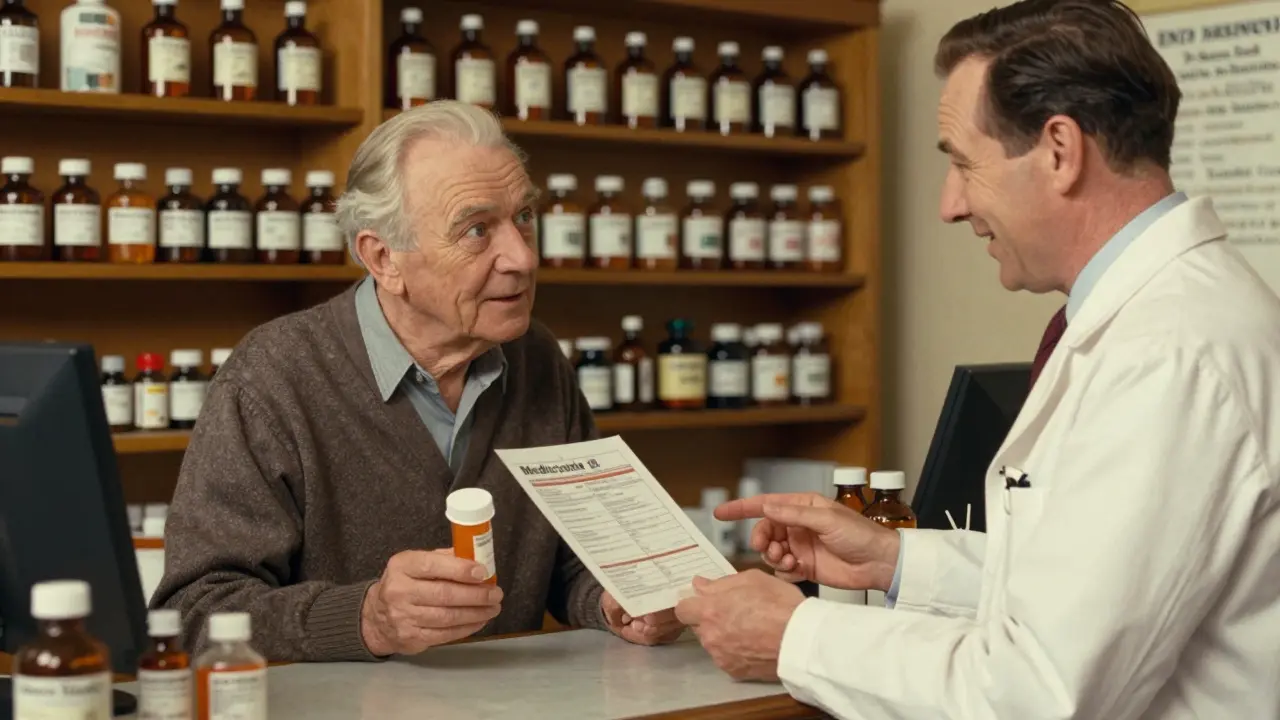
Have you ever left the pharmacy with a prescription but wondered why some drugs come with a detailed pamphlet while others just have a tiny sticker on the bottle? It isn't random. For certain high-risk drugs, the FDA is the U.S. Food and Drug Administration, the federal agency responsible for protecting public health by ensuring the safety and efficacy of drugs, biological products, and medical devices required a specific type of document called a Medication Guide. If you're taking a medication that falls into this category, you have a legal right to receive this information. Not getting one isn't just an oversight-it's a regulatory failure.
Quick Summary of Your Rights
- Mandatory Delivery: If a drug requires a Medication Guide, the pharmacy must give it to you at the time of dispensing.
- Format Choice: You can choose between a printed paper copy or an electronic version.
- Non-Optional: Pharmacists cannot simply tell you that guides are "available if you want them"; they must proactively provide them.
- Standardized Content: These guides are FDA-approved and designed to prevent serious adverse reactions.
What Exactly is a Medication Guide?
A Medication Guide is not your typical pharmacy leaflet. While most pharmacies print their own generic warnings, a Medication Guide is a specific, FDA-approved document created by the drug manufacturer. These are mandated under 21 CFR Part 208, a set of federal regulations established in 1998 to address serious public health concerns.
The FDA doesn't require these for every drug-only for those where the risks are significant enough that a patient needs a clear, written explanation to use the drug safely. As of late 2023, about 150 prescription drugs (roughly 5% of the market) require these guides. They are typically used for drugs where the risk-to-benefit ratio is narrow, or where following the directions exactly is the only way the drug will actually work.
How to Recognize a Real FDA-Approved Guide
Since pharmacies often hand out various pieces of paper, you might wonder if you're looking at the official document. Legally, these guides must follow strict formatting rules to ensure they are readable and honest. If the document you're holding doesn't meet these criteria, it might not be the mandated guide.
| Feature | Legal Requirement |
|---|---|
| Header | Must say "Medication Guide" prominently at the top. |
| Text Size | Minimum 10-point font for the majority of the text. |
| Language | Nontechnical English; no promotional or "salesy" language. |
| Validation | Must state: "This Medication Guide has been approved by the U.S. Food and Drug Administration." |
Your Legal Rights When Requesting Guides
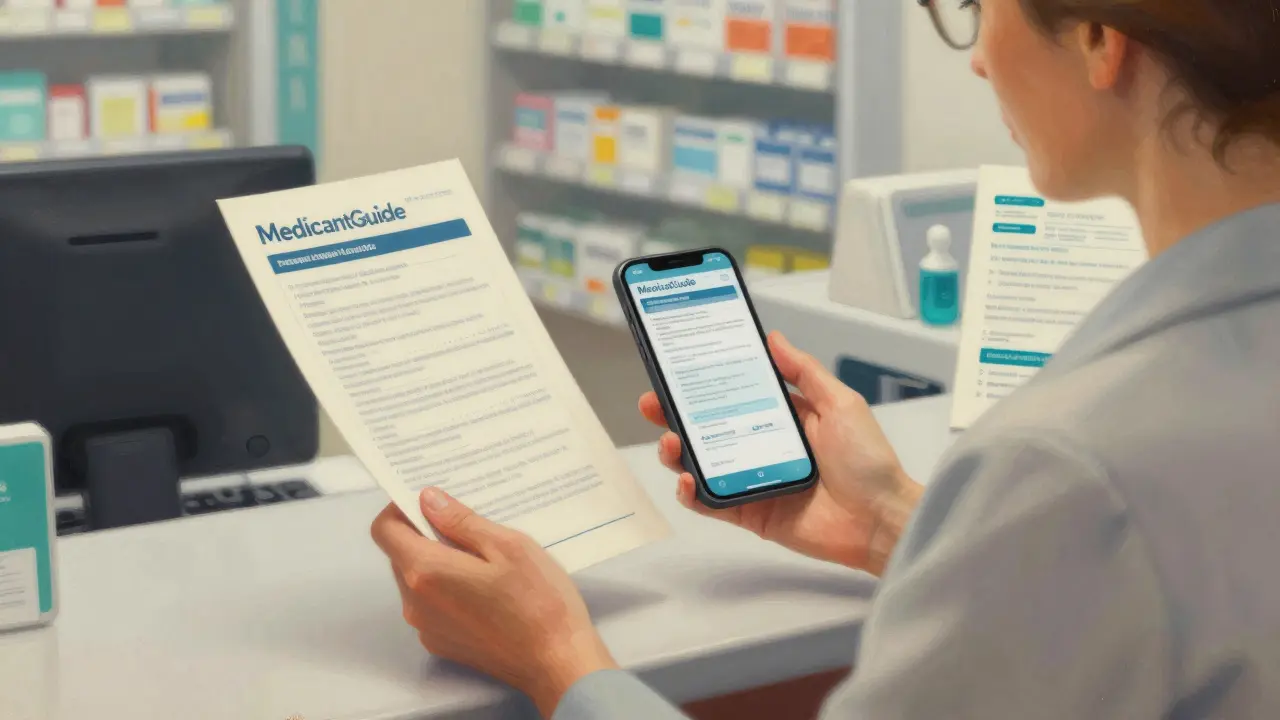
When you stand at the pharmacy counter, the law is on your side. According to 21 CFR §208.24, the pharmacist is required to dispense the guide in paper form unless you specifically ask for something else. You shouldn't have to hunt for the guide or ask the pharmacist to "look for one in the back." It should be handed to you along with your medication.
However, the world is going digital. Thanks to a 2023 update in the Federal Register, you now have the right to request an electronic delivery of the guide. If you prefer a PDF or a digital link over a piece of paper that you'll likely lose in your kitchen drawer, you can legally insist on it. The pharmacist cannot force a paper copy on you if you prefer the digital route.
If a pharmacy tells you they are "out of stock" of guides, they are failing their regulatory duty. Manufacturers are required by law to provide these guides in sufficient numbers, and pharmacies must have the capability to print them on demand. If they can't provide one, you are essentially being given a high-risk medication without the safety instructions required by federal law.
The Gap Between Law and Reality
Despite the strict rules, many patients never actually see these guides. A 2022 survey by the National Consumers League found that 43% of people who were prescribed drugs requiring a guide never received one. Why does this happen? In many cases, it's a resource problem. Pharmacists are often overworked, and a 2021 study in the Journal of the American Pharmacists Association noted that it takes an extra 15-20 seconds per prescription to verify and hand out these guides. During a rush, those seconds add up, and the guide is the first thing to be forgotten.
There's also a problem with how these guides are written. While the FDA mandates "nontechnical" language, the American Society of Health-System Pharmacists (ASHP) found that 68% of these guides are actually written at an 11th-grade reading level or higher. This means that even when you Medication Guides are provided, they can be difficult to understand for the average person.

What to Do if Your Pharmacy Won't Comply
If you suspect your medication requires a guide (especially if it's a new, high-potency, or narrow-therapeutic-index drug) and you didn't get one, don't just ignore it. These documents often contain warnings about dangerous drug interactions that could land you in the emergency room.
- Ask specifically: "Does this medication require an FDA-mandated Medication Guide? If so, I'd like a copy please."
- Request the electronic version: If they claim they don't have a physical copy, ask for the PDF version.
- Check the manufacturer's site: Most drug manufacturers host the approved guide on their professional website.
- Report the issue: If a pharmacy consistently fails to provide these guides, it is a compliance deficiency that can be reported to the FDA or state board of pharmacy.
The Future: Moving Toward Patient Medication Information (PMI)
The FDA knows that the current system is flawed. Between the confusing language and the inconsistent formatting, many people find the guides useless. Because of this, the agency is transitioning to a new system called Patient Medication Information (PMI).
The goal is to replace the varying formats of Medication Guides with a single-page, standardized document. Think of it like a "nutrition label" for your drug-consistent, easy to scan, and designed for the patient rather than the lawyer. FDA usability studies have already shown that this new format can improve patient comprehension by 37%. The transition is expected to be completed by 2027, after which the old 21 CFR Part 208 regulations will be retired.
Are Medication Guides the same as the leaflets that come in the box?
No. Standard pharmacy leaflets are often generic summaries. A Medication Guide is a specific, FDA-approved document mandated for high-risk drugs. It must follow strict layout rules and carry a specific statement of FDA approval at the bottom.
Can I request my Medication Guide in Spanish or another language?
Currently, federal regulations (21 CFR §208.20) require these guides to be written in English. While some manufacturers may provide translations as a courtesy, the legal mandate only covers the English version.
What happens if the pharmacy forgets to give me the guide?
You should contact the pharmacy immediately to request it. Because these guides contain critical safety information to prevent adverse reactions, taking a required drug without the guide increases your health risk. You can also request a digital copy via email.
Is the pharmacy allowed to charge me for printing the guide?
No. The distribution of the Medication Guide is a regulatory requirement for the dispensing of the drug. It is part of the safe delivery of the medication and should not be treated as a paid add-on service.
Why do some drugs have them and others don't?
The FDA only mandates them for drugs that pose a "serious and significant public health concern." This usually means the drug has a high risk of severe side effects if used incorrectly or requires very specific adherence to be effective.
Ms. Sara
April 19, 2026 AT 10:05It is absolutely unacceptable that 43% of patients are being denied this safety information. We need to be more assertive at the pharmacy counter and demand these guides because our health is not a negotiable resource. If the pharmacist says they're too busy, remind them that federal law doesn't have a "rush hour" exception.
Olushola Adedoyin
April 19, 2026 AT 17:51Typical government nonsense! They tell you it's for "safety" but they only give it to you 5% of the time... it's all a giant game to see who survives the experimental batches! The system is rigged to keep us in the dark while the big pharma suits laugh all the way to the bank with their secret formulas!
Tanya Rogers
April 20, 2026 AT 08:06One finds it quite amusing that the author believes a "nutrition label" for pharmaceuticals will magically resolve the cognitive deficit of the general population. The issue is not the format, but rather the inherent inability of the average consumer to synthesize complex biochemical data, regardless of whether it is presented in a standardized grid or a prose leaflet. The pursuit of "simplicity" in medicine is often just a veil for intellectual atrophy.
caesar simpkins
April 22, 2026 AT 05:52Wow, the fact that these things are written at an 11th-grade level when they're supposed to be "nontechnical" is just wild. Like, imagine being in a medical crisis and having to feel like you're taking a high school lit exam just to know if your meds will kill you. That's honestly terrifying.
dallia alaba
April 23, 2026 AT 23:41For anyone struggling to find these, checking the manufacturer's website is a great tip, but also look for the "Professional" section of the site. Often the patient-facing page is just marketing, while the professional section has the actual FDA-approved prescribing information and the mandated guides in PDF format. It is a good way to double-check if your pharmacy is cutting corners.
Valorie Darling
April 24, 2026 AT 08:53lol imagine actually reading these things... i just throw the paper in the trash immediately and google the side effects anyway cuz these pamphlets are boring as hell
Venkatesh Venky
April 25, 2026 AT 13:39Keep the energy high everyone! We can just use the digital links to share the info and help each other out. Even with the jargon-heavy parts, we can find a way to make it simple for everyone. Stay positive!
aman motamedi
April 26, 2026 AT 22:36I believe the emphasis on regulatory compliance is quite necessary for patient safety.
Tokunbo Elegbe
April 27, 2026 AT 19:15This is such an important reminder for all of us... please, please make sure you are advocating for your own health!!! It only takes a moment to ask, but it could save a life!!!
Grace Grace
April 28, 2026 AT 10:23I am utterly devastated to learn that so many patients are being neglected in this manner! It is a travesty of the highest order that a mere twenty seconds of a pharamcist's time is prioritized over human safety!! We must demand bettter standards for our healthcare providers immediately!!
julya tassi
April 30, 2026 AT 09:01I wonder if the electronic versions are easier to search through using Ctrl+F? :) That would be so much better than squinting at those tiny fonts on the paper copies! 🌸
Akshata Kembhavi
May 1, 2026 AT 19:57It's kind of a bummer that they only mandate English. In a lot of places, people really struggle with that, and it makes the whole safety thing feel a bit incomplete. Hope the new PMI system fixes that too!
Arthur Luke
May 2, 2026 AT 10:52The 2027 transition to PMI sounds like a solid step forward. If they can actually hit that 37% comprehension increase, it would solve a lot of the friction we see at the pharmacy counter. I'm curious to see if the electronic delivery will become the default rather than just an option.