
How to Handle Missed Pediatric Medication Doses Safely: A Parent's Guide
 Jun, 5 2026
It’s 8 PM. You’re rushing to get your child ready for bed, and suddenly you realize: you forgot their evening antibiotic. Panic sets in. Do you give it now? Wait until morning? Give a double dose to catch up? This moment of doubt is terrifying for any parent, but the wrong move can be dangerous. Children are not just small adults; their bodies process medicine differently, and their tolerance for error is much lower.
The good news is that there is a clear, science-backed way to handle this. You don’t need to guess. Major health institutions like Children's Wisconsin and the American Academy of Pediatrics (AAP) have established specific time-based rules. The golden rule is simple: never double a dose. But beyond that, knowing exactly when to skip a dose versus when to give it depends on how often the medication is prescribed. Let’s break down the exact steps so you can stay calm and keep your child safe.
The Golden Rule: Never Double Up
Before we look at clocks and schedules, let’s address the biggest mistake parents make. When you miss a dose, your instinct might be to give two pills or twice the liquid volume to "get back on track." Please, resist this urge. Dr. Sarah Verbiest, an expert in family professional partnerships, notes that doubling doses creates a 278% higher risk of severe adverse reactions in children under 12. Why? Because children’s metabolic pathways are still developing. Their livers and kidneys haven’t fully matured, meaning they can’t flush out excess medication as efficiently as adults can.
Doubling up doesn’t just fix the missed hour; it pushes your child’s system into overdose territory. Whether it’s pain relief, antibiotics, or asthma inhalers, taking more than prescribed is always worse than missing one dose. If you’ve already given a double dose by accident, call your pediatrician or Poison Control immediately. Do not wait for symptoms to appear.
Time-Based Rules for Common Schedules
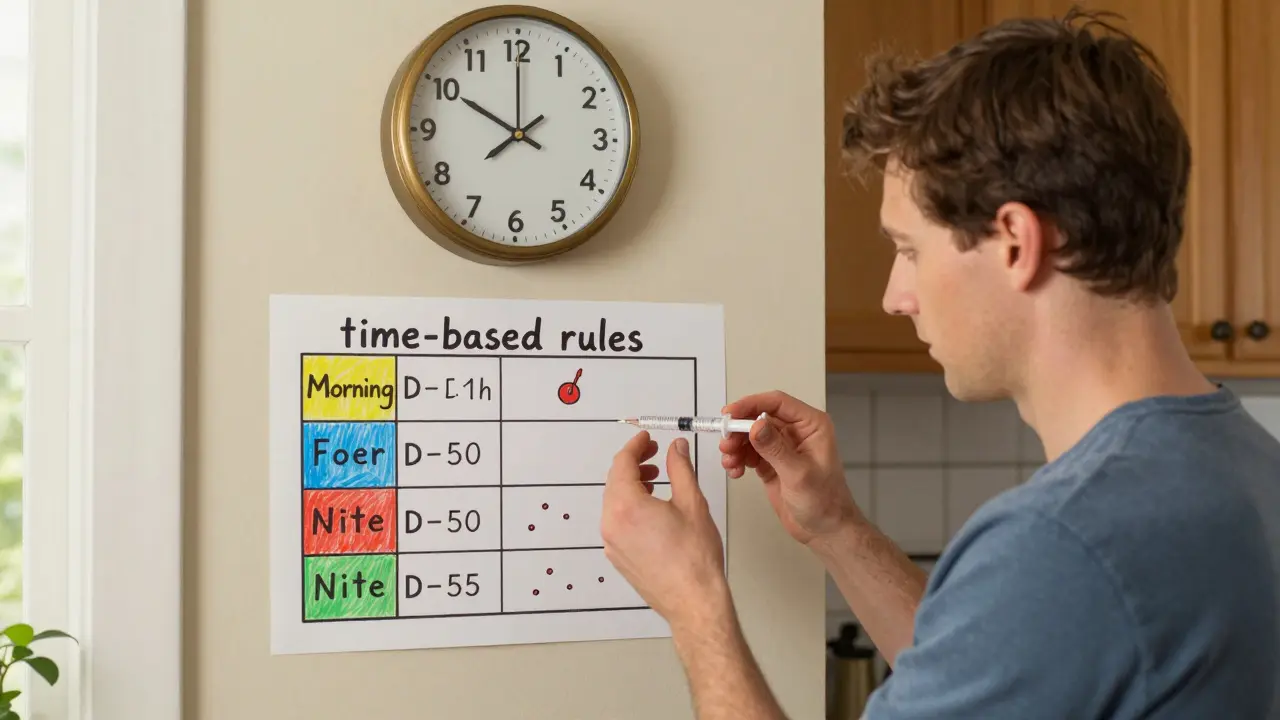
So, if you can’t double up, what do you do? The answer depends on the frequency of the medication. Think of each dose as having a "window of opportunity." If you catch it within that window, give it. If you miss the window, skip it and resume the normal schedule. Here is how those windows work based on guidelines from Children's Wisconsin and Cincinnati Children's Hospital:
- Once-Daily Medications: If you remember within 12 hours of the missed time, give the dose. If it has been more than 12 hours, skip it. For example, if the dose was due at 8 AM and you remember at 6 PM (10 hours later), give it. If you remember at 9 AM the next day, skip it and take the next dose at 8 AM.
- Twice-Daily Medications: The window is tighter here. If you remember within 6 hours, give it. If it’s been longer, skip it. This keeps the drug levels steady without spiking too high.
- Three-Times-Daily Medications: These usually follow an 8-hour cycle. If you remember within 3 hours of the scheduled time, administer the dose. Otherwise, skip it.
- Four-Times-Daily (or Every 4-6 Hours): For these frequent doses, the threshold is just 2 hours. If you’re more than 2 hours late, skip the dose entirely to prevent overlap with the next scheduled dose.
If you find yourself constantly asking, "Is it almost time for the next dose?" use this trick: if giving the missed dose would mean taking the next dose less than half the usual interval apart, skip the missed one. It’s better to be slightly behind than to overload your child’s system.
| Dosing Frequency | Max Time Late to Administer | Action if Later |
|---|---|---|
| Once Daily | 12 Hours | Skip dose; resume normal schedule |
| Twice Daily | 6 Hours | Skip dose; resume normal schedule |
| Three Times Daily | 3 Hours | Skip dose; resume normal schedule |
| Four Times Daily / Q4H | 2 Hours | Skip dose; resume normal schedule |
Critical Exceptions: When to Call the Doctor Immediately
While the time-based rules above cover most common colds, infections, and chronic conditions, some medications are unforgiving. There are specific categories where skipping a dose isn’t an option, and guessing could compromise treatment efficacy.
Oncology Medications: If your child is undergoing chemotherapy or cancer treatment, even a single missed dose can impact the entire treatment plan. In these cases, do not rely on general internet advice. Contact the oncology team immediately. They may have specific protocols that differ from standard guidelines.
Anticonvulsants (Seizure Medication): Drugs used to control seizures require stable blood levels. Missing a dose can lower that level enough to trigger a breakthrough seizure. If you miss a dose of anti-seizure medication, contact your neurologist right away for specific instructions. They may advise giving it as soon as possible regardless of the time gap, or they may have a different rescue plan.
Insulin and Diabetes Management: Blood sugar management is dynamic. Missing a dose of insulin or adjusting it incorrectly can lead to diabetic ketoacidosis (DKA) or severe hypoglycemia. Always follow the specific sick-day rules provided by your endocrinologist.
For all other "red-category" high-risk medications identified by the National Patient Safety Agency, check the patient information leaflet first. Shockingly, 25% of high-risk meds lack clear missed-dose instructions. If yours does too, call the pharmacist. Don’t guess.
Why Errors Happen: The Hidden Risks
You might think, "I’m careful, this won’t happen to me." But data suggests otherwise. According to the American Academy of Pediatrics, medication errors contribute to 11% of all preventable adverse events in pediatric hospitals. Of those, over a third are dosing errors. Why does this happen?
Weight Estimation Mistakes: Many parents estimate their child’s weight rather than weighing them regularly. A study by Dr. Michael R. Anderson found that 73.8% of morphine dosing deviations in emergency settings came from weight estimation errors. As your child grows, their dose needs change. Using outdated weight charts can lead to underdosing or overdosing. Weigh your child every few months and update your dosage calculations with your doctor.
Liquid Measurement Confusion: This is a huge pitfall. Household teaspoons and tablespoons are not accurate measuring tools. The FDA warned about this confusion in 2021, noting it contributed to significant errors. Always use the oral syringe or dosing cup that comes with the medication. Using a kitchen spoon can result in a dose that is 20-50% off from what was prescribed.
Complexity Overload: If your child has medical complexity and takes four or more medications, the risk of error jumps by 300%. The sheer number of pills and liquids makes tracking difficult. This is where systems fail, not necessarily the parent’s intent.

Practical Tools to Prevent Future Misses
Knowing what to do after a miss is important, but preventing the miss is better. Here are practical strategies that have proven effective in reducing errors:
- Use the "Teach-Back" Method: When the doctor prescribes a new med, repeat the instructions back to them. Say, "So I give 5ml every 8 hours, and if I miss it by more than 3 hours, I skip it, correct?" This confirms understanding and catches miscommunications early.
- Color-Coded Charts: For kids on multiple meds, create a visual chart. Use different colors for morning, afternoon, and night doses. Boston Children’s Hospital found that color-coded charts reduced missed dose incidents by 44% compared to standard text schedules.
- Smart Technology: Consider using apps like the AAP’s Pediatric Medication Safety Calculator. It provides real-time guidance based on the specific drug and time missed. Beta testing showed an 83% improvement in caregiver decision accuracy. Smart dispensers are also emerging, reducing misses by 68% in trials.
- Set Alarms: Simple phone alarms set for the exact dosing times can serve as a backup memory aid. Set them for 15 minutes before the actual dose to allow time to prepare the medicine.
- Keep a Log: Mark off doses on a calendar or app as soon as they are given. This prevents accidental double-dosing if someone else in the household administers the next dose.
What to Do If You’re Unsure
If you find yourself staring at the clock, confused about whether 4 hours is "too late" for a twice-daily med, stop. Don’t panic. Take a breath. Then, pick up the phone. Your pharmacist is an excellent resource for non-emergency dosing questions. They know the pharmacokinetics of the drugs better than anyone. If it’s after hours and you’re worried about a critical medication like seizure or heart medication, call your doctor’s on-line service or go to urgent care. It is always better to ask and be told "it’s fine" than to assume and cause harm.
Remember, perfection isn’t the goal. Consistency and safety are. One missed dose rarely ruins a treatment course, but one doubled dose can send you to the ER. Stick to the time thresholds, never double up, and use tools to help you stay on track. You’ve got this.
What should I do if I missed my child's antibiotic dose?
Follow the time-based rules for the frequency of the antibiotic. If it’s once daily and you’re within 12 hours, give it. If it’s twice daily and within 6 hours, give it. If you’re outside that window, skip the dose and resume the normal schedule. Never double the dose. Antibiotics need consistent levels to work, but overdosing can cause side effects like stomach upset or diarrhea.
Can I give a missed dose of ibuprofen or acetaminophen?
Yes, but only if it hasn't been too long since the last scheduled dose. For every 4-6 hour dosing, if you're less than 2 hours late, you can give it. If it's close to the next dose time, skip it. Be very careful not to exceed the maximum daily limit for your child's weight, as liver damage (from acetaminophen) or kidney issues (from ibuprofen) can occur with overdose.
Why shouldn't I use a kitchen spoon for liquid medicine?
Kitchen spoons vary wildly in size. A "teaspoon" in a recipe book might hold 5ml, but a random spoon from your drawer could hold 3ml or 7ml. This inconsistency leads to underdosing or overdosing. Always use the oral syringe or dosing cup provided by the pharmacy, which is calibrated for accuracy.
What if my child vomits after taking a dose?
If vomiting occurs within 15-30 minutes of taking the dose, the medication likely wasn't absorbed. You may need to repeat the dose. However, if it’s been longer than 30 minutes, assume it was absorbed and do not re-dose. Check with your pharmacist for specific advice on the medication type, as some extended-release formulas have different rules.
Are there apps that help manage pediatric medication schedules?
Yes. The American Academy of Pediatrics launched the Pediatric Medication Safety Calculator app, which offers real-time guidance on missed doses. Other generic medication reminder apps can also help by sending alerts and allowing you to log doses, ensuring no one in the household accidentally double-administers a drug.