
Managing Hypoglycemia from Diabetes Medications: A Practical Step-by-Step Plan
 Dec, 19 2025
Hypoglycemia Risk Assessment Tool
This tool helps you assess your hypoglycemia risk based on your medications and lifestyle factors. Enter your information below to get personalized recommendations.
Low blood sugar isn’t just a nuisance-it can be dangerous. If you’re taking insulin, sulfonylureas, or meglitinides for diabetes, you’re at real risk for hypoglycemia. Blood glucose below 70 mg/dL triggers symptoms like sweating, shaking, and confusion. Below 54 mg/dL, you’re at risk for seizures or unconsciousness. The good news? You can manage it. Not with guesswork, but with a clear, practical plan built on evidence, not myths.
Know Which Medications Put You at Risk
Not all diabetes drugs cause low blood sugar. Metformin? Almost zero risk. GLP-1 agonists like semaglutide? Less than 2%. SGLT2 inhibitors like empagliflozin? Around 3%. But insulin and sulfonylureas? That’s where the danger lives.Sulfonylureas-like glimepiride, glipizide, and glyburide-are old-school pills that force your pancreas to pump out insulin, no matter if you’ve eaten. About 15-30% of people on these meds have at least one hypoglycemic episode a year. Meglitinides-nateglinide and repaglinide-work fast but fade fast. Miss a meal? You’re setting yourself up for a crash. Insulin? Even the newest analogs like lispro or aspart can drop your sugar too low, especially if you’re active, skip meals, or drink alcohol.
Here’s the reality: if you’re on insulin or a sulfonylurea, you need to treat hypoglycemia like a daily safety protocol-not an emergency you hope to avoid.
Recognize the Signs Before It’s Too Late
Hypoglycemia doesn’t always hit with a siren. Some people feel it early. Others? They don’t feel anything until it’s severe. That’s called hypoglycemia unawareness. It affects 25% of type 1 patients after 20 years and 10% of type 2 patients after 15 years.Start by learning your body’s warning signs:
- Autonomic symptoms (below 70 mg/dL): Sweating, trembling, heart racing, hunger, dizziness.
- Neuroglycopenic symptoms (below 55 mg/dL): Confusion, slurred speech, weakness, blurred vision, seizures, loss of consciousness.
Don’t wait for dizziness to turn into collapse. If you feel shaky or sweaty after taking your pill or injecting insulin, check your blood sugar-even if you think you ate. That’s not paranoia. That’s prevention.
The 15-15 Rule: Do It Right
When your blood sugar drops below 70 mg/dL, you need fast-acting sugar. Not candy bars. Not juice boxes. Not honey straight from the jar.Use the 15-15 rule:
- Take 15 grams of fast-acting carbohydrate.
- Wait 15 minutes.
- Check your blood sugar again.
- If it’s still below 70, repeat.
What counts as 15 grams?
- 4 glucose tablets (each is about 4g)
- 1/2 cup (4 oz) of regular soda (not diet)
- 1 tablespoon of honey or sugar
- 1 tube of glucose gel
Why not fruit or bread? Because they’re slow. Fiber and fat delay absorption. You need sugar that hits your bloodstream in under 10 minutes. Glucose tablets are the gold standard-they’re precise, portable, and don’t come with extra calories or fat.
And here’s the big mistake most people make: they use artificial sweeteners. Diet soda, sugar-free gum, stevia-they don’t raise blood sugar. They’re useless in a hypoglycemic episode. Don’t waste time.
Carry Your Rescue Kit-Everywhere
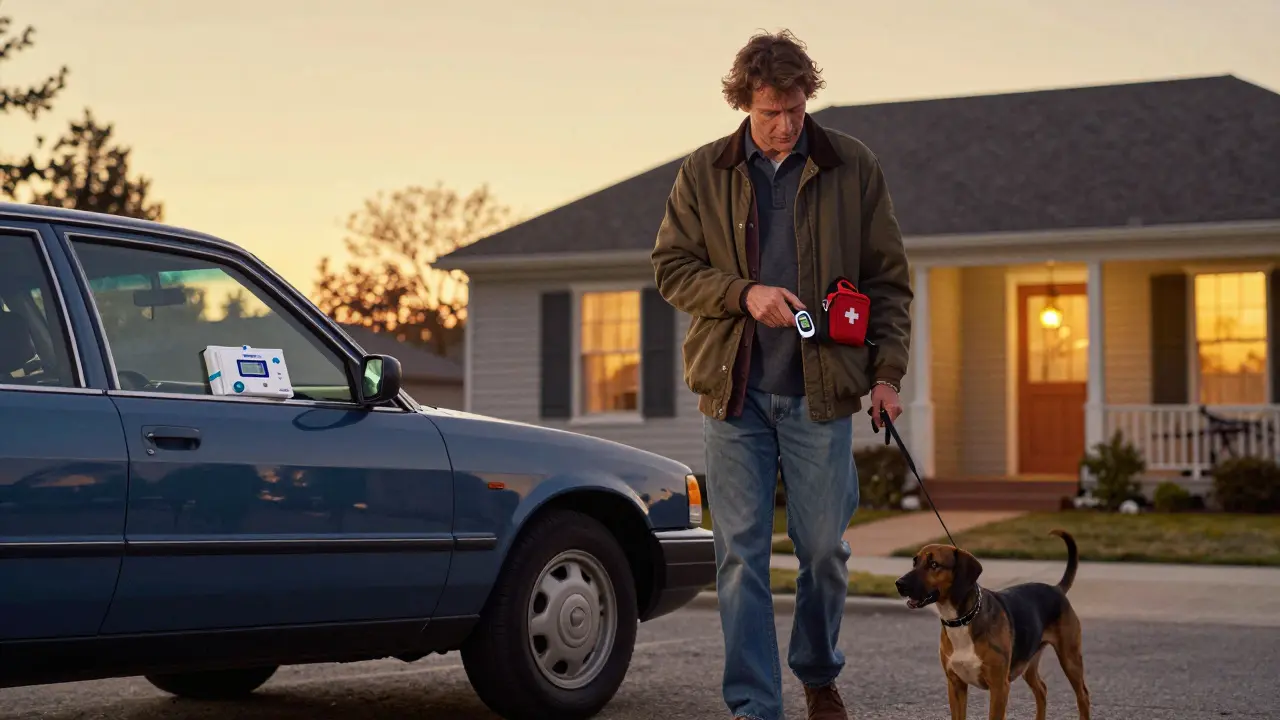
If you’re at risk, you need a hypoglycemia kit. Not just one. At least three: your purse, your car, your work desk.Essential items:
- Glucose tablets: 20-count pack ($8-$12). Keep one in your wallet, one in your coat pocket, one by your bed.
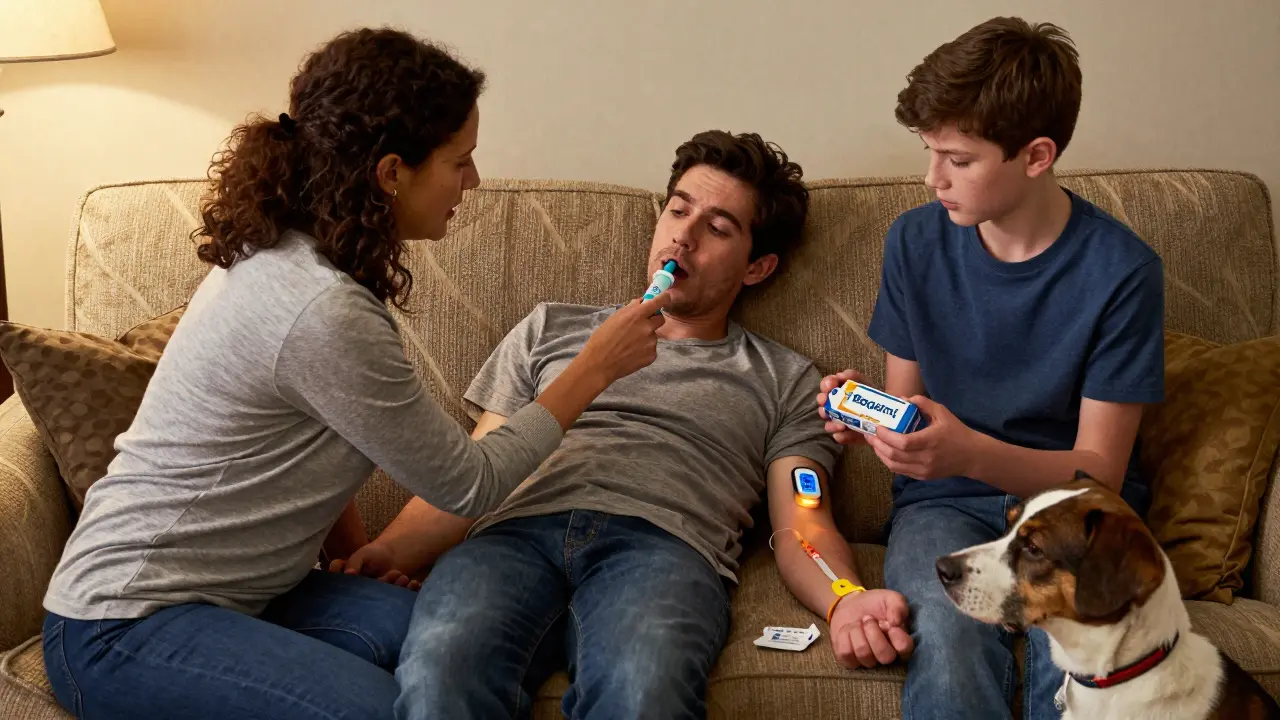
- Glucagon emergency kit: If you pass out or can’t swallow, someone else must act. Baqsimi nasal spray (new, easy to use) costs about $250. Gvoke auto-injector is $350. These aren’t optional-they’re life-saving.
- Medical ID bracelet: It tells paramedics you have diabetes. No time to explain when you’re unconscious.
And yes, your family, coworkers, or roommates need to know where your kit is and how to use glucagon. Practice with a trainer kit (non-active) so no one panics when it’s real.
Use Technology-If You Can
Continuous glucose monitors (CGMs) like Dexcom G7 or Freestyle Libre 3 don’t just track your sugar-they predict drops. They beep before you feel anything. In trials, CGMs reduce severe hypoglycemia by 48% and cut time spent low by 35%.But cost is a barrier. Medicare now covers CGMs for insulin users, but out-of-pocket costs still run $89-$399 per month. If you can’t afford one, ask your doctor about sample programs or manufacturer discounts. Some brands offer free trials.
Smart insulin pens-like InPen or NovoPen 6-are another tool. They track your doses and remind you when to eat. If you’re on multiple daily injections, this cuts guesswork.
Adjust for Lifestyle Triggers
Hypoglycemia doesn’t happen in a vacuum. It’s tied to your habits.- Alcohol: It blocks your liver from releasing glucose. One drink can cause a drop 6-12 hours later. Never drink on an empty stomach.
- Exercise: You burn glucose. If you take insulin or sulfonylureas, eat 15-30g of carbs before or during activity. Check your sugar before, during (if long workout), and after.
- Sleep: Nocturnal hypoglycemia is common. Set an alarm to check your sugar at 2-3 a.m. if you’ve had a heavy workout or skipped dinner. CGMs can do this for you.
- Beta-blockers: If you take these for high blood pressure or heart issues, they hide the shaking and racing heart-your body’s early warning. You might not feel it until you’re confused or dizzy. Your doctor should know this.
Track Patterns, Not Just Numbers
Logging your blood sugar isn’t about perfection. It’s about spotting trends.Use a simple log: medication, time, food, activity, glucose reading. You don’t need an app-paper works. But do it daily for at least two weeks.
Look for patterns:
- Do you crash every time you take glipizide before lunch?
- Does your sugar drop after walking the dog?
- Do you have lows after drinking wine on weekends?
Patients who track consistently reduce hypoglycemia by 37% in three months. But only 28% keep it up past six weeks. Make it a habit. Link it to brushing your teeth. Or your morning coffee.
Ask Your Doctor: Is Your Meds Regimen Safe?
Your HbA1c isn’t the whole story. You can have a “good” HbA1c of 7% and still be crashing 3 times a week. That’s dangerous.Ask your doctor:
- “Am I on the lowest effective dose of this medication?”
- “Could I switch to a drug with lower hypoglycemia risk-like a GLP-1 agonist or SGLT2 inhibitor?”
- “Do I need a CGM?”
- “Should I get trained in the 15-15 rule and glucagon use?”
There’s no shame in asking for a safer regimen. In fact, the American Diabetes Association now recommends individualized targets-especially for older adults or those with other health problems. For someone over 65 with heart disease, a target of 80-130 mg/dL is safer than chasing 7%.
What to Do If You or Someone Else Passes Out
If you’re unconscious or having a seizure:- Do NOT put food or drink in their mouth. You could choke them.
- Give glucagon if you have it. Baqsimi nasal spray? Just spray one dose into one nostril. No mixing. No needles.
- Call 911 immediately-even if they wake up.
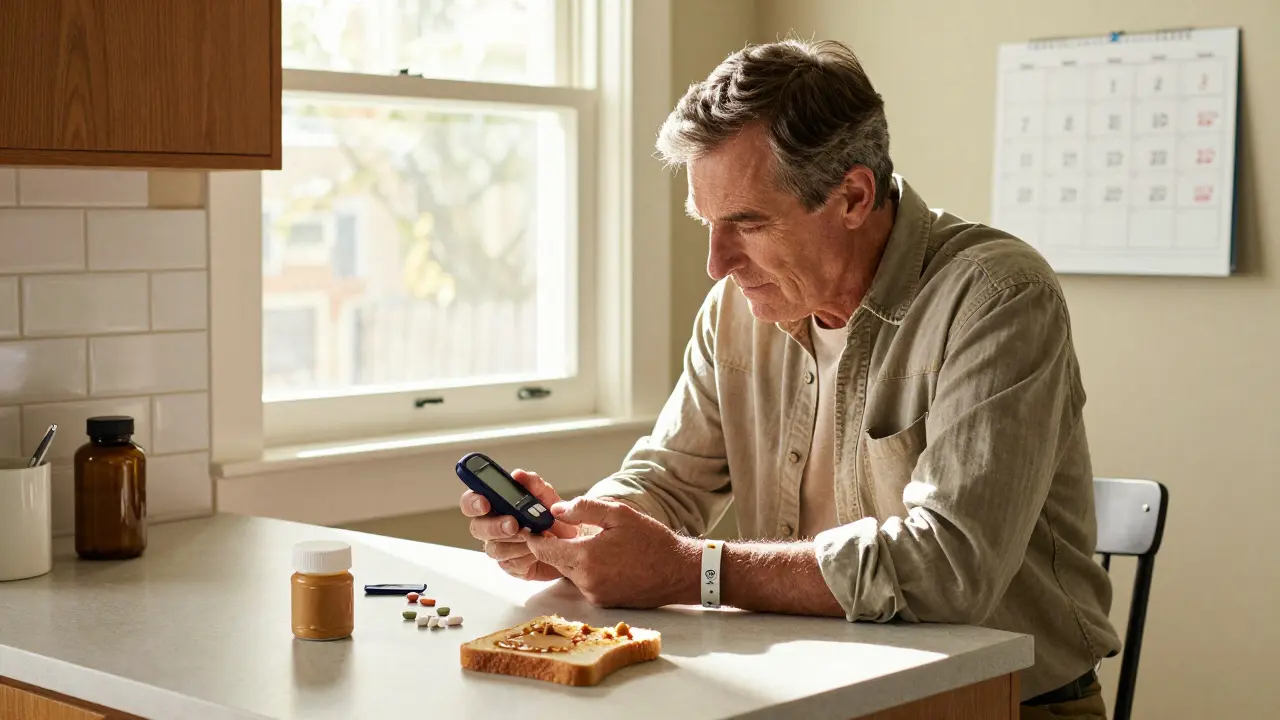
- After recovery, they need to eat a snack with protein and carbs (like peanut butter on toast) to prevent another drop.
Glucagon isn’t scary. It’s simple. Practice with a trainer kit. Know where yours is. Tell someone.
Final Thought: Safety Over Perfection
Managing hypoglycemia isn’t about hitting a perfect blood sugar number every day. It’s about staying alive. It’s about knowing your meds, recognizing your body’s signals, carrying your rescue kit, and talking to your doctor about safety-not just control.You’re not failing if you have a low. You’re human. But you can stop it from becoming a crisis. With the right plan, you don’t just survive-you live well.
Nancy Kou
December 20, 2025 AT 05:34This is the most practical guide I've ever read on hypoglycemia. No fluff, just actionable steps. I've been on glimepiride for 8 years and never realized how dangerous skipping meals could be until I read this. I keep glucose tabs in my purse, car, and bedside now. Game changer.
Aboobakar Muhammedali
December 20, 2025 AT 19:24i read this and cried a little. my dad had a seizure last year because no one knew how to use glucagon. i wish someone had shared this with us before. i just ordered a baqsimi kit and am teaching my whole family how to use it. thank you for writing this like you actually care.
Chris Clark
December 21, 2025 AT 21:19you know what’s wild? in india we call this ‘jhatka’ - sudden sugar crash. elders say eat jaggery or date syrup but that’s slow as hell. glucose tabs? they’re called ‘sugar pills’ in rural clinics and everyone knows them. this 15-15 rule? universal. just needs better translation and street-level awareness.
Hussien SLeiman
December 23, 2025 AT 20:06Let me just say this: the entire premise of this post is dangerously oversimplified. You treat hypoglycemia like a checklist? That’s not management, that’s automation. You’re reducing a complex metabolic disorder to a series of snack-based responses. The real issue is insulin resistance, not ‘medication risk.’ And let’s not pretend CGMs are accessible to everyone - most people in this country can’t afford a single month of Dexcom, let alone a year. You’re preaching to the privileged while ignoring systemic healthcare failure. Also, why are you still using ‘sulfonylureas’ as if they’re the villain? They’re cheap, effective, and have saved lives for 60 years. Maybe the problem isn’t the drug - it’s the lack of proper monitoring and education. And don’t get me started on the ‘15-15 rule’ - it’s a band-aid for a broken system.
Nicole Rutherford
December 24, 2025 AT 07:39Wait - so you’re telling me the government is hiding the truth about insulin? Why are they pushing these expensive CGMs? Who profits? Big Pharma? The ADA? I’ve seen videos of people getting ‘free’ glucose tabs from pharmacies… then their insurance drops them next month. This isn’t health advice - it’s a sales funnel. And why do all the ‘experts’ sound like they’re reading from a pharma brochure? I’m not buying it.
Gloria Parraz
December 24, 2025 AT 12:02I’m a nurse and I’ve seen too many patients panic during lows because they didn’t know what to do. This guide is exactly what we need in clinics. I printed it out and gave copies to every new diabetic patient. Glucagon training should be mandatory. No one should die because no one knew how to spray a nose.
Sahil jassy
December 25, 2025 AT 05:52bro this is gold. i use glucose gels now after my evening walk. used to just eat a banana and wonder why i still felt weak. also - tell your doctor about beta blockers. mine didn’t know they mask symptoms until i brought it up. now he switched me to amlodipine. life changed.
Kathryn Featherstone
December 27, 2025 AT 01:34I used to think hypoglycemia was just ‘being hangry.’ I didn’t realize how close I was to passing out until I got my CGM. The alarms saved me twice. I still don’t love wearing it, but I’d rather be annoyed than unconscious. If you’re on insulin, get one. Even if you have to save up.
anthony funes gomez
December 28, 2025 AT 12:53While the 15-15 protocol is empirically sound, it fails to account for the heterogeneity of glycemic kinetics across individuals - particularly those with delayed gastric emptying, autonomic neuropathy, or concurrent hepatic dysfunction. The assumption that 15g of pure glucose uniformly elevates serum glucose to >70mg/dL within 15 minutes is a reductionist heuristic that neglects pharmacokinetic variability. Furthermore, the conflation of ‘fast-acting’ carbohydrates with ‘high-glycemic’ substances ignores the role of insulin sensitivity dynamics. A more nuanced approach would incorporate continuous glucose variability indices, such as MAGE or LAGE, to personalize intervention thresholds - not just fixed numerical cutoffs. Glucose tablets are convenient, yes - but they are not physiological. The liver’s endogenous glucose production is the true homeostatic mechanism - and we are treating symptoms, not restoring regulatory integrity.
Dorine Anthony
December 28, 2025 AT 19:30Just wanted to say I saved this. My mom has type 2 and takes glipizide. She refuses to check her sugar. I’m printing this out and leaving it on her fridge. No drama. Just facts. She’ll read it eventually.
James Stearns
December 28, 2025 AT 22:01It is with the utmost solemnity and adherence to established clinical protocols that I must express my profound concern regarding the casual tone and non-regulatory language employed in this document. The casual reference to ‘glucose tabs’ as opposed to ‘pharmaceutically standardized dextrose monohydrate tablets’ is not only scientifically imprecise but potentially misleading to the lay public. Furthermore, the use of emotive phrasing such as ‘you’re human’ undermines the rigorous discipline required for metabolic management. I implore the author to revise this content in accordance with the American Medical Association’s Guidelines for Patient Education Materials, which stipulate formal diction, third-person voice, and avoidance of colloquialisms. This is not a blog post. It is a clinical intervention.
Laura Hamill
December 30, 2025 AT 00:05They don’t want you to know this - but the REAL reason they push insulin and sulfonylureas is because they’re paid by Big Pharma to keep you dependent. CGMs? Too expensive for them to control. Glucagon? Too easy to use. This is all a scam. The ‘15-15 rule’? That’s just to keep you buying their sugar packets. They want you scared. They want you hooked. I stopped all meds and went keto. My sugar’s perfect now. And no one told me this. 😈