
Understanding the Hatch-Waxman Act: How US Generic Drug Policy Works
 Apr, 20 2026
Imagine a world where a life-saving drug exists, but because of a legal technicality, no one is allowed to even test a cheaper version until the original patent expires. This was the reality for pharmaceutical companies until 1984. A Supreme Court ruling in the case of Roche Products, Inc. v. Bolar Pharmaceutical Co. essentially told generic makers that preparing for the market during a patent term was illegal. This created a massive gap where drugs remained expensive long after their patents should have lapsed. To fix this, the U.S. government created the Hatch-Waxman Act is a landmark 1984 law that balances the need for pharmaceutical innovation with the need for affordable generic medicines. Also known as the Drug Price Competition and Patent Term Restoration Act, it fundamentally changed how the FDA handles drug approvals.
The Great Compromise: Innovation vs. Affordability
The law wasn't a simple decision; it was a hard-fought truce between two warring factions: brand-name drug companies and generic manufacturers. Innovators wanted more time to recoup their massive R&D investments, while generic companies wanted a faster, cheaper way to bring equivalent drugs to the public. The result was a two-way street of incentives.
On one side, the law gave innovator companies a way to get some of their time back. When a company spends years in clinical trials, those years eat into the 20-year patent life. The Act allows for patent term restoration, giving companies back some of that lost time-averaging about 2.6 years per drug. On the other side, it created a "safe harbor" (35 U.S.C. §271(e)(1)). This is a legal shield that lets generic companies use and test patented drugs to get the necessary data for approval before the patent actually expires. This means the moment a patent ends, the generic can hit the market immediately, rather than waiting years to start the process.
The ANDA: A Shortcut to the Market
Before this Act, generic companies had to prove safety and efficacy from scratch, which is incredibly expensive. Now, they use a process called the Abbreviated New Drug Application (or ANDA), which is a streamlined regulatory pathway that allows generic drugs to be approved by proving bioequivalence to a brand-name drug rather than repeating full clinical trials.
Basically, the generic company only has to prove that their version of the drug works the same way in the human body as the original "Reference Listed Drug." This shift is a game-changer. According to FDA estimates, this reduces development costs by roughly 75%. Instead of spending hundreds of millions on new trials, a company can focus on chemistry and manufacturing. This efficiency is why generics now make up about 90% of all prescriptions filled in the U.S., even though they only account for a small fraction of total drug spending.
The Orange Book and the Paragraph IV Battle
To make this system work, the FDA maintains the Orange Book, which is the official FDA publication listing all approved drug products and their associated patents. When a generic company wants to enter the market, they look at the Orange Book and make a certification. The most controversial and strategic of these is the Paragraph IV certification.
In a Paragraph IV filing, a generic company claims that the brand-name patent is either invalid or that the generic drug doesn't actually infringe on it. This is essentially a legal challenge. If they win, they can enter the market early. To reward the risk of fighting a giant pharmaceutical company in court, the first generic applicant to successfully file a Paragraph IV certification gets 180 days of marketing exclusivity. For a blockbuster drug, those six months of being the only generic on the shelf can be worth millions. In the early days, this was so intense that generic reps literally camped outside FDA offices to be first in line.
| Metric | Pre-1984 Framework | Modern Era (Post-Act) |
|---|---|---|
| Annual Generic Approvals | Less than 10 per year | Up to 771 per year (peak) |
| % of US Prescriptions | Low/Minimal | ~90% |
| Generic Entry Speed | Delayed by testing laws | Faster than EU (approx. 1.8 yrs) |
| Patent Strategy | Single primary patent | "Patent Thickets" (avg. 14 per drug) |
The Dark Side: Gaming the System
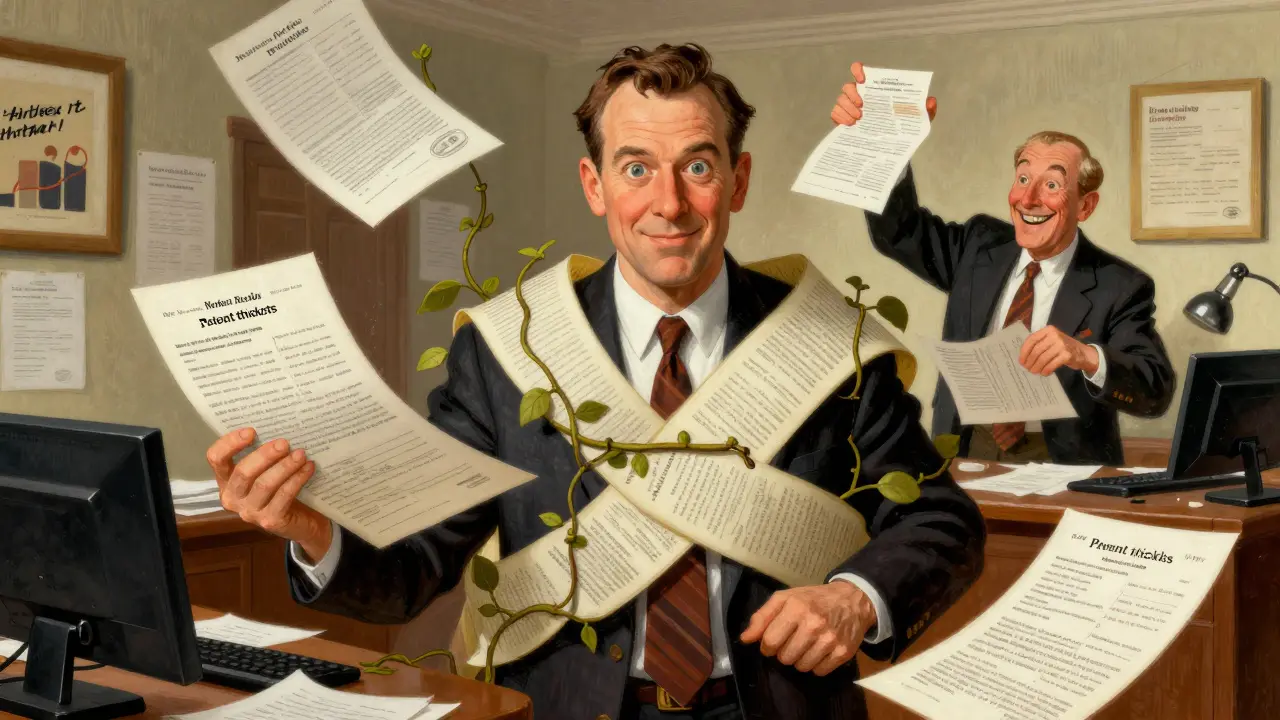
While the law was designed to be a balance, humans are great at finding loopholes. Over the last few decades, brand-name companies have developed a playbook to extend their monopolies, often referred to as "gaming" the Act. One common tactic is the creation of patent thickets. Instead of one main patent, companies now file dozens of secondary patents on minor things-like a slightly different pill coating or a different dosage timing. This forces generic companies into "litigation marathons" that can last a decade.
Then there is "product hopping." This happens when a brand company slightly modifies a drug (like changing it from a tablet to a capsule) and pushes patients to the new version just before the old patent expires. Since the new version has its own patent, the generic version of the old drug becomes irrelevant. Perhaps the most criticized practice is the "pay-for-delay" settlement. This is when a brand-name company simply pays the generic company a huge sum of money to stay out of the market for a few more years. It's a win-win for the companies, but a lose-lose for the patients paying high prices.
Practical Reality for Today's Pharma Companies
If you're running a generic drug company today, the FDA requirements are more daunting than ever. A modern ANDA submission can be between 30,000 and 50,000 pages of documentation. The legal side is even heavier; challenging a patent can cost between $15 million and $30 million per case. This high barrier to entry has led to a concentration of power, where a handful of giant generic firms control the majority of the market.
To fight back, the government has introduced tools like the CREATES Act, which stops brand companies from refusing to sell samples to generic makers for testing. There are also ongoing efforts to ban "reverse payment" settlements. While some argue that too much reform will kill innovation-pointing to a drop in new drug approvals in Japan after similar reforms-most agree that the current "patent thickets" have gone too far. The goal now is to return to the original spirit of the 1984 law: a fair trade where innovators get their reward, and the public gets their affordable medicine.
What is the primary goal of the Hatch-Waxman Act?
The primary goal is to balance two competing interests: encouraging the development of new, innovative drugs by protecting patents, and ensuring the public has access to cheaper generic versions once those patents expire.
How does an ANDA differ from a standard drug application?
A standard application (NDA) requires full clinical trials to prove safety and efficacy. An Abbreviated New Drug Application (ANDA) only requires the generic maker to prove that their version is bioequivalent to the original brand-name drug, drastically reducing time and cost.
What is Paragraph IV certification?
It is a statement by a generic drug applicant claiming that the patents listed in the Orange Book for a brand-name drug are either invalid or will not be infringed by the generic version. This often triggers a legal battle but can lead to early market entry.
What are "patent thickets"?
Patent thickets occur when a brand-name company files numerous secondary patents on minor variations of a drug to make it legally difficult and expensive for generic competitors to enter the market, even after the main patent expires.
Who manages the Orange Book?
The FDA manages the Orange Book, which serves as the official directory of approved drug products and the patents that protect them, providing a roadmap for generic manufacturers.
Next Steps and Troubleshooting
For those navigating this landscape, the path depends on your role. If you are a regulatory professional, your priority should be the FDA's Generic Drug Development QbR Pilot Program, which has been shown to cut approval times by 35%. Focus on the quality of the bioequivalence data to avoid the 43% deficiency rate seen in initial ANDA reviews.
For legal teams, the focus is now shifting toward the "improper listing" of patents. Keep a close eye on the FDA's latest draft guidance on the Orange Book, as the government is actively trying to prune patent thickets. If you're dealing with a brand-name company that refuses to provide samples, the CREATES Act is your strongest tool for legal recourse.
Anastasios Kyriacou
April 20, 2026 AT 19:33absolute joke of a system tbh... just lets big pharma keep the cash flow goin while people suffer
Sue Stoller
April 21, 2026 AT 03:00It's so great to see the breakdown of how these things actually work!! 🌟 Even with the loopholes, it's a step in the right direction for accessibility! Keep sharing this knowledge! ✨💖
RAJESH MARAVI
April 22, 2026 AT 10:59lol imagine beliving the fda actually cares about the peple... its all just a big scam to keep the stock prices up for the big guys!! totaly fake balance
Mayur Pankhi Saikia
April 23, 2026 AT 13:39The sheer banalitiy of these observations is staggering...!!! Anyone with a modicum of legal training knows that "patent thickets" are merely a byproduct of insufficient regulatory rigor...!!! Truly amateurish analysis...!!!
Saptatshi Biswas
April 24, 2026 AT 21:05The United States is utterly pathetic for allowing these "pay-for-delay" schemes to persist while India leads the way in truly affordable generic manufacturing for the global south! Your legal framework is a playground for corporate greed and a disgrace to the concept of public health!
Dave Edwards
April 25, 2026 AT 17:27Oh please, the "safe harbor" is just a gift to the generic companies to allow them to steal R&D secrets under the guise of testing. It's an absolute travesty of justice! :-( This whole act is a moral failure from start to finish!
Dan Wizard
April 27, 2026 AT 13:29I find it quite fascinating how the intersection of law and medicine creates these complex incentives, especially when you consider the long-term impact of the ANDA process on global health equity and whether the 180-day exclusivity actually serves the public or just creates a different kind of corporate monopoly in the generic sector.
Amy Fredericks
April 28, 2026 AT 04:11I really appreciate how this explains the balance between innovation and cost. It's a tough spot for the government to be in, but it's nice to know there are tools like the CREATES Act to keep things fair for everyone.
Mel Glick
April 28, 2026 AT 05:22Cut the crap about "balance." It's a corporate racket! The product hopping is a disgusting way to manipulate patients and it needs to be illegal across the board, not just "criticized." Get rid of the thickets and let the generics in!
Olayinka Ibukunoluwa Mercy
April 29, 2026 AT 05:53This is such a helpful overview!!! 📚 It really helps us understand the struggle for affordable medicine...!!! We must always support those trying to lower the barriers for everyone...!!! Keep fighting the good fight for accessibility!!! 🌈🙏✨🌟💖